What an exponent means
An exponent is a small raised number that tells you how many times to multiply a number, the base, by itself. In 10⁴, the base is 10 and the exponent is 4:
10⁴ = 10 × 10 × 10 × 10 = 10,000
In chemistry the base is almost always 10, because the metric system and our number system both count in tens. A power of ten with a positive exponent is a 1 followed by that many zeros: 10² = 100, 10⁶ = 1,000,000.
Chemistry needs these because its numbers span an enormous range. A spoonful of water holds about 10²³ molecules; a molecule is about 10⁻¹⁰ m wide. You will work with both kinds of number on every page of this course.
The four rules
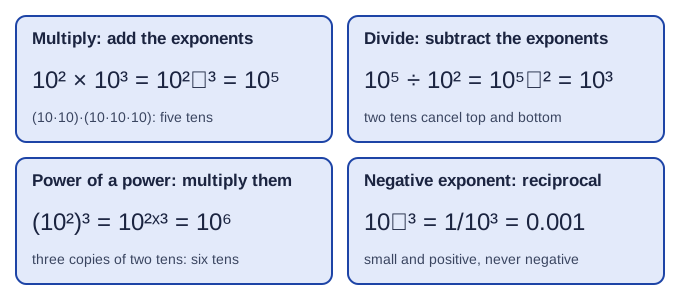
Every exponent rule comes from writing out the multiplication (Figure 1).
| Operation | Rule | Example | Why |
|---|---|---|---|
| Multiply | add the exponents | 10² × 10³ = 10⁵ | (10 × 10) × (10 × 10 × 10) is five tens |
| Divide | subtract the exponents | 10⁵ ÷ 10² = 10³ | two tens on the bottom cancel two on the top |
| Power of a power | multiply the exponents | (10²)³ = 10⁶ | 10² × 10² × 10² is six tens |
| Root | divide the exponent | √(10⁶) = 10³ | 10³ × 10³ = 10⁶; a square root is the power ½ |
These rules work for any base, not just 10: 2³ × 2² = 2⁵ = 32. They need the same base: 10² × 2³ cannot be combined into one power.
Zero and negative exponents
Follow the division rule into smaller results. 10³ ÷ 10³ = 10⁰, and any number divided by itself is 1, so 10⁰ = 1. Keep going: 10² ÷ 10⁵ = 10⁻³, and writing it out shows three tens left on the bottom: 1/(10 × 10 × 10) = 1/1000.
So a negative exponent means "one divided by": 10⁻ⁿ = 1/10ⁿ. It makes a number small, not negative. 10⁻¹ = 0.1, 10⁻² = 0.01, 10⁻³ = 0.001. The exponent tells you which place after the decimal point the 1 sits in.
Worked example. Evaluate (10⁻⁴ × 10⁷) ÷ 10².
Top first, multiplying adds the exponents: −4 + 7 = 3, so the top is 10³.
Then divide, subtracting: 10³ ÷ 10² = 10³⁻² = 10¹ = 10.
Check by writing it out: 0.0001 × 10,000,000 = 1000, and 1000 ÷ 100 = 10.
Adding is different
The rules above are for multiplying and dividing. Adding and subtracting do not combine exponents. 10⁴ + 10⁴ is 10,000 + 10,000 = 20,000, which is 2 × 10⁴, not 10⁸. To add two powers of ten, write them as ordinary numbers (or with the same exponent) first, then add.
Exponents on units
Units follow the same rules. A cube 10⁻² m on a side has a volume of (10⁻² m)³ = 10⁻⁶ m³: the number is cubed and so is the unit. A unit in the denominator can be written with a negative exponent: g/mL is the same as g·mL⁻¹. You will see this style on the equations sheet, for example m s⁻¹ (meters per second) for a speed.
Worked example. Simplify 2³ × 2⁻⁵.
Same base, so add: 3 + (−5) = −2. Then 2⁻² = 1/2² = 1/4 = 0.25.
On the calculator
Most calculators have a key marked ^ or xʸ for powers, and an EE or EXP key that means "× 10 to the". Typing 10^-3 and typing 1 EE -3 both give 0.001. Use the (−) key for a negative exponent, not the subtraction key, and use brackets when the exponent is a calculation: 10^(5−8).