A hospital IV bag of saline, a sports drink and the vinegar in your kitchen are all solutions, and each one works only at the right concentration. Saline for an IV is 0.154 M sodium chloride; much stronger or weaker would damage blood cells. Chemists need a way to say exactly how much is dissolved, and a way to make a solution that hits that number.
What a solution is
A solution is a homogeneous mixture: the same composition all the way through, down to the level of particles. The substance present in the largest amount is the solvent; whatever is dissolved in it is a solute. When the solvent is water the solution is aqueous, written (aq). Solutions are not only liquids: air is a gaseous solution, and many alloys, such as brass, are solid solutions.
Because a solution is a mixture, its composition can vary. Salt water can be a little salty or very salty. That is why we need a number for concentration.
Molarity
The concentration chemists use most is molarity, M: moles of solute per liter of solution.
M = moles of solute / liters of solution
A 0.500 M glucose solution has 0.500 mol of glucose in every liter of the finished solution. Note "of solution", not "of solvent": dissolving the solute changes the volume a little, so you fill to the final volume, not add a measured volume of water.
Worked example: molarity from a mass. 2.922 g of NaCl (58.44 g/mol) is dissolved in water and diluted to 250.0 mL of solution. What is the molarity?
Step 1, moles. 2.922 g × (1 mol / 58.44 g) = 0.05000 mol NaCl.
Step 2, liters. 250.0 mL × (1 L / 1000 mL) = 0.2500 L.
Step 3, divide. M = 0.05000 mol / 0.2500 L = 0.2000 M (four significant figures).
A common slip is to leave the volume in mL: 0.05000 / 250.0 = 0.0002000, a thousand times too small.
Worked example: mass needed. How many grams of KNO3 (101.10 g/mol) are needed to make 500.0 mL of 0.1500 M solution?
moles = M × V = 0.1500 mol/L × 0.5000 L = 0.07500 mol. mass = 0.07500 mol × 101.10 g/mol = 7.583 g.
Making a solution precisely
To prepare a solution of known molarity (Figure 1):
- Weigh the solute on an analytical balance (reads to 0.0001 g).
- Transfer it all into a volumetric flask of the required size, rinsing the weighing boat into the flask with deionized water.
- Add deionized water until the flask is about half full and swirl until the solid has dissolved.
- Add water until the bottom of the curved liquid surface sits exactly on the etched mark ("dilute to the mark"). Use a dropper for the last few drops.
- Stopper and invert the flask several times so the solution is the same throughout.
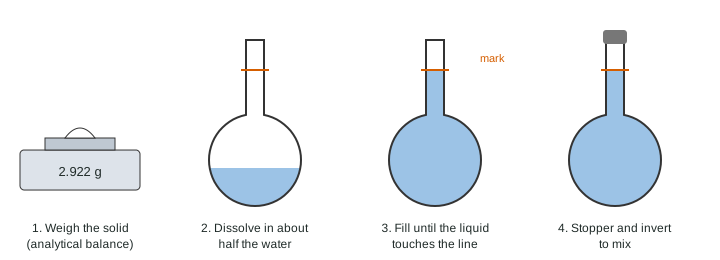
A beaker or graduated cylinder is not precise enough: a beaker's markings are only within about 5%. A volumetric flask is made to hold one volume very accurately.
Dilution
To make a weaker solution from a stronger stock solution, you take a measured volume of the stock and add water. Adding water does not change how many moles of solute you took, so
moles before = moles after, M1V1 = M2V2
V2 is the total final volume, not the volume of water added.
Worked example: a dilution. How would you make 100.0 mL of 0.250 M HCl from 6.00 M stock?
Step 1. V1 = M2V2 / M1 = (0.250 M × 100.0 mL) / 6.00 M = 4.17 mL of stock.
Step 2, procedure. Measure 4.17 mL of stock with a graduated pipet (or a volumetric pipet if one of that size is available) into a 100-mL volumetric flask that already holds some deionized water (always add acid to water), then dilute to the mark and invert to mix. You do not add 100.0 mL of water; you add water until the total is 100.0 mL.
Electrolytes
Pure water barely conducts electricity. Dissolve table salt in it and it conducts well; dissolve sugar and it still does not. A solute whose solution conducts is an electrolyte. Ionic compounds such as NaCl break apart into separate ions in water, and moving ions carry the current. A substance that gives many ions is a strong electrolyte; one that gives only a few, such as acetic acid in vinegar, is a weak electrolyte; one that gives none, such as sugar or ethanol, which stay as whole molecules, is a nonelectrolyte. The next topic draws what the particles in each kind of solution look like.
Ions count separately. A 0.10 M solution of CaCl2 holds 0.10 M Ca2+ and 0.20 M Cl−, because each formula unit gives one calcium ion and two chloride ions.