You probably learned that acids taste sour and bases feel slippery, or that acids contain H and bases contain OH. Those descriptions work for some substances and fail for others. Chemists use a definition based on what the particles actually do, and it explains far more reactions. This page introduces it; Unit 8 builds the rest of acid-base chemistry on it.
A proton on the move
A hydrogen atom is one proton and one electron. Take away the electron and only the proton is left, so the ion H⁺ is often just called a proton. In an acid-base reaction, an H⁺ moves from one particle to another.
- A Brønsted-Lowry acid is a proton donor: it gives up an H⁺.
- A Brønsted-Lowry base is a proton acceptor: it takes the H⁺, using a lone pair of electrons to bond to it.
Every acid-base reaction needs both: a proton cannot be given away unless something accepts it.
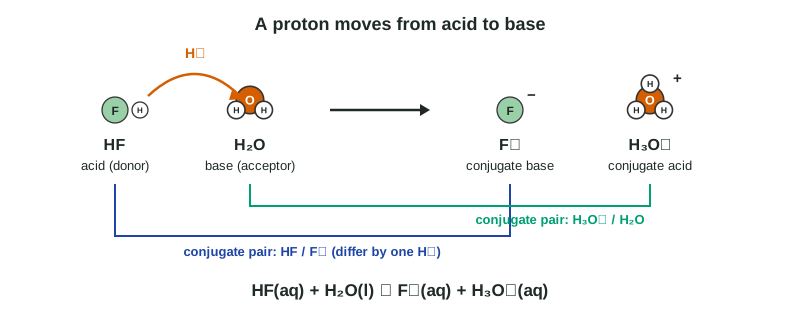
When hydrogen fluoride dissolves in water (Figure 1), an HF molecule gives an H⁺ to a water molecule:
HF(aq) + H₂O(l) ⇌ F⁻(aq) + H₃O⁺(aq)
HF is the acid; water is the base. The double arrow means the products also react to give back the reactants; you will study that in Unit 7.
Hydronium
A bare proton is a concentrated point of positive charge. In water it bonds at once to a lone pair on a water molecule's oxygen, forming the hydronium ion, H₃O⁺. Chemists often write H⁺(aq) as a shortcut, but H₃O⁺(aq) is what is really present. Both are acceptable in equations.
That is why hydrogen chloride gas dissolving in water is a reaction, not just dissolving. The HCl molecules give their protons to water molecules:
HCl(g) + H₂O(l) → H₃O⁺(aq) + Cl⁻(aq)
Pure liquid HCl contains only neutral molecules and does not conduct electricity. The solution, full of H₃O⁺ and Cl⁻ ions, conducts well.
Conjugate pairs
Look at what each reactant becomes. When HF loses H⁺, what is left is F⁻. When water gains H⁺, it becomes H₃O⁺. Two species that differ by exactly one H⁺ are a conjugate acid-base pair:
- F⁻ is the conjugate base of HF (HF minus H⁺).
- H₃O⁺ is the conjugate acid of H₂O (H₂O plus H⁺).
Every proton-transfer reaction has two conjugate pairs, one on each side of the arrow: acid₁ + base₂ → base₁ + acid₂.
Worked example. Identify the acid, base and conjugate pairs in NH₃(aq) + H₂O(l) ⇌ NH₄⁺(aq) + OH⁻(aq).
1. Follow the proton. NH₃ becomes NH₄⁺, so ammonia gains an H⁺: it is the base. Water becomes OH⁻, so it loses an H⁺: it is the acid.
2. Pairs: NH₄⁺/NH₃ (NH₄⁺ is the conjugate acid of ammonia) and H₂O/OH⁻ (OH⁻ is the conjugate base of water).
A quick check: removing H⁺ takes away one H and one positive charge. So the conjugate base of HPO₄²⁻ is PO₄³⁻, and its conjugate acid is H₂PO₄⁻.
Amphoteric species
Water was a base when it reacted with HF and an acid when it reacted with NH₃. A species that can donate or accept a proton is amphoteric (also called amphiprotic). To be amphoteric, a particle needs an H it can lose and a lone pair to accept another. Water, HCO₃⁻, HSO₄⁻ and H₂PO₄⁻ are common examples. Cl⁻ cannot donate (it has no H), and NH₄⁺ cannot accept (it has no lone pair left).
Neutralization
When an acid solution reacts with a hydroxide base, the net ionic equation is often just
H⁺(aq) + OH⁻(aq) → H₂O(l) (or H₃O⁺ + OH⁻ → 2H₂O)
This is a neutralization: the H⁺ and OH⁻ that made the solutions acidic and basic combine into water. The other ions, such as Na⁺ and Cl⁻ from HCl and NaOH, are spectators that remain as a dissolved salt.
Why the definition matters
| "Contains H / contains OH" | Brønsted-Lowry | |
|---|---|---|
| Ammonia, NH₃ | not a base (no OH) | a base: accepts H⁺ to form NH₄⁺ |
| Methane, CH₄ | an acid (has H) | not an acid in water: gives up no H⁺ |
| Water | unclear | acid or base, depending on its partner |
The Brønsted-Lowry view also explains why acid-base reactions are so fast and so common: a proton is tiny and moves easily from one lone pair to another.