There are far too many reactions to memorize one by one. Instead, chemists sort them by what happens between the particles. Once you can tell which kind of change is happening, you can predict products, write net ionic equations and know which calculation applies. This page introduces the main families; the next two topics take acid-base and electron-transfer reactions further.
Sorting by what changes
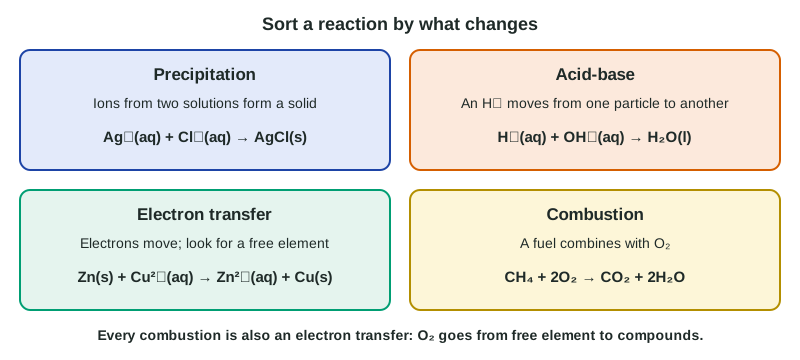
Ask what moves or regroups between the particles (Figure 1):
- Ions pair off into a solid. That is a precipitation reaction.
- A hydrogen ion, H⁺, passes from one particle to another. That is an acid-base reaction.
- Electrons pass from one particle to another. That is an electron-transfer reaction.
Combustion, a fourth familiar family, is a special case of electron transfer.
Precipitation reactions
In a precipitation reaction, two solutions of ionic compounds are mixed, and two of the ions form a combination that cannot stay dissolved. It comes out as a solid, the precipitate. The other ions stay in solution as spectators.
Worked example. Solutions of K₂CO₃ and CaCl₂ are mixed. Calcium carbonate is insoluble; potassium chloride is soluble. Predict the result.
1. List the ions: K⁺, CO₃²⁻, Ca²⁺, Cl⁻.
2. Try the new partners: Ca²⁺ with CO₃²⁻ gives CaCO₃ (insoluble, so it precipitates); K⁺ with Cl⁻ gives KCl (soluble, so the ions stay dissolved).
3. Net ionic equation: Ca²⁺(aq) + CO₃²⁻(aq) → CaCO₃(s).
Because the two compounds swap partners, the molecular equation looks like a "double replacement": K₂CO₃ + CaCl₂ → CaCO₃ + 2KCl.
Acid-base reactions
In an acid-base reaction a hydrogen ion moves from one particle to another. When nitric acid solution is mixed with potassium hydroxide solution, the K⁺ and NO₃⁻ ions are spectators, and the change is
H⁺(aq) + OH⁻(aq) → H₂O(l)
An H⁺ joins an OH⁻ to make water. Topic 4.8 gives the full picture: which particle gives up the H⁺, which accepts it, and what each becomes.
Electron-transfer reactions
When zinc metal is dipped in a blue copper(II) sulfate solution, the zinc slowly dissolves and red-brown copper coats it. Each neutral zinc atom has given two electrons to a Cu²⁺ ion:
Zn(s) + Cu²⁺(aq) → Zn²⁺(aq) + Cu(s)
A quick clue that electrons are moving: an element appears uncombined on one side and combined in a compound (or as an ion) on the other. Here zinc goes from metal to Zn²⁺, and copper from Cu²⁺ to metal. Magnesium dissolving in hydrochloric acid is another example: Mg(s) + 2H⁺(aq) → Mg²⁺(aq) + H₂(g). Two electrons pass from each magnesium atom to two hydrogen ions. Topic 4.9 shows how to track the electrons with numbers.
Many of these reactions have the pattern "an element replaces another element in a compound", called single replacement. Reactions where elements combine into a compound (synthesis, 2Na + Cl₂ → 2NaCl) and where a compound breaks into simpler substances that include an element (decomposition, 2H₂O₂ → 2H₂O + O₂) usually involve electron transfer too.
Combustion
Combustion is a fast reaction with oxygen gas that gives off heat and light. The most important fuels are hydrocarbons, compounds of only carbon and hydrogen, such as methane (CH₄), propane (C₃H₈) and octane (C₈H₁₈). In plenty of oxygen, every carbon atom ends up in CO₂ and every hydrogen atom in H₂O.
Worked example. Balance the complete combustion of butane, C₄H₁₀.
1. Skeleton: C₄H₁₀ + O₂ → CO₂ + H₂O.
2. Carbon: 4 C, so 4CO₂. Hydrogen: 10 H, so 5H₂O.
3. Oxygen on the right: 4 × 2 + 5 × 1 = 13 O atoms, which would need 13/2 O₂.
4. Double everything to clear the fraction: 2C₄H₁₀ + 13O₂ → 8CO₂ + 10H₂O. Check: 8 C, 20 H, 26 O on each side.
With too little oxygen, as in a furnace with a blocked vent, combustion is incomplete and some carbon ends up as carbon monoxide, CO, a colorless, odorless, toxic gas: 2CH₄ + 3O₂ → 2CO + 4H₂O.
Combustion is always an electron transfer: oxygen goes from the uncombined element O₂ into compounds.
Using combustion to find a formula
Because all the carbon of a hydrocarbon ends up in CO₂ and all its hydrogen in H₂O, weighing the products of a combustion tells you the formula. This is the elemental analysis you met in Unit 1, now explained by the reaction.
Worked example. Burning 0.8617 g of a hydrocarbon gives 2.641 g CO₂ and 1.261 g H₂O. Find its empirical formula.
Moles C = 2.641 g ÷ 44.01 g/mol × (1 mol C / 1 mol CO₂) = 0.06001 mol C.
Moles H = 1.261 g ÷ 18.02 g/mol × (2 mol H / 1 mol H₂O) = 0.1400 mol H.
Ratio H : C = 0.1400 ÷ 0.06001 = 2.333 = 7/3. Multiply by 3: C₃H₇.
Check the mass: 0.06001 mol × 12.01 g/mol + 0.1400 mol × 1.008 g/mol = 0.7207 g + 0.1411 g = 0.8618 g, matching the sample, so there is no oxygen in the compound.
The types overlap
| Reaction | Descriptions that fit |
|---|---|
| Pb(NO₃)₂ + 2NaCl → PbCl₂(s) + 2NaNO₃ | precipitation; double replacement |
| HNO₃ + KOH → KNO₃ + H₂O | acid-base; double replacement |
| Mg + 2HCl → MgCl₂ + H₂ | electron transfer; single replacement |
| CH₄ + 2O₂ → CO₂ + 2H₂O | combustion; electron transfer |
| 2H₂O₂ → 2H₂O + O₂ | decomposition; electron transfer |
The exam cares most about the particle-level description (what moves). The pattern names are useful shorthand, not a test of their own.