A balanced equation tells you the ratio in which particles react. Stoichiometry turns that ratio into real amounts: how many grams of oxygen a fuel needs, how much product a reaction can make, how much of an ion a sample contains. One idea runs through all of it, and this page builds every kind of problem from that idea.
The key idea: coefficients relate moles
In 2H₂ + O₂ → 2H₂O, the coefficients say 2 molecules of H₂ react with 1 molecule of O₂. Scale that up by Avogadro's number and it says 2 mol of H₂ react with 1 mol of O₂. So the coefficients give mole ratios, conversion factors such as
(2 mol H₂O / 1 mol O₂) or (1 mol O₂ / 2 mol H₂).
Coefficients do not relate grams: 2 g of H₂ do not react with 1 g of O₂. A balance measures grams and glassware measures volumes, so every problem has three stages: convert what you measured into moles, use the mole ratio, then convert the moles into what you want (Figure 1). Using mole ratios like this is called stoichiometry.
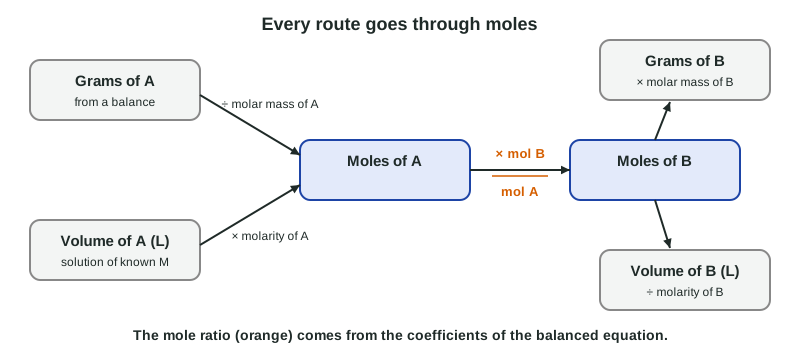
Mass to mass
Worked example. Propane burns: C₃H₈(g) + 5O₂(g) → 3CO₂(g) + 4H₂O(g). What mass of O₂ is needed to burn 10.0 g of propane? Molar masses: C₃H₈ 44.09 g/mol, O₂ 32.00 g/mol.
Set up one chain of conversion factors, so each unit cancels the one before:
10.0 g C₃H₈ × (1 mol C₃H₈ / 44.09 g C₃H₈) × (5 mol O₂ / 1 mol C₃H₈) × (32.00 g O₂ / 1 mol O₂) = 36.29 g O₂
Round once, at the end, to the three significant figures of 10.0 g: 36.3 g O₂.
Check: the mole ratio has the unit you want (mol O₂) on top and the unit you have (mol C₃H₈) on the bottom. Flipping it, a very common slip, would give 1.45 g.
Solutions: moles from molarity and volume
For a reactant in solution, molarity is moles per liter, so moles = molarity × volume in liters.
Worked example. What mass of PbI₂ (461.0 g/mol) can form from 25.0 mL of 0.0800 M Pb(NO₃)₂ with excess KI? Pb²⁺(aq) + 2I⁻(aq) → PbI₂(s).
Moles of Pb²⁺ = 0.0800 mol/L × 0.0250 L = 0.00200 mol.
Mole ratio: 1 mol PbI₂ per 1 mol Pb²⁺, so 0.00200 mol PbI₂.
Mass = 0.00200 mol × 461.0 g/mol = 0.922 g PbI₂.
Remember to change mL to L (divide by 1000) before multiplying by molarity.
Limiting reactant
When two reactants are mixed, one usually runs out first. That limiting reactant decides how much product forms; the other is left over, in excess. You met this with particles in topic 4.3. With masses, the trap is comparing grams, or even comparing moles without the mole ratio. The safe method is to ask what each reactant could make.
Worked example. 20.0 g of N₂ (28.02 g/mol) and 5.00 g of H₂ (2.016 g/mol) react: N₂ + 3H₂ → 2NH₃. What mass of NH₃ (17.03 g/mol) forms, and how much of which reactant is left?
1. Moles of each: N₂, 20.0 ÷ 28.02 = 0.7138 mol. H₂, 5.00 ÷ 2.016 = 2.480 mol.
2. Product each could make: from N₂, 0.7138 × (2/1) = 1.428 mol NH₃. From H₂, 2.480 × (2/3) = 1.653 mol NH₃.
3. N₂ makes less, so N₂ is limiting. Note that H₂ has the smaller mass, yet it is not limiting: the answer comes from moles and the mole ratio, never from grams. The theoretical amount is 1.428 mol NH₃ × 17.03 g/mol = 24.3 g NH₃.
4. H₂ used: 0.7138 mol N₂ × (3 mol H₂ / 1 mol N₂) = 2.141 mol = 4.317 g. Left over: 5.00 g − 4.32 g = 0.68 g H₂. (When subtracting, keep the decimal places of the least precise value: two.)
Check with mass: 20.0 g N₂ + 4.32 g of H₂ that reacted = 24.3 g NH₃. Mass is conserved.
Theoretical, actual and percent yield
The amount of product the limiting reactant can make is the theoretical yield. What you actually collect is the actual yield. It is usually less: some product sticks to glassware, side reactions occur, or the reaction is incomplete.
Percent yield = (actual yield ÷ theoretical yield) × 100
Worked example. Heating 2.520 g of NaHCO₃ (84.01 g/mol) decomposes it: 2NaHCO₃(s) → Na₂CO₃(s) + H₂O(g) + CO₂(g). The student collects 1.582 g of Na₂CO₃ (105.99 g/mol). Find the percent yield.
Theoretical yield: 2.520 g × (1 mol / 84.01 g) × (1 mol Na₂CO₃ / 2 mol NaHCO₃) × (105.99 g / 1 mol) = 1.590 g.
Percent yield: 1.582 g ÷ 1.590 g × 100 = 99.52%.
A percent yield above 100% for a dry, pure product is a red flag: the weighed solid contains something else, such as water that was not driven off or unreacted starting material.
In the lab, "heat to constant mass" is the safeguard: heat, cool in a desiccator, weigh, and repeat until two weighings agree. Until then, the reaction or the drying is not finished.
Gravimetric analysis
Gravimetric analysis finds how much of an ion is in a sample by turning it into a precipitate of known formula and weighing it.
- Weigh the sample on an analytical balance and dissolve it in distilled water.
- Add a precipitating reagent until no more solid forms, then a little extra, so the ion being measured is the limiting reactant and all of it precipitates.
- Filter through weighed filter paper and rinse the solid with distilled water to wash away soluble ions.
- Dry, cool and weigh, repeating until the mass is constant.
- Calculate: mass of precipitate → moles of precipitate → moles of the ion → mass and percent of the ion.
Worked example. A 0.5120 g sample of a chloride mixture gives 0.9333 g of dry AgCl (143.32 g/mol). What is the mass percent of chloride (35.45 g/mol)?
0.9333 g AgCl × (1 mol AgCl / 143.32 g) × (1 mol Cl / 1 mol AgCl) × (35.45 g Cl / 1 mol Cl) = 0.2308 g Cl
0.2308 g ÷ 0.5120 g × 100 = 45.09% chloride
Think through errors by asking which way they move the measured mass. A precipitate weighed while still wet is too heavy, so the percent comes out too high. Precipitate that passes through the filter paper or is spilled is lost, so the percent comes out too low.