Forensic chemists separate the dyes in a pen's ink to match a ransom note to a pen. Refineries split crude oil into gasoline, kerosene and diesel. Water plants remove grit before treating water. Each method works because the parts of a mixture differ in some physical property, and each property traces back to the forces between particles.
Filtration: by particle size
Filtration separates a solid that has not dissolved from a liquid. The liquid and everything dissolved in it pass through the tiny pores of filter paper (the liquid that comes through is the filtrate); the solid particles are too large and stay behind. Filtration cannot separate a solution: dissolved particles are individual ions or molecules, far smaller than the pores, so salt water goes straight through.
Chromatography: by attraction to two phases
Chromatography separates the parts of a mixture by how strongly each is attracted to two things: a stationary phase that stays put (paper, a coated plate, or a packed column) and a mobile phase that moves past it (a liquid solvent, or a gas). Every component is pulled both ways. One that interacts more strongly with the stationary phase spends more time stuck to it and moves more slowly. One that interacts more strongly with the mobile phase is carried along faster.
In paper chromatography, paper is made of cellulose, which is covered in –OH groups, so the stationary phase is very polar. With a nonpolar or weakly polar solvent, polar components hydrogen-bond to the paper and lag behind, while nonpolar components travel with the solvent.
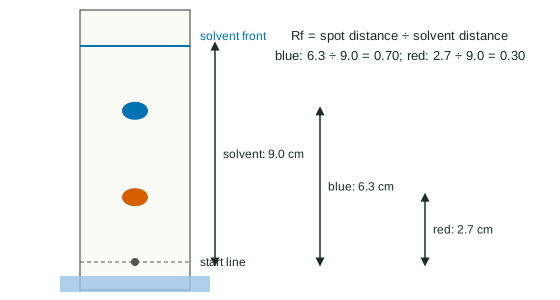
Each spot is described by its retention factor:
Rf = distance traveled by the spot / distance traveled by the solvent front
Both distances are measured from the start line where the sample was placed. Rf is always between 0 and 1. A large Rf means the component moved nearly as far as the solvent: it is attracted more to the mobile phase. A small Rf means it is held by the stationary phase. With the same paper and solvent, a substance always gives the same Rf, so comparing an unknown's spots with known substances identifies them.
Worked example: finding Rf. On the chromatogram above, the solvent front is 9.0 cm above the start line. The blue spot is 6.3 cm above it and the red spot 2.7 cm.
Rf(blue) = 6.3 cm / 9.0 cm = 0.70. Rf(red) = 2.7 cm / 9.0 cm = 0.30. The units cancel, so Rf has none.
Claim. Paper is polar, so the red dye, held back more, interacts more strongly with the paper: it is likely the more polar dye.
Changing the solvent changes the result. A more polar solvent competes better for polar components and carries them farther, so their Rf values rise. In column chromatography the same idea runs in a tube: the components come out of the bottom one after another, the most weakly held first.
Distillation: by volatility
Distillation separates liquids, or a liquid from dissolved solids, by heating the mixture so that the most volatile component boils off first, then cooling its vapor so it condenses in a separate flask. It works because the components differ in vapor pressure, and vapor pressure depends on intermolecular forces: the component with weaker forces between its molecules has the higher vapor pressure and the lower boiling point, so its vapor is richer in it.
Worked example: which comes off first? A mixture of methanol (CH3OH, boils at 65 °C) and water (boils at 100 °C) is distilled. Which liquid collects first, and why?
Both hydrogen-bond, but each water molecule can form more hydrogen bonds (two O–H hydrogens and two lone pairs) than each methanol molecule (one O–H). Methanol's weaker attractions give it the higher vapor pressure at each temperature, so the vapor, and the first distillate, is richer in methanol.
Salt water can be distilled into pure water: water boils off and condenses, and the ions stay behind, because their attractions are far too strong for them to enter the vapor. When two liquids have close boiling points, one distillation gives only partial separation; a tall column packed with glass beads (fractional distillation) repeats the boil-and-condense cycle many times and does better.
| Method | Separates | Based on | Example |
|---|---|---|---|
| Filtration | undissolved solid from a liquid | particle size | sand from water |
| Chromatography | dissolved components | attraction to stationary vs mobile phase | dyes in ink |
| Distillation | liquids; liquid from dissolved solids | vapor pressure (intermolecular forces) | water from salt water |