Water boils at 100 °C, but methane, a molecule of almost the same mass, boils at −162 °C. Nothing about the size of the two molecules explains a gap of 262 degrees. What explains it is how strongly the molecules attract each other. This page is about those attractions: what they are, where they come from, and how to compare them.
Forces inside molecules and forces between them
You have already met the forces inside a molecule: covalent bonds, which hold the atoms of one molecule together. These are intramolecular forces. Molecules also attract other molecules. These attractions are intermolecular forces (IMFs), and in general, forces between any separate particles, including ions, are called interparticle forces.
The two kinds are very different in strength. Breaking the O–H covalent bonds in water takes about 460 kJ per mole of bonds. Pulling two water molecules apart from each other takes roughly a twentieth of that. So when water boils, the molecules separate from each other but stay whole: the steam is still H2O. Boiling and melting overcome intermolecular forces; they never break covalent bonds.
All intermolecular forces are electrostatic: a partly positive region of one particle attracts a partly negative region of another, as Coulomb's law describes. The kinds differ in where those charges come from.
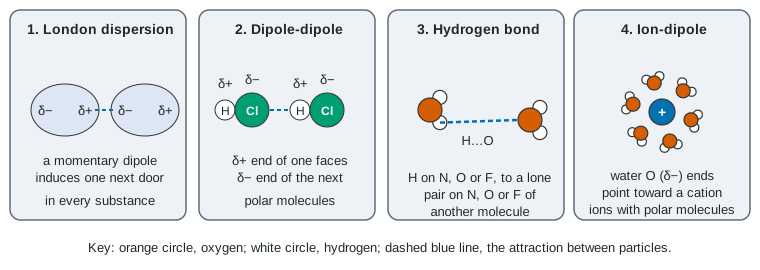
London dispersion forces: in every substance
Electrons move constantly. At any instant, the electrons of a molecule may be bunched a little more on one side, giving a momentary δ− end and a δ+ end. That momentary dipole pushes on the electrons of the molecule next door and creates an opposite dipole there, and the two attract. These attractions are London dispersion forces. They act between all particles, polar or nonpolar, and they are the only attraction between nonpolar molecules and noble gas atoms.
How strong they are depends on polarizability: how easily a particle's electron cloud is pushed out of shape. A particle with more electrons, spread over more occupied shells and farther from the nucleus, is more polarizable, so its dispersion forces are stronger. That is why the halogens go from gases (F2, Cl2) to a liquid (Br2) to a solid (I2) down the group.
Heavier molecules usually have more electrons, so boiling points often rise with molar mass. But mass is not the cause. The cause is the number of electrons and how easily they shift. Shape matters too: pentane (a long chain) boils at 36 °C, while its compact branched isomer, with the same formula and the same number of electrons, boils at 10 °C, because the long molecules touch over more surface.
Dipole-dipole forces: polar molecules
A polar molecule has a permanent dipole. Neighboring polar molecules turn so that the δ+ end of one sits near the δ− end of the next. That adds a dipole-dipole force on top of dispersion forces. Compare Br2 and ICl: both have 70 electrons and nearly the same molar mass (160 and 162 g/mol), but nonpolar Br2 boils at 59 °C and polar ICl at 97 °C. The extra 38 degrees come from the dipole-dipole forces. A polar molecule can also create a dipole in a nonpolar neighbor, a weaker dipole-induced dipole attraction; it is how a little oxygen gas dissolves in water.
Hydrogen bonds: a strong kind of dipole-dipole force
When hydrogen is covalently bonded to nitrogen, oxygen or fluorine, the very electronegative atom pulls the shared electrons far toward itself. The H is left with a large δ+ and, being tiny, its positive charge is very exposed. It is strongly attracted to a lone pair on an N, O or F atom of a neighboring molecule. That attraction is a hydrogen bond, drawn as a dashed line from the H of one molecule to the N, O or F of another.
Two conditions must both hold: an H bonded to N, O or F on one molecule, and a lone pair on N, O or F on the other. A hydrogen bond is never drawn between two H atoms, between two O atoms, or along the O–H bond inside one molecule. Hydrogen bonds explain why H2O, HF and NH3 boil far higher than the next hydrides down their groups (H2S boils at −60 °C, water at 100 °C).
Ion-dipole forces
An ion attracts the oppositely charged end of a polar molecule. A Na+ ion pulls the δ− oxygen end of water molecules toward it; a Cl− ion pulls the δ+ hydrogen ends toward it. This ion-dipole force is the strongest of the attractions on this page because an ion carries a full charge. It is what lets salts dissolve in water, which a later topic draws in detail.
Comparing substances
| Force | Between | Comes from | Example |
|---|---|---|---|
| London dispersion | all particles | momentary dipoles; stronger with more electrons and larger contact area | I2, CH4, Ar |
| Dipole-dipole | polar molecules | permanent dipoles lining up | ICl, HCl, acetone |
| Hydrogen bond | H on N, O or F, to N, O or F | very large δ+ on H, lone pair on the partner | H2O, NH3, HF, alcohols |
| Ion-dipole | an ion and a polar molecule | a full charge attracting a partial one | Na+ in water |
Stronger attractions hold particles together more tightly, so they raise the boiling point (the temperature at which a liquid boils; the "normal boiling point" is at sea-level air pressure) and the melting point. To compare two substances, name every force in both, then reason:
- If the molecules are about the same size, the one with the extra kind of force (dipole-dipole, then hydrogen bonding) attracts more strongly.
- If both have only dispersion forces, the one with more electrons (more polarizable) or more contact area attracts more strongly.
- A much larger molecule can out-attract a small polar one: octane (C8H18, 66 electrons, dispersion only) boils at 126 °C, above water.
Worked example: three molecules of the same mass. Butane (C4H10, 58.12 g/mol), acetone ((CH3)2CO, 58.08 g/mol) and 1-propanol (CH3CH2CH2OH, 60.10 g/mol) boil at −0.5 °C, 56 °C and 97 °C. Explain the order.
Step 1, list the forces. Butane is nonpolar: dispersion only. Acetone has a polar C=O bond and is a polar molecule: dispersion and dipole-dipole. 1-Propanol has an O–H group: dispersion, dipole-dipole and hydrogen bonds.
Step 2, compare dispersion. All three have similar numbers of electrons (34, 32 and 34), so their dispersion forces are similar. Molar mass cannot explain a 98-degree spread.
Step 3, claim with reasoning. Each step up adds a stronger kind of attraction: acetone's dipole-dipole forces put it above butane, and 1-propanol's hydrogen bonds (H on O attracted to a lone pair on O of the next molecule) put it highest. More energy is needed to separate the molecules, so the boiling point rises.