A microwave oven heats your food, an infrared camera sees your body heat, and too much ultraviolet light burns your skin. All three are light, the same kind of wave, differing only in wavelength. What each does to molecules depends on how much energy each photon carries, and that is the key to spectroscopy: using light to find out what substances are made of.
Light as a wave
Light is electromagnetic radiation: a wave of electric and magnetic fields that travels through empty space. Like any wave it has a wavelength (λ), the distance from one crest to the next, and a frequency (ν), the number of crests passing a point each second. The full range of wavelengths is the electromagnetic spectrum, from radio waves meters long to X-rays smaller than an atom (Figure 1). Visible light, from about 400 nm (violet) to 700 nm (red), is a thin slice in the middle.
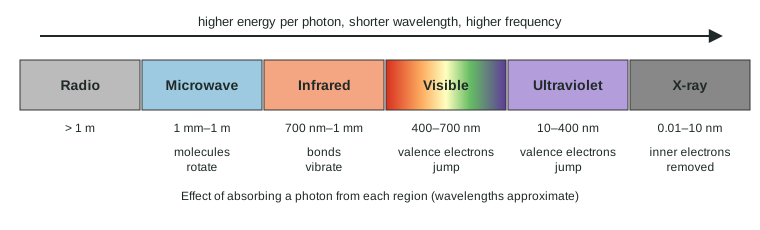
Light also comes in packets of energy called photons, which you met with photoelectron spectroscopy. Shorter wavelength means higher frequency and more energy per photon. A UV photon carries more energy than a visible one, which carries more than an infrared one, which carries more than a microwave one. The next topic makes this exact with equations.
Energy levels and absorption
A molecule can hold energy in several ways, and each one comes in fixed amounts, like the rungs of a ladder rather than a ramp:
- Electronic energy: electrons occupy particular energy levels. Moving an electron from its usual level (the ground state) to a higher one (an excited state) is an electronic transition. The gaps are large.
- Vibrational energy: bonds stretch and bend like springs. Each bond vibrates at particular energies; a molecular vibration can step up one level at a time. The gaps are medium-sized.
- Rotational energy: a molecule tumbles end over end at particular rates. The gaps are small.
A molecule absorbs a photon only if the photon's energy matches the gap between two of its levels. Too little energy and nothing happens; too much and (for these transitions) the photon is not absorbed either, it passes through. That matching rule is why each region of the spectrum does a particular job:
| Region | Energy per photon | Change in the molecule | Everyday example |
|---|---|---|---|
| Microwave | low | faster rotation | a microwave oven spins water molecules, which heats food |
| Infrared | medium | more vibration of bonds | CO2 absorbing IR from Earth's surface (greenhouse effect) |
| Visible and ultraviolet | high | valence electrons jump to higher levels | a dye's color; UV damaging skin |
| X-ray | very high | inner (core) electrons removed | X-ray imaging |
Spectroscopy
Spectroscopy measures which wavelengths a sample absorbs (an absorption spectrum) or gives off (an emission spectrum). Because the energy levels depend on the atoms and bonds present, the pattern of wavelengths is a fingerprint.
- Infrared spectroscopy identifies bonds. Each kind of bond vibrates at its own energy: an O–H stretch absorbs around 3,300 cm−1 on an IR chart, a C=O stretch near 1,700 cm−1, a C–H stretch near 2,900 cm−1. Spectra are often plotted in wavenumber (cm−1), which is larger for higher energy.
- Visible and UV spectroscopy follows electronic transitions. A colored substance absorbs some visible wavelengths and transmits or reflects the rest; we see the light it does not absorb. A solution that absorbs orange light looks blue.
Worked example: reading what light does. A gas sample absorbs strongly at 4.3 μm (4,300 nm) but not at all in the visible. What kind of transition does it undergo, and what does that suggest about the gas?
Step 1, region. 4,300 nm is longer than 700 nm and shorter than 1 mm: infrared.
Step 2, transition. Infrared photons match vibrational energy gaps, so a bond in the molecule is vibrating more.
Step 3, claim. The gas has bonds that absorb IR but no electronic transition in the visible, so it is colorless. (CO2 absorbs here; that absorption is part of why it is a greenhouse gas.)