When you stir salt into water it seems to vanish. The salt is still there; it has come apart into ions, and each ion is wrapped in water molecules. On the exam you will be asked to draw, or pick, exactly what that looks like, and the most common error is drawing the water molecules the wrong way round. This page shows how to get it right every time.
What happens when an ionic solid dissolves
In solid NaCl, each Na+ is held by the Cl− ions around it, and each Cl− by the Na+ ions. Water molecules are polar: the oxygen end is δ− and the hydrogen ends are δ+. At the surface of the crystal, water molecules turn their δ− oxygen ends toward Na+ ions and their δ+ hydrogen ends toward Cl− ions. These ion-dipole attractions pull ions out of the lattice one at a time.
The ions separate from each other: the solid dissociates. Each freed ion is then surrounded by a shell of water molecules, all pointing the right way. That surrounding is called hydration (and the ion is "hydrated").
NaCl(s) → Na+(aq) + Cl−(aq)
The "(aq)" means a hydrated ion: an ion with its shell of water molecules.
Getting the water molecules the right way round
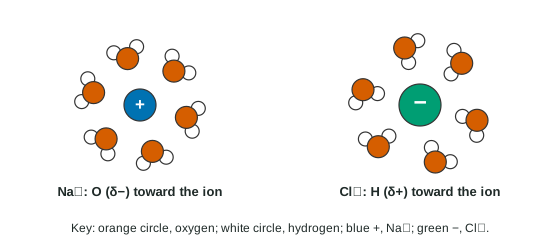
The rule is just Coulomb's law: opposite charges face each other.
- Cation (+), such as Na+, K+, Ca2+: the oxygen (δ−) of each water points toward the ion; both hydrogens point away.
- Anion (−), such as Cl−, NO3−, SO42−: a hydrogen (δ+) of each water points toward the ion; the oxygen points away.
A drawing with hydrogens pointing at a cation would put two positive charges side by side. That arrangement repels, so it is wrong.
Ions with a larger charge and a smaller radius attract water more strongly. A Mg2+ ion holds its water shell more tightly than a Na+ ion, because by Coulomb's law the attraction grows with charge and with closeness.
Drawing a solution: the checklist
A particle diagram of an aqueous solution of an ionic compound must show:
- Separate ions, not formula units stuck together. Dissolved KBr is K+ and Br− apart, not K–Br pairs.
- The formula ratio of ions. CaCl2 gives two Cl− for every Ca2+; Na2SO4 gives two Na+ for every SO42−. The total charge in the box is zero.
- Polyatomic ions kept whole. SO42− and NO3− stay in one piece: the bonds inside them are covalent and do not break.
- Even spread. A solution is homogeneous, so solute particles are spread through the whole volume, not piled at the bottom.
- Correctly oriented water where water is shown, with O toward cations and H toward anions.
Worked example: counting particles. A box represents 1.0 mL of 0.30 M Na2SO4. If it shows 3 sulfate ions, how many sodium ions must it show, and how many particles of solute in all?
Step 1, the ratio. Na2SO4 → 2 Na+ + SO42−, so 2 Na+ per SO42−.
Step 2, count. 3 SO42− × 2 = 6 Na+. Total solute particles = 6 + 3 = 9.
Check charge. 6(+1) + 3(−2) = 0. A box that does not add to zero charge is drawn wrong.
Molecular solutes
A molecular solute such as glucose (C6H12O6) or ethanol does not break into ions. Its molecules stay whole, spread among the water molecules and held by hydrogen bonds and other intermolecular forces. A particle diagram shows intact molecules, so the solution has no ions and does not conduct.
| Solute | Particles drawn | Ratio | Conducts? |
|---|---|---|---|
| KBr | K+, Br− | 1 : 1 | yes |
| CaCl2 | Ca2+, Cl− | 1 : 2 | yes |
| K2SO4 | K+, SO42− | 2 : 1 | yes |
| Glucose | whole C6H12O6 molecules | no ions | no |