Representations of Solutions
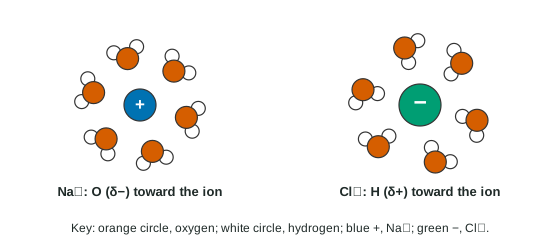
When an ionic compound dissolves, ion-dipole attractions pull it apart into separate ions, and each is hydrated: water's oxygen faces cations and its hydrogens face anions.
Part 1 · Hook
Why this matters
Part 2 · Before you start
What this builds on
Part 3 · Prerequisite check
Quick check before you start
1. Which end of a water molecule carries a partial negative charge?
- The oxygen end
- The hydrogen end
- Neither; water is nonpolar
Show the answer
Oxygen is more electronegative and pulls the shared electrons toward itself.
- Correct: The oxygen end:
- The hydrogen end:
- Neither; water is nonpolar:
2. What is an ion-dipole force?
- An ion attracting the oppositely charged end of a polar molecule
- A covalent bond between an ion and water
- The attraction between two ions
Show the answer
An ion attracts the opposite partial charge of a polar molecule.
- Correct: An ion attracting the oppositely charged end of a polar molecule:
- A covalent bond between an ion and water:
- The attraction between two ions:
3. What is the molarity of Cl⁻ in 0.10 M CaCl₂?
- 0.20 M
- 0.10 M
- 0.30 M
Show the answer
Each CaCl₂ gives two Cl⁻ ions.
- Correct: 0.20 M:
- 0.10 M:
- 0.30 M:
Part 4 · See it
See it first
Part 5 · Step by step
How it works, step by step
- Water molecules are polar, with δ− O and δ+ Hthey attract the ions at the surface of an ionic crystal
- Ion-dipole attractions pull ions out of the latticethe solid dissociates into separate ions
- Opposite charges attractwater points O toward cations and H toward anions, forming a hydration shell
- Each formula unit gives a fixed set of ionsa correct diagram keeps the formula ratio and a total charge of zero
Part 6 · Key ideas
Key ideas
- Dissolved ionic compounds are separate, hydrated ions; molecular solutes stay as whole molecules.
- Water orientation: O (δ−) toward cations, H (δ+) toward anions.
- Keep the formula ratio (CaCl₂: 1 Ca²⁺ to 2 Cl⁻) and keep polyatomic ions whole.
- Spread solute particles evenly: a solution is homogeneous.
Part 7 · Misconception
A common mistake
The wrong idea: Water always points its oxygen toward a dissolved ion, because oxygen is the part of water that attracts things.
What actually happens: Water turns its δ− oxygen toward a cation but its δ+ hydrogens toward an anion. Like charges facing each other would repel.
Part 8 · Check yourself
Check yourself
Exam-style questions. Anything you miss goes into your review queue.
Particle view
Four drawings of sodium chloride in water
Key: blue +, Na⁺; green −, Cl⁻; orange circle, oxygen; white circle, hydrogen.
1. Which box correctly represents NaCl dissolved in water?
- W
- X
- Y
- Z
Show the answer
W shows separate ions in a 1 : 1 ratio, with water's δ− oxygen toward Na⁺ and a δ+ hydrogen toward Cl⁻.
- Correct: W: Right: separate ions, 1 : 1, correct orientation.
- X: X has every water molecule backwards: H toward the cation and O toward the anion, so like charges face each other.
- Y: Y shows the ions still paired, but dissolving separates them into hydrated ions.
- Z: Z shows two Na⁺ for one Cl⁻, which has a net charge of +1 and the wrong ratio for NaCl.
2. What is wrong with box X?
- Like partial charges face each other: water's δ+ H points at Na⁺ and its δ− O at Cl⁻.
- It shows the ions separated, but in water the Na⁺ and Cl⁻ ions stay bonded together.
- It has too many water molecules, because each ion attracts one water molecule.
- It shows Cl⁻ as larger than Na⁺, but the chloride ion is the smaller of the two.
Show the answer
Ion-dipole attraction lines up opposite charges. X turns every water molecule backwards, which would put repelling charges side by side.
- Correct: Like partial charges face each other: water's δ+ H points at Na⁺ and its δ− O at Cl⁻.: Right: the orientation is reversed for both ions.
- It shows the ions separated, but in water the Na⁺ and Cl⁻ ions stay bonded together.: Dissolving does separate the ions; that part of X is correct.
- It has too many water molecules, because each ion attracts one water molecule.: Each ion is surrounded by several water molecules, so a shell of four is reasonable.
- It shows Cl⁻ as larger than Na⁺, but the chloride ion is the smaller of the two.: Cl⁻ (181 pm) is larger than Na⁺ (102 pm), as drawn.
3. Why is box Y not a correct picture of the solution?
- Dissolving separates the ions, and each ion is hydrated; Y shows an ion pair that has not come apart.
- Y has too few water molecules in it to represent water as the solvent for the solution.
- Y shows the Na⁺ and Cl⁻ in a 1 : 1 ratio, but the ratio in the solution is 2 : 1.
- Y shows covalent bonds inside the water molecules, which break when salt dissolves in water.
Show the answer
Ion-dipole attractions pull the ions out of the lattice and apart. A correct drawing shows each ion separately, with its own water shell.
- Correct: Dissolving separates the ions, and each ion is hydrated; Y shows an ion pair that has not come apart.: Right: the ions should be separate and hydrated.
- Y has too few water molecules in it to represent water as the solvent for the solution.: Y shows several water molecules; the number drawn is a sampling choice.
- Y shows the Na⁺ and Cl⁻ in a 1 : 1 ratio, but the ratio in the solution is 2 : 1.: NaCl gives a 1 : 1 ratio, which Y gets right.
- Y shows covalent bonds inside the water molecules, which break when salt dissolves in water.: The O–H bonds in water do not break when salt dissolves.
Particle view
A potassium sulfate solution
Key: blue +, K⁺; yellow center with four orange O, SO₄²⁻ (water molecules not shown).
4. How many solute particles (ions) are shown in the box?
Type a number in ions.
Show the answer
Three SO₄²⁻ ions and six K⁺ ions: 3 + 6 = 9 ions. Each sulfate ion counts as one particle; its atoms stay bonded together.
- Answer: 9 ions
5. Why does the drawing show twice as many K⁺ ions as SO₄²⁻ ions?
- K₂SO₄ gives two K⁺ for each SO₄²⁻, so the charges balance: 2(+1) + (−2) = 0.
- K⁺ ions are smaller, so more of them fit into the same volume of the solution.
- Half of the sulfate ions break apart into sulfur and oxygen atoms when dissolved.
- Potassium ions attract more water, so more of them dissolve than sulfate ions.
Show the answer
The formula K₂SO₄ fixes the ratio: two K⁺ per SO₄²⁻, which makes each formula unit, and the whole box, neutral.
- Correct: K₂SO₄ gives two K⁺ for each SO₄²⁻, so the charges balance: 2(+1) + (−2) = 0.: Right: the ratio follows the formula and the charges.
- K⁺ ions are smaller, so more of them fit into the same volume of the solution.: Ion size does not set how many of each ion form.
- Half of the sulfate ions break apart into sulfur and oxygen atoms when dissolved.: Sulfate stays whole; the S–O bonds are covalent.
- Potassium ions attract more water, so more of them dissolve than sulfate ions.: Every formula unit gives the same two K⁺ and one SO₄²⁻.
6. Water molecules are added to the drawing around one K⁺ ion and one SO₄²⁻ ion. How should they point?
- O toward K⁺; H toward the O atoms of SO₄²⁻.
- H toward K⁺; O toward the O atoms of SO₄²⁻.
- O toward both ions, because oxygen is the larger atom.
- H toward both ions, because hydrogen bonds to both.
Show the answer
Opposite charges face each other: water's δ− oxygen toward the cation, and its δ+ hydrogens toward the negatively charged sulfate ion (whose outer O atoms carry the negative charge).
- Correct: O toward K⁺; H toward the O atoms of SO₄²⁻.: Right: δ− to the cation, δ+ to the anion.
- H toward K⁺; O toward the O atoms of SO₄²⁻.: This reverses both: like charges would face each other.
- O toward both ions, because oxygen is the larger atom.: Atom size does not decide; charge does, and O is δ− so it suits only the cation.
- H toward both ions, because hydrogen bonds to both.: H is δ+, so it is attracted to the anion but repelled by the cation.
7. A student draws dissolved KBr with each water molecule's oxygen pointing toward BOTH the K⁺ and the Br⁻ ions, "because oxygen is the part of water that bonds." Which response is best?
- Water orients by charge: δ− O faces K⁺, but δ+ H must face Br⁻, since O facing Br⁻ would repel.
- The drawing is correct, because the oxygen atom forms hydrogen bonds with the ions in solution.
- The drawing is correct for K⁺ and Br⁻ alike, because both are ions with a full charge on them.
- Water should point H toward both ions, because H is the δ+ end and so it attracts ions.
Show the answer
Ion-dipole attraction is Coulombic. A δ− oxygen is attracted to a cation and repelled by an anion, so around Br⁻ the water molecules turn their δ+ hydrogens inward.
- Correct: Water orients by charge: δ− O faces K⁺, but δ+ H must face Br⁻, since O facing Br⁻ would repel.: Right: orientation depends on the ion's sign.
- The drawing is correct, because the oxygen atom forms hydrogen bonds with the ions in solution.: Ion-dipole forces are not hydrogen bonds, and O–to–anion would repel.
- The drawing is correct for K⁺ and Br⁻ alike, because both are ions with a full charge on them.: A full charge of either sign attracts the opposite end of water, which differs for + and −.
- Water should point H toward both ions, because H is the δ+ end and so it attracts ions.: δ+ H would be repelled by K⁺.
Part 9 · Summary
Summary
Part 10 · Up next
What comes next
Part 11 · Connections