Table salt, sugar, sand and copper are all solids, yet salt melts at 801 °C, sugar at about 186 °C, sand (quartz) above 1,700 °C, and copper at 1,085 °C. Sugar dissolves and does not conduct; copper conducts but does not dissolve in water. All of this follows from one question: what are the particles, and what holds them together?
Crystalline and amorphous solids
In a crystalline solid the particles sit in an ordered pattern that repeats in every direction, so the solid has flat faces and a sharp melting point. In an amorphous solid, such as glass or many plastics, the particles are packed with no long-range order, and the solid softens gradually over a range of temperatures instead of melting at one temperature.
Four kinds of crystalline solid
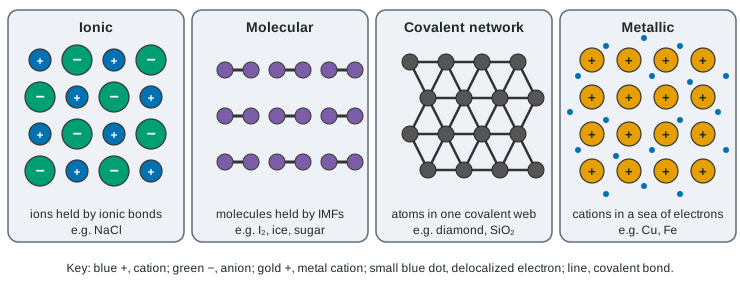
Ionic solids (you met these with ionic bonding) are cations and anions in a lattice, held by strong ionic bonds. They melt high, are brittle, and conduct only when melted or dissolved, when the ions can move.
Metallic solids are metal cations in a sea of delocalized electrons. The moving electrons let them conduct as solids, and the layers can slide without breaking the bonding, so metals are malleable.
Molecular solids are made of separate molecules, such as I2, ice (H2O) or sucrose (C12H22O11). Each molecule is held together by strong covalent bonds, but the molecules are held to each other only by intermolecular forces. Melting a molecular solid only has to overcome those weaker attractions, so molecular solids melt low (ice at 0 °C, iodine at 114 °C). They are soft, and they do not conduct electricity in any state, because they contain no ions and no free electrons. Within the group, the ones with stronger intermolecular forces melt higher, exactly as the last topic predicts.
Covalent network solids have no separate molecules at all. Every atom is covalently bonded to its neighbors in one continuous web through the whole crystal. Diamond (each C bonded to four others), quartz, SiO2 (each Si bonded to four O, each O to two Si), and silicon carbide are examples. Melting one means breaking covalent bonds, so these solids have very high melting points (quartz about 1,710 °C, diamond above 3,500 °C) and are very hard. Most do not conduct, because every valence electron is locked in a bond. Graphite is the exception: its carbon atoms form flat sheets, each C bonded to three others, and the leftover electrons are delocalized across the sheet, so graphite conducts along the sheets. The sheets are held to each other only by dispersion forces, so they slide, which is why graphite is soft and slippery.
Comparing the four kinds
| Kind | Particles | Held by | Melting point | Conducts? | Other |
|---|---|---|---|---|---|
| Ionic | cations and anions | ionic bonds | high | only melted or dissolved | hard, brittle |
| Metallic | metal cations, delocalized electrons | metallic bonding | low to very high | yes, solid and liquid | malleable, ductile |
| Molecular | molecules | intermolecular forces | low | no | soft |
| Covalent network | atoms | covalent bonds throughout | very high | no (graphite along its sheets) | very hard (graphite soft) |
Worked example: identifying an unknown solid. A white solid melts at 1,710 °C, is very hard, does not conduct as a solid or when melted, and does not dissolve in water. Which kind of solid is it?
Step 1, melting point. 1,710 °C is far too high for a molecular solid, so strong bonds hold the particles. It must be ionic, metallic or covalent network.
Step 2, conductivity. It does not conduct as a solid, which rules out a metal. It does not conduct when melted either, so it has no ions that become free to move. That rules out an ionic solid.
Step 3, claim. A very high melting point with no conduction in any state points to a covalent network solid; the data fit quartz, SiO2.
The same logic works backwards: if a substance's formula tells you which atoms it contains, you can predict its kind of solid. Metal and nonmetal: ionic. Metal only: metallic. Nonmetals that form small molecules (I2, CO2, H2O): molecular. C, Si and their compounds with each other or with O, such as SiO2 and SiC: often covalent network. Note that CO2 and SiO2 have similar formulas but are completely different solids: dry ice is a molecular solid that turns to gas at −78 °C, while quartz is a network.