Cooking an egg and melting butter both change the food in front of you, but only one of them turns it into something new. Older textbooks give lists of "signs" to tell the two kinds of change apart. The exam asks for something better: an explanation in terms of what the particles do. This page builds that explanation.
Two kinds of change
A physical change alters how particles are arranged, how far apart they are, or how fast they move, but leaves each particle as it was. Melting, freezing, boiling, condensing, sublimation, dissolving and mixing are physical changes. Water molecules in ice, liquid water and steam are the same H₂O molecules; only their spacing and the attractions between them differ.
A chemical change breaks bonds within particles and forms new ones, so the particles after are different from the particles before. New substances with new properties appear. When water is split by an electric current into hydrogen and oxygen, the O–H bonds inside each molecule break and H–H and O=O bonds form. Water, a liquid that puts out fires, becomes two gases that burn.
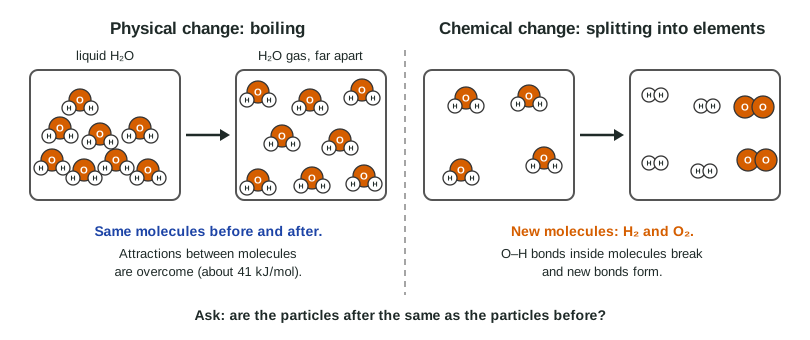
So the one question to ask is: are the particles after the same as the particles before? (Figure 1). If yes, the change is physical. If new particles have formed, it is chemical.
Why the energy is so different
The attractions between molecules are much weaker than the covalent bonds inside them. Compare two ways of pulling water apart:
| Process | What is separated | Energy needed |
|---|---|---|
| Boiling at 100 °C | whole molecules from their neighbors | about 41 kJ/mol |
| Breaking water vapor into H and O atoms | the two O–H bonds in each molecule | about 927 kJ/mol |
Worked example. How many times more energy does breaking water vapor into atoms take than boiling the same amount of water?
927 kJ/mol ÷ 41 kJ/mol = 22.6, which is 23 to the two significant figures of 41 kJ/mol. The units cancel, so the answer is a pure number.
Breaking the bonds takes over twenty times as much energy. That is why heating water on a stove boils it long before any molecule falls apart.
This is the reason a classic error loses points: saying that covalent bonds break when a molecular substance boils. Boiling bromine gives Br₂ molecules in the gas, not Br atoms. Subliming iodine gives I₂ vapor. The weak attractions between molecules are overcome; the strong bonds inside them are not.
Why "signs of a reaction" are not enough
Color changes, bubbles, heat and light are useful clues, but each can come from a physical change too:
- Boiling water bubbles, but the bubbles are water vapor.
- Dissolving some salts makes water noticeably colder or warmer.
- Iodine crystals give off a purple vapor when warmed, but the vapor is still I₂.
A claim that a change is chemical needs evidence that a new substance formed: a gas that was not there before and has different properties (such as one that turns limewater cloudy), a solid with a different color and composition, or a product you can identify.
Another unreliable test is "can it be undone?" Freezing water can be undone by melting, but so can many chemical changes. Blue copper(II) sulfate crystals turn white when heated because water bonded inside the crystal is driven off, and adding water turns them blue again, giving off heat. The white powder is a different compound with a different formula, so heating is a chemical change, even though it can be reversed.
Dissolving: the in-between case
When sugar dissolves, the sugar molecules separate from each other and mix with water, but each one stays a whole sugar molecule. That is clearly physical.
Dissolving an ionic solid such as sodium chloride is harder to classify. The ionic attractions holding the crystal together are strong, comparable to bonds, and they are broken. New ion-dipole attractions form between the ions and water molecules. Yet the Na⁺ and Cl⁻ ions are the same before and after, and evaporating the water gives back the original salt. So dissolving an ionic solid has a feature of a chemical change (strong attractions broken and new ones formed) and a feature of a physical change (no new substance). If you are asked to classify it, what matters is the particle-level reasoning behind your answer, not the label alone.
Writing a strong justification
When asked to classify a change, state the claim, give the evidence, and reason about the particles:
"Boiling ethanol is a physical change. The vapor is ethanol, with the same boiling point when it condenses (evidence). Only the attractions between ethanol molecules are overcome; no covalent bonds within the molecules break, so no new substance forms (reasoning)."