Physical and Chemical Changes
A physical change rearranges particles without changing them; a chemical change breaks and forms bonds and makes new substances.
Part 1 · Hook
Why this matters
Part 2 · Before you start
What this builds on
Part 3 · Prerequisite check
Quick check before you start
1. When water boils, which attractions are overcome?
- Attractions between water molecules
- Covalent O–H bonds within each molecule
- Ionic bonds between H⁺ and O²⁻
- Bonds between protons and neutrons
Show the answer
A phase change separates whole molecules by overcoming intermolecular forces.
- Correct: Attractions between water molecules:
- Covalent O–H bonds within each molecule:
- Ionic bonds between H⁺ and O²⁻:
- Bonds between protons and neutrons:
2. In a balanced equation, what is conserved?
- The number of each kind of atom
- The number of molecules
- The state of each substance
- The number of substances
Show the answer
Atoms are rearranged, never created or destroyed.
- Correct: The number of each kind of atom:
- The number of molecules:
- The state of each substance:
- The number of substances:
Part 4 · See it
See it first
Part 5 · Step by step
How it works, step by step
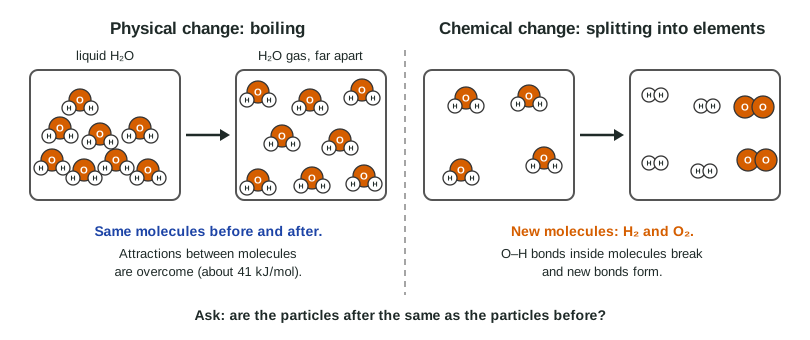
- A physical change overcomes or forms attractions between particlesthe particles themselves stay the same, so no new substance forms
- A chemical change breaks and forms bonds within particlesnew particles, and so new substances, form
- Covalent bonds are much stronger than attractions between moleculesphase changes need far less energy than breaking molecules apart
- Dissolving an ionic solid breaks strong ionic attractions and forms ion-dipole attractionsit has features of both kinds of change
Part 6 · Key ideas
Key ideas
- A physical change (melting, boiling, dissolving, mixing) changes how particles are arranged, not what they are.
- A chemical change breaks and forms bonds within particles, so new substances with new properties form.
- Decide at the particle level: are the particles after the same as the particles before?
- Dissolving salt breaks strong ionic attractions yet makes no new substance, so it sits between the two.
Part 7 · Misconception
A common mistake
The wrong idea: A change that can be undone is physical, and one that cannot be undone is chemical.
What actually happens: Whether a change can be undone does not decide it. Many chemical changes can be run backward, and some physical changes are hard to undo. Ask whether new substances, with new bonds, formed.
Part 8 · Check yourself
Check yourself
Exam-style questions. Anything you miss goes into your review queue.
Particle view
Three changes
Key: red O, oxygen atom; white H, hydrogen atom; brown Br, bromine atom; blue N, nitrogen atom. Each pair shows the same sample before and after.
1. Which of the changes shown are chemical changes?
- P and R
- Q alone
- P, Q and R
- R alone
Show the answer
In P and R the molecules after are different from the molecules before: bonds broke and new ones formed. In Q every Br₂ molecule is intact; only the arrangement of the molecules changed.
- Correct: P and R: Right: new substances form in P and R.
- Q alone: Q is the one change in which every molecule stays the same, so it is the physical change.
- P, Q and R: Q keeps the same Br₂ molecules, so it is not a chemical change.
- R alone: P also makes new substances (H₂ and O₂ from water).
2. Which description of change Q matches the diagram?
- Bromine evaporating: Br₂ molecules move apart, each staying whole
- Bromine splitting into atoms as Br–Br bonds break on heating
- Bromine reacting to form a new compound with a higher boiling point
- Bromine dissolving as Br₂ molecules break into Br⁺ and Br⁻ ions
Show the answer
The molecules end up far apart but each is still Br₂. Only the forces between molecules were overcome: a phase change, which is physical.
- Correct: Bromine evaporating: Br₂ molecules move apart, each staying whole: Right: the molecules separate, but each molecule stays whole.
- Bromine splitting into atoms as Br–Br bonds break on heating: The second box still shows Br₂ pairs, so no Br–Br bond broke.
- Bromine reacting to form a new compound with a higher boiling point: No new compound appears; every particle is still Br₂.
- Bromine dissolving as Br₂ molecules break into Br⁺ and Br⁻ ions: No ions appear in the diagram, and there is no water to dissolve in.
3. In change R, how many oxygen atoms are in the After box?
Type a number in atoms.
Show the answer
6 NO hold 6 O atoms and 3 O₂ hold 6 O atoms: 12 in all, matching the 6 NO₂ × 2 = 12 O atoms before.
- Answer: 12 atoms
4. A student claims that change P is physical because water and the gases H₂ and O₂ are all made of the same atoms. Which response best corrects the claim?
- P is chemical: O–H bonds break, and new H–H and O=O bonds form
- P is physical, since it involves just the atoms already present
- P is physical, because burning the two gases would undo it again
- P is chemical, because water becomes a gas, which is a new state
Show the answer
Every reaction keeps the same atoms, so "same atoms" cannot tell physical from chemical. What matters is whether bonds within particles break and new ones form. In P they do.
- Correct: P is chemical: O–H bonds break, and new H–H and O=O bonds form: Right: bonds inside the particles change, so new substances form.
- P is physical, since it involves just the atoms already present: Atoms are present before and after any change; that alone does not make a change physical.
- P is physical, because burning the two gases would undo it again: Whether a change can be undone does not decide it; many chemical changes can be undone by another reaction.
- P is chemical, because water becomes a gas, which is a new state: A change of state alone is physical; P is chemical because new substances form, not because a gas appears.
Data table
Energy to pull particles apart
The table gives the energy needed for two processes involving water, per mole of water.
| Process | What is separated | Energy needed (kJ per mol H₂O) |
|---|---|---|
| Boiling water at 100 °C | Whole water molecules from each other | 41 |
| Breaking water vapor into atoms | H and O atoms within each molecule (two O–H bonds) | 927 |
5. Which claim do the data in the table support?
- Boiling overcomes forces between molecules, far weaker than O–H bonds
- Boiling at 100 °C breaks about 4% of the O–H bonds in the water
- Splitting water into atoms is a physical change, since it needs energy
- Hydrogen bonds between molecules are stronger than O–H bonds within them
Show the answer
Boiling needs about 41 kJ/mol, while breaking the O–H bonds needs about 927 kJ/mol, over 20 times more. Boiling separates whole molecules; it does not break covalent bonds.
- Correct: Boiling overcomes forces between molecules, far weaker than O–H bonds: Right: the intermolecular attractions overcome in boiling are much weaker than covalent bonds.
- Boiling at 100 °C breaks about 4% of the O–H bonds in the water: Boiling separates whole molecules; no O–H bond breaks. 41 ÷ 927 is a ratio of energies, not a share of bonds broken.
- Splitting water into atoms is a physical change, since it needs energy: Both processes need energy; that does not decide physical or chemical. Making H and O atoms from water is chemical, since new substances form.
- Hydrogen bonds between molecules are stronger than O–H bonds within them: The data show the opposite: 41 kJ/mol to separate molecules versus 927 kJ/mol to break bonds.
6. Water vapor at 100 °C is cooled and condenses back to liquid. Based on the table, which statement is correct?
- About 41 kJ/mol is released as attractions between molecules re-form
- About 927 kJ/mol is released as the broken O–H bonds re-form
- No energy change occurs, because condensing is a physical change
- Energy is absorbed, because the molecules move closer together
Show the answer
Condensing is the reverse of boiling: the same attractions between molecules form again, so the same 41 kJ/mol is released. No O–H bonds broke on boiling, so none re-form.
- Correct: About 41 kJ/mol is released as attractions between molecules re-form: Right: forming intermolecular attractions releases the energy boiling took in.
- About 927 kJ/mol is released as the broken O–H bonds re-form: No O–H bonds broke when the water boiled, so none re-form on condensing.
- No energy change occurs, because condensing is a physical change: Physical changes involve energy too; boiling and condensing are examples.
- Energy is absorbed, because the molecules move closer together: Particles moving closer as attractions form release energy; separating them is what takes energy.
Part 9 · Summary
Summary
Part 10 · Up next
What comes next
Part 11 · Connections