A balanced equation and a particle diagram are two ways of telling the same story. The equation is compact; the diagram lets you count. The exam expects you to read either one and produce the other, and to spot when a drawing breaks the rules. This page shows how.
State symbols
A formula tells you what a substance is. A state symbol after it tells you how it exists in the reaction:
| Symbol | Meaning | How it looks in a particle diagram |
|---|---|---|
| (s) | solid | particles packed close together in a regular array; for an ionic solid, alternating cations and anions |
| (l) | liquid | particles close together but disordered |
| (g) | gas | particles far apart, spread through the whole box |
| (aq) | dissolved in water | solute particles spread apart among water molecules; an ionic solute as separate ions |
State symbols carry meaning. 2H₂(g) + O₂(g) → 2H₂O(l) and 2H₂(g) + O₂(g) → 2H₂O(g) involve the same atoms in the same ratio, but in the second the water forms as vapor. The two differ in energy, which you will meet in Unit 6. And NaCl(s) is a crystal, while NaCl(aq) is Na⁺ and Cl⁻ ions spread through water.
Reading a particle diagram
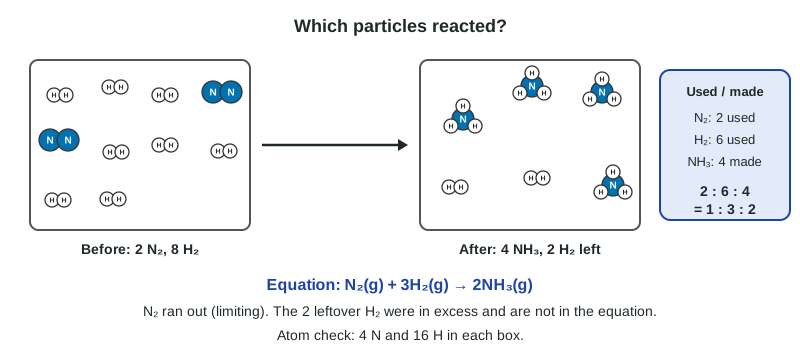
A reaction particle diagram usually has two boxes, before and after. Two rules hold for every correct diagram:
- Atoms are conserved. Every atom in the Before box appears in the After box, in some molecule or ion. Count each element in both boxes; the counts must match.
- The ratio follows the coefficients. The particles that reacted and formed are in the ratio of the balanced equation.
Molecules are not conserved. Atoms regroup, so the number of molecules can go up or down.
Worked example. A Before box holds 2 N₂ and 8 H₂. The After box holds 4 NH₃ and 2 H₂ (Figure 1). Write the equation.
1. Find what changed. N₂: 2 → 0, so 2 used. H₂: 8 → 2, so 6 used. NH₃: 0 → 4, so 4 made.
2. The reacting ratio is 2 : 6 : 4. Divide by 2: 1 : 3 : 2.
3. Equation: N₂(g) + 3H₂(g) → 2NH₃(g).
4. Check atoms in the boxes: before, 2 × 2 = 4 N and 8 × 2 = 16 H; after, 4 × 1 = 4 N and 4 × 3 + 2 × 2 = 16 H.
The two H₂ molecules in the After box did not react, so they are not in the equation. Writing "2N₂ + 8H₂ → 4NH₃ + 2H₂" copies one particular mixture instead of the reacting ratio, and it is the most common error on this kind of item.
Limiting and excess reactants in a picture
Reactants are rarely mixed in exactly the ratio of the equation. The reaction stops when one reactant runs out. That reactant is the limiting reactant: it sets how much product can form. A reactant with particles left over is in excess.
In the diagram above, nitrogen is limiting: both N₂ molecules are used. Hydrogen is in excess: two H₂ remain. Notice that hydrogen started with more molecules than nitrogen, but that is not what decides. Each N₂ needs three H₂, so two N₂ need six H₂, and eight H₂ were more than enough.
Worked example. Particles react by X₂ + 3Y₂ → 2XY₃. A box starts with 5 X₂ and 9 Y₂. What is in the After box?
1. Test one reactant. All 5 X₂ would need 5 × 3 = 15 Y₂; only 9 are present. So Y₂ runs out first: Y₂ is limiting.
2. 9 Y₂ react with 9 ÷ 3 = 3 X₂ and make 9 × (2 ÷ 3) = 6 XY₃.
3. Left over: 5 − 3 = 2 X₂.
4. After box: 6 XY₃ and 2 X₂. Check: 10 X atoms and 18 Y atoms before (5 × 2, 9 × 2), and 6 + 4 = 10 X and 18 Y after.
You will do the same reasoning with moles and grams in topic 4.5; the particle picture is the idea behind every calculation there.
Drawing the diagram yourself
When the exam asks you to draw the products, use this checklist:
- Use the key: the same circle for the same element in both boxes.
- Draw each product with the right formula (CO₂ is one C between two O; an ionic solid is an alternating array, not molecules).
- Draw any excess reactant in the After box, unchanged.
- Match the state: gases spread out, solids packed together, dissolved ions apart from each other.
- Count every element on both sides before you finish.
Common errors in diagrams
A drawing that adds or loses atoms is wrong, however neat. So is one that shows an ionic solid as separate NaCl "molecules", or that leaves no excess when the starting amounts are not in the reacting ratio, or that leaves excess when they are. For example, 4 SO₂ and 2 O₂ are exactly in the 2 : 1 ratio of 2SO₂ + O₂ → 2SO₃, so the After box should hold 4 SO₃ and nothing else.