Burn a candle, rust a nail or bake a cake and you make substances that were not there before. Chemistry calls each of these a reaction and writes it as an equation. This page covers what happens to the particles in a reaction, the evidence that one has happened, and how to write a balanced equation.
What a chemical reaction is
In a chemical reaction, bonds between atoms break and new bonds form. The atoms themselves are not changed: the same carbon, hydrogen and oxygen atoms are present before and after, but they are joined into different substances. The starting substances are the reactants; the new substances are the products.
Take hydrogen burning in oxygen. Before the reaction you have H₂ molecules and O₂ molecules. The H–H and O=O bonds break, and new O–H bonds form, giving water molecules, H₂O. Water has properties neither reactant has: it is a liquid at room temperature and does not burn.
Evidence of a reaction
You cannot see bonds break, so in the lab you look for signs that a new substance has formed:
- a gas forms from liquids or solids at a temperature where nothing should boil (bubbles when baking soda meets vinegar);
- a solid forms when two solutions are mixed;
- a color changes in a way that mixing alone does not explain;
- the temperature rises or falls, or light is given off.
None of these is proof on its own. Boiling water makes bubbles, but the bubbles are still water. Dissolving a salt can warm or cool the water, yet the ions are the same before and after. The real test is a new substance with new properties; the signs are clues to look further.
Writing a balanced equation
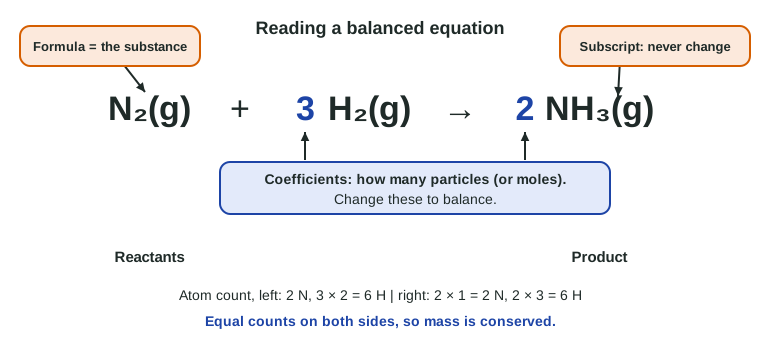
A chemical equation writes the reactants, an arrow, then the products, each as a correct formula (Figure 1). The number in front of a formula is its coefficient. It counts particles: 3H₂ means three hydrogen molecules. Because a mole is just a fixed number of particles, it also counts moles: 3 mol of H₂.
Atoms are rearranged, never created or destroyed, so a correct equation has the same number of each kind of atom on both sides. That is what "balanced" means. You balance by changing coefficients only. The subscripts belong to the formula and say what the substance is: H₂O is water, and H₂O₂ is hydrogen peroxide, a different substance. Changing a subscript to make the atoms fit changes the reaction you are describing.
Worked example. Balance the reaction of aluminum with oxygen gas to make aluminum oxide: Al + O₂ → Al₂O₃.
1. Count atoms. Left: 1 Al, 2 O. Right: 2 Al, 3 O.
2. Start with the element that is hardest to fix, oxygen. It comes in twos on the left and threes on the right. The smallest number both divide into is 6, so write 3O₂ and 2Al₂O₃: Al + 3O₂ → 2Al₂O₃.
3. Now the right has 2 × 2 = 4 Al, so write 4Al: 4Al + 3O₂ → 2Al₂O₃.
4. Check: 4 Al and 6 O on each side. The coefficients 4, 3, 2 share no common factor, so this is the smallest whole-number ratio.
Some tips that save time:
- Leave elements that appear alone (like Al or O₂) until last; they are the easiest to adjust.
- If a polyatomic ion such as NO₃⁻ or SO₄²⁻ appears unchanged on both sides, balance it as one unit.
- If you end with coefficients that can all be divided by the same number, divide. 4H₂ + 2O₂ → 4H₂O balances but should be 2H₂ + O₂ → 2H₂O.
Conservation of mass
Each atom keeps its mass through a reaction, so the total mass of the products equals the total mass of the reactants. This is the law of conservation of mass, and a balanced equation is that law written in symbols.
Worked example. In a closed container, 2.43 g of magnesium reacts completely with 1.60 g of oxygen gas: 2Mg + O₂ → 2MgO. What mass of magnesium oxide forms?
Every atom of magnesium and oxygen ends up in the product, so the masses add: 2.43 g + 1.60 g = 4.03 g of MgO.
Notice what you did not do: you did not multiply by the coefficient 2. Coefficients count particles, not grams.
In an open container the balance can seem to break the law. Baking soda and vinegar in an open flask lose mass, because one product, carbon dioxide gas, floats away. Do the same reaction in a tightly capped plastic bottle, so the gas stays inside, and the reading does not change. When mass seems to vanish, look for a product that escaped; when mass seems to appear (a metal gaining mass as it rusts), look for a reactant that came from the air.
What coefficients do and do not mean
| Scale | What the equation says |
|---|---|
| Particles | 2 molecules of H₂ react with 1 molecule of O₂ to give 2 molecules of H₂O |
| Moles | 2 mol of H₂ react with 1 mol of O₂ to give 2 mol of H₂O |
| Mass | 4.03 g of H₂ react with 32.00 g of O₂ to give 36.03 g of H₂O; not a 2 : 1 : 2 ratio of grams |
The number of molecules can change in a reaction (three molecules become two above), but the number of each kind of atom cannot. Count atoms, not molecules, when you check a balance.