Many reactions happen in water, between dissolved substances. Writing them as whole formulas hides what the particles are really doing. This page shows how to write a reaction the way the particles exist in the solution, and how to strip it down to the species that actually change.
What is really in the beaker
When an ionic compound such as silver nitrate, AgNO₃, dissolves in water, it does not float around as AgNO₃ units. It separates into Ag⁺ ions and NO₃⁻ ions, each surrounded by water molecules. A strong electrolyte separates almost completely, so its solution is a sea of ions.
Now mix silver nitrate solution with sodium chloride solution. The beaker briefly holds four kinds of dissolved ions: Ag⁺, NO₃⁻, Na⁺ and Cl⁻. Silver ions and chloride ions attract each other so strongly that they cannot stay dissolved together. They pack into a white solid, silver chloride. Sodium and nitrate ions stay dissolved, just as they were. An insoluble solid that forms when solutions are mixed is a precipitate.
Three ways to write the same reaction
Molecular equation. Every substance as a whole formula, each with its (s), (l), (g) or (aq) label. It is useful for counting moles, but it hides the ions:
AgNO₃(aq) + NaCl(aq) → AgCl(s) + NaNO₃(aq)
Complete ionic equation. Every dissolved strong electrolyte written as its separate ions. Everything else stays as a formula:
Ag⁺(aq) + NO₃⁻(aq) + Na⁺(aq) + Cl⁻(aq) → AgCl(s) + Na⁺(aq) + NO₃⁻(aq)
Net ionic equation. Na⁺ and NO₃⁻ appear unchanged on both sides. They are spectator ions: present, but not taking part. Cross them out and what remains is the change itself:
Ag⁺(aq) + Cl⁻(aq) → AgCl(s)
The net ionic equation is more general than the molecular one. Mixing silver nitrate with potassium chloride or calcium chloride gives the same white solid, and the same net ionic equation; only the spectators differ.
What to split and what to keep
The rule is simple: write each species the way most of it exists in the solution.
| Species | Write it as | Example |
|---|---|---|
| Soluble ionic compound (aq) | Separate ions | Na₂SO₄(aq) → 2Na⁺(aq) + SO₄²⁻(aq) |
| An acid that ionizes fully in water, such as HCl(aq) | Separate ions | H⁺(aq) + Cl⁻(aq) |
| Solid, including a precipitate | Formula with (s) | AgCl(s), CaCO₃(s) |
| Pure liquid or gas | Formula | H₂O(l), CO₂(g) |
| Weak electrolyte (mostly molecules) | Formula with (aq) | CH₃COOH(aq) |
| Nonelectrolyte | Formula with (aq) | C₆H₁₂O₆(aq) |
Two details trip people up. First, a subscript on a monatomic ion becomes a coefficient: Na₂SO₄ gives two Na⁺ ions, never "Na₂⁺". Second, a polyatomic ion such as sulfate or nitrate stays together; its atoms are joined by covalent bonds that water does not break.
You will need to know which compounds dissolve. The exam gives you that information when it matters (it does not expect you to memorize solubility rules), but two facts are worth knowing: compounds of sodium, potassium and ammonium are soluble, and so are all nitrates.
Balancing atoms and charge
Charge is conserved as well as atoms, so a net ionic equation must have the same total charge on each side.
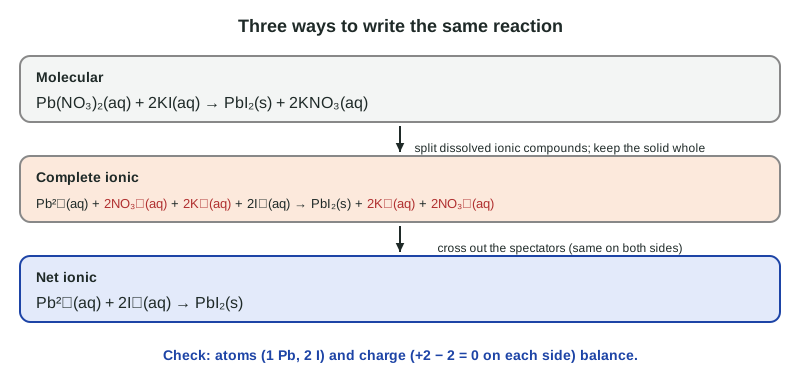
Worked example. Lead(II) nitrate solution is mixed with potassium iodide solution and a yellow solid forms. Write the net ionic equation.
1. Molecular equation: Pb(NO₃)₂(aq) + 2KI(aq) → PbI₂(s) + 2KNO₃(aq). Lead(II) is Pb²⁺, so its iodide is PbI₂, the yellow solid; KNO₃ is soluble.
2. Complete ionic equation: Pb²⁺(aq) + 2NO₃⁻(aq) + 2K⁺(aq) + 2I⁻(aq) → PbI₂(s) + 2K⁺(aq) + 2NO₃⁻(aq).
3. Cross out 2K⁺ and 2NO₃⁻, which are identical on both sides.
4. Net ionic equation: Pb²⁺(aq) + 2I⁻(aq) → PbI₂(s).
5. Check atoms: 1 Pb and 2 I on each side. Check charge: (+2) + 2(−1) = 0 on the left, 0 on the right.
An equation can balance in atoms but not in charge. Zn(s) + Ag⁺(aq) → Zn²⁺(aq) + Ag(s) has one of each atom per side, but a charge of +1 on the left and +2 on the right. Doubling the silver fixes both: Zn(s) + 2Ag⁺(aq) → Zn²⁺(aq) + 2Ag(s).
When there is no reaction
If you mix potassium chloride solution with sodium nitrate solution, every combination of ions (KCl, KNO₃, NaCl, NaNO₃) is soluble. All four ions stay dissolved, so every ion is a spectator. Crossing them all out leaves nothing: no net ionic equation, because there is no reaction. Writing "K⁺(aq) + NO₃⁻(aq) → KNO₃(aq)" is a common slip; KNO₃(aq) is K⁺ and NO₃⁻ in water, so nothing has changed.
A solid that dissolves
A solid can also be a reactant. Chalk, CaCO₃(s), fizzes in hydrochloric acid. The solid stays a formula; HCl is fully ionized, so it is written as H⁺ with Cl⁻ as a spectator:
CaCO₃(s) + 2H⁺(aq) → Ca²⁺(aq) + H₂O(l) + CO₂(g)
Charge check: +2 on the left, +2 on the right.