Suppose you need the concentration of acid in vinegar, or of chloride in seawater. You cannot count the particles, but you can react them with a solution whose concentration you know, and measure exactly how much of that solution it takes. That technique is a titration. It is stoichiometry done with glassware, and the exam tests both the calculation and the lab skills.
The idea
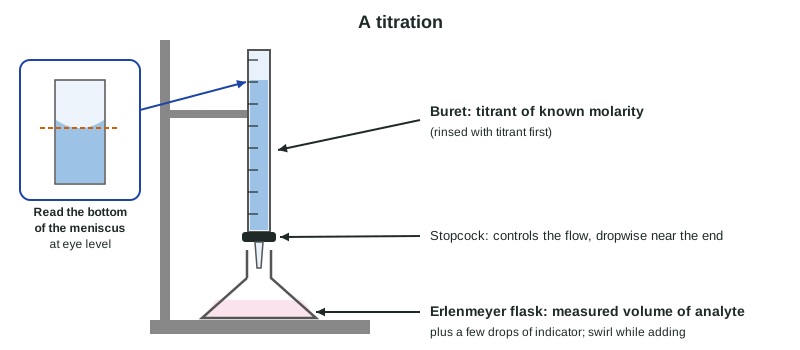
In a titration, a solution of known concentration, the titrant, is added from a buret to a measured amount of the substance you are studying, the analyte (Figure 1). Titrant is added until it has reacted completely with the analyte, in exactly the mole ratio of the balanced equation. That moment is the equivalence point.
At the equivalence point you know two things: the volume of titrant delivered (read from the buret) and its molarity. Their product is the moles of titrant. The mole ratio then gives the moles of analyte.
Seeing the equivalence point: indicators
Most titration reactions give no visible sign when they finish. So a few drops of an indicator are added to the analyte. An indicator changes color when the first slight excess of titrant appears. Phenolphthalein, for example, is colorless while acid is left in the flask and turns pink once a little extra sodium hydroxide is present.
The point where the color changes is the end point. It is what you observe; the equivalence point is what you want. A well-chosen indicator changes color within a drop of the equivalence point, so the two nearly coincide. A faint color that lasts about 30 seconds of swirling marks the end point; a deep color means you have gone past it.
The calculation
The steps are the stoichiometry road map with a buret at the start:
- Volume of titrant (mL) → liters.
- Moles of titrant = molarity × volume in liters.
- Moles of analyte = moles of titrant × mole ratio from the balanced equation.
- Molarity of analyte = moles ÷ volume of analyte in liters (or find mass or percent, as asked).
Worked example. A 5.00 mL sample of vinegar is titrated with 0.1050 M NaOH. The average volume needed is 39.67 mL. CH₃COOH(aq) + OH⁻(aq) → CH₃COO⁻(aq) + H₂O(l). Find the molarity of acetic acid.
Moles of NaOH = 0.1050 mol/L × 0.03967 L = 0.004165 mol.
Mole ratio 1 : 1, so 0.004165 mol CH₃COOH.
Molarity = 0.004165 mol ÷ 0.00500 L = 0.8331 M, which rounds to 0.833 M (three significant figures, set by 5.00 mL).
Always check the mole ratio. Sulfuric acid gives two H⁺ per formula unit, so it needs two NaOH:
Worked example. 25.00 mL of H₂SO₄ needs 31.20 mL of 0.1000 M NaOH. H₂SO₄ + 2NaOH → Na₂SO₄ + 2H₂O. Find the molarity of the H₂SO₄.
Moles of NaOH = 0.1000 mol/L × 0.03120 L = 0.003120 mol.
Moles of H₂SO₄ = 0.003120 mol NaOH × (1 mol H₂SO₄ / 2 mol NaOH) = 0.001560 mol.
Molarity = 0.001560 mol ÷ 0.02500 L = 0.06240 M.
Titrations are not only for acids. Chloride in water can be titrated with silver nitrate, Ag⁺ + Cl⁻ → AgCl(s), and the same four steps apply.
Glassware and technique
Readers of the exam repeatedly mark down vague procedures. Name the glassware and say exactly what you do.
| Job | Use | Why |
|---|---|---|
| Measure the analyte | volumetric pipet (e.g. 25.00 mL) | delivers one volume very precisely |
| Hold the analyte | Erlenmeyer flask | can be swirled without splashing |
| Deliver titrant | buret, read to 0.01 mL | measures any volume delivered |
| Weigh a solid analyte | analytical balance (0.0001 g) | mass becomes moles |
- Rinse the buret with a few milliliters of titrant, then drain, before filling. Water left inside would dilute the titrant, so more volume would be needed and the calculated result would come out too high.
- Run some titrant through the tip to remove the air bubble. A bubble that escapes during the titration is counted as liquid delivered.
- Read the bottom of the meniscus at eye level. The liquid surface curves; its lowest point is the reading. Looking from above or below gives a parallax error.
- Record to 0.01 mL. A 50 mL buret is marked every 0.1 mL, so the hundredths digit is estimated. Remember that buret numbers increase downward.
- The flask does not need to be dry, and water may be added to the analyte or used to rinse the flask walls. Water does not change the moles of analyte.
- Do a rough trial, then repeat carefully until at least three trials agree (within about 0.10 mL). Leave out the rough trial and any outlier when you average.
Worked example. Buret readings: initial 3.46 mL, final 27.81 mL. Volume delivered = 27.81 mL − 3.46 mL = 24.35 mL. Both readings have two decimal places, so the difference does too.
Thinking about errors
To predict how a mistake affects the result, follow it through the calculation. More titrant volume recorded means more moles of titrant calculated, so more analyte calculated. Overshooting the end point, a diluted titrant and a bubble that escapes all raise the recorded volume, so the result comes out too high. Losing analyte (a splash out of the flask) lowers the volume needed and the result comes out too low.