Introduction to Titration
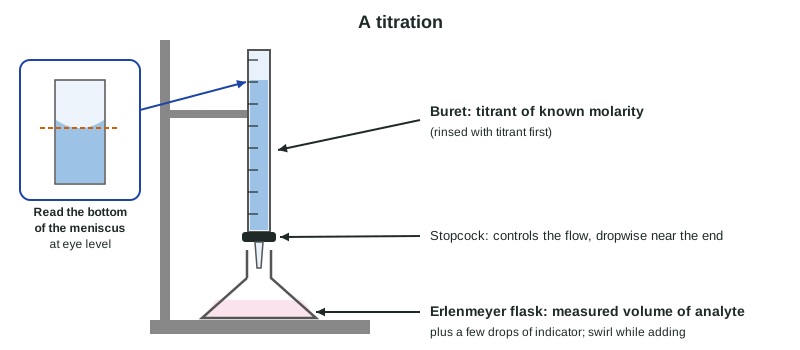
In a titration, a titrant of known concentration is added from a buret until it has reacted with the analyte in the mole ratio, the equivalence point, signaled by an indicator's end point.
Part 1 · Hook
Why this matters
Part 2 · Before you start
What this builds on
Part 3 · Prerequisite check
Quick check before you start
1. How many moles of NaOH are in 25.00 mL of 0.1000 M NaOH?
- 0.002500 mol
- 2.500 mol
- 0.004000 mol
- 0.2500 mol
Show the answer
0.1000 mol/L × 0.02500 L = 0.002500 mol.
- Correct: 0.002500 mol:
- 2.500 mol:
- 0.004000 mol:
- 0.2500 mol:
2. For H₂SO₄ + 2NaOH → Na₂SO₄ + 2H₂O, how many moles of H₂SO₄ react with 0.0040 mol NaOH?
- 0.0020 mol
- 0.0080 mol
- 0.0040 mol
- 0.0010 mol
Show the answer
Use the mole ratio: 0.0040 mol × (1/2) = 0.0020 mol.
- Correct: 0.0020 mol:
- 0.0080 mol:
- 0.0040 mol:
- 0.0010 mol:
3. Which glassware measures a fixed volume such as 10.00 mL most precisely?
- A volumetric pipet
- A beaker
- An Erlenmeyer flask
- A 100 mL graduated cylinder
Show the answer
A volumetric pipet is made to deliver one volume to ±0.02 mL or better.
- Correct: A volumetric pipet:
- A beaker:
- An Erlenmeyer flask:
- A 100 mL graduated cylinder:
Part 4 · See it
See it first
Part 5 · Step by step
How it works, step by step
- Titrant of known concentration is added from a buretthe moles added are known from molarity × volume
- At the equivalence point the reactants have reacted in the mole ratiomoles of analyte follow from moles of titrant and the balanced equation
- An indicator changes color with the first slight excess of titrantthe end point signals the equivalence point
- Volumes are read to 0.01 mL and trials are repeatedthe result is precise, and outlying trials are spotted
Part 6 · Key ideas
Key ideas
- In a titration, the titrant (known concentration) is added from a buret to the analyte (unknown amount).
- At the equivalence point, moles of titrant match the analyte by the mole ratio. The indicator's color change, the end point, signals it.
- Calculation: M × V (in L) of titrant → mole ratio → moles of analyte → ÷ volume of analyte.
- Rinse the buret with titrant, clear the tip, read the bottom of the meniscus at eye level to 0.01 mL, and repeat until trials agree.
Part 7 · Misconception
A common mistake
The wrong idea: Water added to the analyte flask, or left in the flask from rinsing, changes the result, so the flask must be dry.
What actually happens: The titrant reacts with the moles of analyte, and water does not change them. Water in the buret matters, because it dilutes the titrant; water in the flask does not.
Part 8 · Check yourself
Check yourself
Exam-style questions. Anything you miss goes into your review queue.
Data table
Titrating vinegar
A student uses a volumetric pipet to transfer 5.00 mL of vinegar into an Erlenmeyer flask, adds about 20 mL of distilled water and three drops of phenolphthalein, and titrates with 0.1050 M NaOH from a 50 mL buret until a faint pink color lasts for 30 seconds. The reaction is CH₃COOH(aq) + OH⁻(aq) → CH₃COO⁻(aq) + H₂O(l).
| Trial | Initial reading (mL) | Final reading (mL) | Volume of NaOH added (mL) |
|---|---|---|---|
| Rough | 0.15 | 40.60 | 40.45 |
| 1 | 0.50 | 40.17 | 39.67 |
| 2 | 1.22 | 40.90 | 39.68 |
| 3 | 0.85 | 40.51 | 39.66 |
1. What volume of NaOH should the student use in the calculation?
Type a number and its unit.
Show the answer
The rough trial is a quick first run that overshoots; it is not used. Trials 1-3 agree closely: (39.67 + 39.68 + 39.66) mL ÷ 3 = 39.67 mL.
- Answer: 39.67 mL
2. What is the molarity of acetic acid in the vinegar?
Type a number and its unit.
Show the answer
Moles NaOH = 0.1050 mol/L × 0.03967 L = 0.004165 mol. Mole ratio 1 : 1, so 0.004165 mol CH₃COOH. Molarity = 0.004165 mol ÷ 0.00500 L = 0.833 M (three significant figures, from 5.00 mL).
- Answer: 0.833 M
3. Why does adding about 20 mL of distilled water to the flask not affect the result?
- It does not change the moles of acid that the NaOH reacts with
- The water evaporates before the end point is reached
- Water reacts with NaOH in a 1 : 1 ratio, which cancels out
- Its volume is added to the 5.00 mL of vinegar in the calculation
Show the answer
The NaOH needed depends on the moles of acid present, and adding water does not change that number. Only the volume of vinegar pipetted (5.00 mL) enters the calculation, so the water need not be measured precisely.
- Correct: It does not change the moles of acid that the NaOH reacts with: Right: dilution changes concentration, not moles of acid.
- The water evaporates before the end point is reached: The water stays in the flask; it does not need to evaporate to have no effect.
- Water reacts with NaOH in a 1 : 1 ratio, which cancels out: Water does not use up hydroxide; if it did, the extra water would change the result.
- Its volume is added to the 5.00 mL of vinegar in the calculation: The water is not used in the calculation at all; that is why "about 20 mL" is fine.
4. Suppose the student had rinsed the buret with distilled water but not with the NaOH solution before filling it. How would the calculated acid molarity compare with the true value?
- Too high, since more of the diluted NaOH is needed
- Too low, because the diluted NaOH reacts with less of the acid
- No change, because the moles of NaOH in the buret stay the same
- Too low, because water from the buret dilutes the acid in the flask
Show the answer
Water left in the buret dilutes the titrant, so its real concentration is below 0.1050 M. More volume is needed for the same moles of acid. The calculation still uses 0.1050 M, so it counts too many moles of NaOH and the acid molarity comes out too high.
- Correct: Too high, since more of the diluted NaOH is needed: Right: a larger volume times the labeled molarity overstates the moles of base.
- Too low, because the diluted NaOH reacts with less of the acid: The diluted base still reacts with all the acid; it just takes more volume, which raises the calculated result.
- No change, because the moles of NaOH in the buret stay the same: The concentration of the solution in the buret drops, so more volume is used; the calculation uses the label concentration and the larger volume.
- Too low, because water from the buret dilutes the acid in the flask: The water in the buret mixes with the NaOH, not the acid; the effect is a larger titrant volume.
5. In the rough trial the solution turned dark pink. What does this observation indicate?
- The end point was overshot, with excess NaOH added
- The vinegar in that trial was more concentrated than in the others
- The indicator was added too late to change color in time
- The equivalence point was reached exactly, with no excess
Show the answer
A faint pink that lasts shows the first slight excess of NaOH. Dark pink means many drops of excess base were added past that point, which is why the rough trial used 40.45 mL instead of about 39.67 mL.
- Correct: The end point was overshot, with excess NaOH added: Right: the deep color shows a large excess of base.
- The vinegar in that trial was more concentrated than in the others: All trials used the same vinegar, measured with the same pipet.
- The indicator was added too late to change color in time: The indicator was in the flask from the start; it changed color strongly because of the excess base.
- The equivalence point was reached exactly, with no excess: At the end point the color is faint; dark pink means it went well past.
6. A 25.00 mL sample of sulfuric acid is titrated with 0.1000 M NaOH. The end point is reached after 31.20 mL. H₂SO₄(aq) + 2NaOH(aq) → Na₂SO₄(aq) + 2H₂O(l). What is the molarity of the H₂SO₄?
Type a number and its unit.
Show the answer
Moles NaOH = 0.1000 mol/L × 0.03120 L = 0.003120 mol. × (1 mol H₂SO₄ / 2 mol NaOH) = 0.001560 mol H₂SO₄. ÷ 0.02500 L = 0.06240 M.
- Answer: 0.06240 M
Part 9 · Summary
Summary
Part 10 · Up next
What comes next
Part 11 · Connections