Types of Chemical Reactions
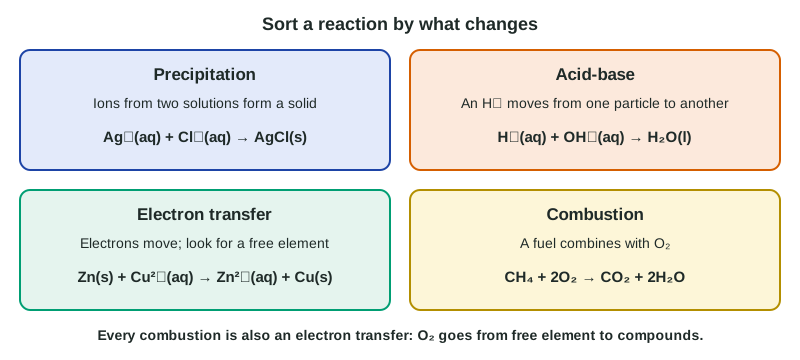
Reactions can be sorted by what changes between particles: ions combining into an insoluble solid (precipitation), an H⁺ moving (acid-base), electrons moving (electron transfer, including every combustion).
Part 1 · Hook
Why this matters
Part 2 · Before you start
What this builds on
Part 3 · Prerequisite check
Quick check before you start
1. Mixing two solutions forms an insoluble solid. What is that solid called?
- A precipitate
- A spectator
- An electrolyte
- A solvent
Show the answer
An insoluble solid formed from solutions is a precipitate.
- Correct: A precipitate:
- A spectator:
- An electrolyte:
- A solvent:
2. What is the charge on a magnesium ion?
- 2+
- 1+
- 2−
- 0
Show the answer
Magnesium is in group 2 and loses its two valence electrons, forming Mg²⁺.
- Correct: 2+:
- 1+:
- 2−:
- 0:
3. Which formula is empirical?
- CH₂O
- C₆H₁₂O₆
- C₂H₄O₂
- H₂O₂
Show the answer
CH₂O has subscripts with no common factor; the others can be divided.
- Correct: CH₂O:
- C₆H₁₂O₆:
- C₂H₄O₂:
- H₂O₂:
Part 4 · See it
See it first
Part 5 · Step by step
How it works, step by step
- Ions from two solutions meet a partner they cannot stay dissolved withan insoluble solid forms: a precipitation reaction
- An H⁺ passes from one particle to anotherthe reaction is an acid-base reaction, such as H⁺ + OH⁻ → H₂O
- An element goes from uncombined to combined, or the reverseelectrons have moved between particles
- A hydrocarbon burns in plenty of oxygenits carbon ends up in CO₂ and its hydrogen in H₂O
Part 6 · Key ideas
Key ideas
- Precipitation reaction: two solutions give an insoluble solid. Acid-base: an H⁺ moves. Electron transfer: electrons move from one particle to another.
- Clue for electron transfer: an element appears uncombined on one side and in a compound on the other.
- Combustion of a hydrocarbon in excess O₂ gives CO₂ and H₂O; with too little O₂, toxic CO can form.
- Older names describe the pattern: synthesis, decomposition reaction, single replacement, double replacement.
Part 7 · Misconception
A common mistake
The wrong idea: Every reaction belongs to exactly one type.
What actually happens: The categories overlap. Every combustion is also an electron-transfer reaction, and magnesium dissolving in acid is both a single replacement and an electron transfer. Classify by what changes between the particles, and name every description that fits.
Part 8 · Check yourself
Check yourself
Exam-style questions. Anything you miss goes into your review queue.
Data table
Five reactions
A student lists five reactions seen in lab.
| Reaction | Equation |
|---|---|
| 1 | Pb(NO₃)₂(aq) + 2NaCl(aq) → PbCl₂(s) + 2NaNO₃(aq) |
| 2 | Mg(s) + 2HCl(aq) → MgCl₂(aq) + H₂(g) |
| 3 | HNO₃(aq) + KOH(aq) → KNO₃(aq) + H₂O(l) |
| 4 | C₂H₅OH(l) + 3O₂(g) → 2CO₂(g) + 3H₂O(g) |
| 5 | 2H₂O₂(aq) → 2H₂O(l) + O₂(g) |
1. Which reaction is a precipitation reaction?
- Reaction 1
- Reaction 2
- Reaction 3
- Reaction 5
Show the answer
In reaction 1 two solutions are mixed and an insoluble solid, PbCl₂(s), forms from ions that were dissolved.
- Correct: Reaction 1: Right: two solutions give an insoluble solid.
- Reaction 2: Reaction 2 makes a gas from a metal and acid; no solid forms from the solutions.
- Reaction 3: Reaction 3 makes water and a soluble salt; every product stays dissolved or is liquid water.
- Reaction 5: Reaction 5 is one substance breaking into two; no solid forms.
2. In which reactions are electrons transferred? Select all that apply. (Hint: look for an element that is uncombined on one side and part of a compound on the other.)
- Reaction 1
- Reaction 2
- Reaction 3
- Reaction 5
Show the answer
Reaction 2: Mg metal becomes Mg²⁺ and H⁺ becomes H₂. Reaction 5: oxygen in H₂O₂ ends up partly as O₂. In reactions 1 and 3, every ion keeps its charge; ions change partners or an H⁺ moves. (Reaction 4, a combustion, also transfers electrons.)
- Reaction 1: In reaction 1 the ions Pb²⁺, NO₃⁻, Na⁺ and Cl⁻ keep their charges; they only change partners, so no electrons move.
- Correct: Reaction 2: Right: neutral Mg atoms become Mg²⁺ ions and H⁺ ions become neutral H₂.
- Reaction 3: In reaction 3 an H⁺ moves from HNO₃ to OH⁻; no element changes from uncombined to combined, so no electrons move.
- Correct: Reaction 5: Right: some oxygen leaves the compound as the element O₂.
3. Which is the net ionic equation for reaction 3?
- H⁺(aq) + OH⁻(aq) → H₂O(l)
- K⁺(aq) + NO₃⁻(aq) → KNO₃(aq)
- HNO₃(aq) + OH⁻(aq) → NO₃⁻(aq) + H₂O(l) + K⁺(aq)
- H⁺(aq) + KOH(aq) → K⁺(aq) + H₂O(l)
Show the answer
HNO₃ and KOH are fully ionized in water, and K⁺ and NO₃⁻ are spectators. What changes is an H⁺ joining an OH⁻ to make water: the acid-base reaction in its simplest form.
- Correct: H⁺(aq) + OH⁻(aq) → H₂O(l): Right: only H⁺ and OH⁻ change.
- K⁺(aq) + NO₃⁻(aq) → KNO₃(aq): KNO₃(aq) is just the spectator ions dissolved; nothing changes there.
- HNO₃(aq) + OH⁻(aq) → NO₃⁻(aq) + H₂O(l) + K⁺(aq): Unbalanced (K⁺ appears from nowhere) and it keeps a spectator.
- H⁺(aq) + KOH(aq) → K⁺(aq) + H₂O(l): KOH is a soluble ionic compound, so it is written as K⁺ and OH⁻, and K⁺ is a spectator.
4. Reaction 4 is a combustion. Which statement best explains why it is also an electron-transfer reaction?
- O₂, an uncombined element, ends up combined in CO₂ and H₂O
- It gives off heat and light, which shows that electrons moved
- It produces gases, which carry electrons away from the flame
- Ethanol already holds oxygen, which passes to the CO₂ formed
Show the answer
Use the clue for electron transfer: an element uncombined on one side and combined on the other. Oxygen is the free element O₂ before and part of the compounds CO₂ and H₂O after, so electrons have moved. That is true of every combustion.
- Correct: O₂, an uncombined element, ends up combined in CO₂ and H₂O: Right: oxygen goes from the free element to compounds, so electrons move.
- It gives off heat and light, which shows that electrons moved: Many processes give off heat without electron transfer, such as an acid neutralizing a base; heat and light are not the test.
- It produces gases, which carry electrons away from the flame: Forming a gas says nothing about electrons; reaction 2 makes a gas by electron transfer, but boiling makes gas with none.
- Ethanol already holds oxygen, which passes to the CO₂ formed: Oxygen already in ethanol stays combined; the clue is the O₂ that starts uncombined.
Particle view
Magnesium in hydrochloric acid
Key: green Mg, magnesium atom (in the strip) or Mg²⁺ ion (labeled 2+); small white H with +, H⁺ ion; green Cl with −, chloride ion; two joined white H, H₂ molecule. Water molecules are not drawn.
5. Which net ionic equation matches the diagram?
- Mg(s) + 2H⁺(aq) → Mg²⁺(aq) + H₂(g)
- Mg(s) + 2HCl(aq) → MgCl₂(aq) + H₂(g)
- Mg(s) + H⁺(aq) → Mg²⁺(aq) + H(g)
- Mg²⁺(aq) + 2Cl⁻(aq) → MgCl₂(s)
Show the answer
Two Mg atoms and four H⁺ ions were used; two Mg²⁺ ions and two H₂ molecules formed. That is a 1 : 2 : 1 : 1 ratio. Cl⁻ is unchanged (4 before, 4 after), so it is a spectator.
- Correct: Mg(s) + 2H⁺(aq) → Mg²⁺(aq) + H₂(g): Right: atoms and charge balance (+2 each side) and Cl⁻ is left out.
- Mg(s) + 2HCl(aq) → MgCl₂(aq) + H₂(g): This is the molecular equation; it keeps the spectator chloride ions.
- Mg(s) + H⁺(aq) → Mg²⁺(aq) + H(g): Unbalanced in atoms and charge, and hydrogen forms H₂ molecules, not single atoms.
- Mg²⁺(aq) + 2Cl⁻(aq) → MgCl₂(s): No solid MgCl₂ forms; the Mg²⁺ and Cl⁻ ions stay dissolved in the After box.
6. Which reactant was limiting in this mixture?
- H⁺, because none is left while some magnesium remains
- Mg, because there were fewer Mg atoms than H⁺ ions
- Cl⁻, because it does not appear in the equation
- Mg, because one atom remains in the strip
Show the answer
H⁺ ran out (4 before, 0 after). One Mg atom is left, so magnesium was in excess.
- Correct: H⁺, because none is left while some magnesium remains: Right: the reactant used up is H⁺.
- Mg, because there were fewer Mg atoms than H⁺ ions: Fewer particles does not mean limiting: each Mg needs two H⁺, and H⁺ ran out first.
- Cl⁻, because it does not appear in the equation: A spectator ion is not a reactant, so it cannot be limiting.
- Mg, because one atom remains in the strip: A reactant that is left over is in excess, not limiting.
Part 9 · Summary
Summary
Part 10 · Up next
What comes next
Part 11 · Connections