Introduction to Acid-Base Reactions
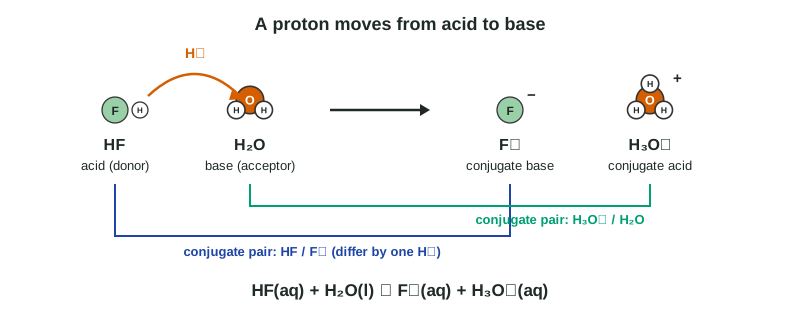
In a Brønsted-Lowry acid-base reaction, a proton (H⁺) moves from the acid to the base.
Part 1 · Hook
Why this matters
Part 2 · Before you start
What this builds on
Part 3 · Prerequisite check
Quick check before you start
1. What is left when a hydrogen atom loses its electron?
- A proton
- A neutron
- An electron
- A hydride ion
Show the answer
A hydrogen atom is one proton and one electron, so H⁺ is just a proton.
- Correct: A proton:
- A neutron:
- An electron:
- A hydride ion:
2. Which part of a water molecule carries a partial negative charge and lone pairs?
- The oxygen atom
- The hydrogen atoms
- The O–H bonds equally
- Neither part
Show the answer
Oxygen is more electronegative and has two lone pairs.
- Correct: The oxygen atom:
- The hydrogen atoms:
- The O–H bonds equally:
- Neither part:
3. In H⁺(aq) + OH⁻(aq) → H₂O(l), what kind of reaction is shown?
- Acid-base
- Precipitation
- Combustion
- Decomposition
Show the answer
An H⁺ moves to OH⁻ to form water.
- Correct: Acid-base:
- Precipitation:
- Combustion:
- Decomposition:
Part 4 · See it
See it first
Part 5 · Step by step
How it works, step by step
- A Brønsted-Lowry acid gives up an H⁺ (a proton)what remains is its conjugate base, with one less H and one less + charge
- A Brønsted-Lowry base uses a lone pair to accept the H⁺it becomes its conjugate acid, with one more H and one more + charge
- Water has both O–H bonds and lone pairs on oxygenit can act as an acid or a base: it is amphoteric
- A bare proton bonds at once to a water moleculeacid in water gives hydronium ions, H₃O⁺
Part 6 · Key ideas
Key ideas
- A Brønsted-Lowry acid is a proton donor; a Brønsted-Lowry base is a proton acceptor (it needs a lone pair).
- A conjugate acid-base pair differs by exactly one H⁺: HF/F⁻, NH₄⁺/NH₃, H₂O/OH⁻, H₃O⁺/H₂O.
- Amphoteric species such as H₂O and HCO₃⁻ can donate or accept a proton.
- In water, H⁺ is carried as hydronium, H₃O⁺. Neutralization: H⁺ + OH⁻ → H₂O.
Part 7 · Misconception
A common mistake
The wrong idea: An acid is anything with H in its formula, and a base is anything with OH.
What actually happens: Acid and base describe what a particle does in a reaction. Methane has H but gives up no protons; ammonia has no OH but accepts a proton. Look for the H⁺ that moves.
Part 8 · Check yourself
Check yourself
Exam-style questions. Anything you miss goes into your review queue.
Model
Four proton transfers
Each equation shows a proton (H⁺) moving from one particle to another.
| Reaction | Equation |
|---|---|
| 1 | HF(aq) + H₂O(l) ⇌ F⁻(aq) + H₃O⁺(aq) |
| 2 | NH₃(aq) + H₂O(l) ⇌ NH₄⁺(aq) + OH⁻(aq) |
| 3 | HCO₃⁻(aq) + OH⁻(aq) → CO₃²⁻(aq) + H₂O(l) |
| 4 | CH₃COOH(aq) + NH₃(aq) → CH₃COO⁻(aq) + NH₄⁺(aq) |
The double arrow (⇌) means the products also react to re-form the reactants, which you will study in Unit 7.
1. In reaction 2, which species acts as the Brønsted-Lowry acid?
- H₂O
- NH₃
- NH₄⁺
- OH⁻
Show the answer
Water gives up an H⁺ (becoming OH⁻) and ammonia accepts it (becoming NH₄⁺). The proton donor on the reactant side is water.
- Correct: H₂O: Right: water donates the proton and becomes OH⁻.
- NH₃: Ammonia gains an H⁺, so it is the base (proton acceptor).
- NH₄⁺: NH₄⁺ is a product: the conjugate acid formed when ammonia accepts the proton.
- OH⁻: OH⁻ is a product: what is left of water after it donates a proton.
2. In which reactions does water act as a base? Select all that apply.
- Reaction 1
- Reaction 2
- Reaction 3
- Reaction 4
Show the answer
In reaction 1, water accepts the proton from HF and becomes H₃O⁺, so it is a base there. In reaction 2 water donates a proton (acid). In reaction 3 water is a product, and in reaction 4 it does not appear.
- Correct: Reaction 1: Right: water accepts H⁺ from HF and becomes hydronium.
- Reaction 2: In reaction 2 water gives an H⁺ to ammonia, so it is the acid.
- Reaction 3: Water is formed in reaction 3 (when OH⁻ gains a proton); it is not a reactant there.
- Reaction 4: Water is not one of the reacting species in reaction 4.
3. In reaction 3, what is the conjugate base of HCO₃⁻?
- CO₃²⁻
- H₂CO₃
- OH⁻
- H₂O
Show the answer
Remove one H⁺ from HCO₃⁻ and you get CO₃²⁻; the charge drops by one. They differ by exactly one proton, so they are a conjugate pair.
- Correct: CO₃²⁻: Right: HCO₃⁻ minus H⁺ is CO₃²⁻.
- H₂CO₃: H₂CO₃ has one more H⁺, so it is the conjugate acid of HCO₃⁻.
- OH⁻: OH⁻ is the base that takes the proton; its conjugate acid is H₂O.
- H₂O: Water is the conjugate acid of OH⁻, not related to HCO₃⁻ by one proton.
4. HCO₃⁻ appears in reaction 3. Which statement about it is supported by its behavior?
- It can donate or accept a proton, so it is amphoteric
- It is a base, because it carries a negative charge
- It is an acid and not a base, as it has an H to give
- It is a spectator, because it keeps its carbon atom
Show the answer
In reaction 3 HCO₃⁻ donates a proton to OH⁻. It also has a site to accept one (giving H₂CO₃). A species that can do either is amphoteric, like water.
- Correct: It can donate or accept a proton, so it is amphoteric: Right: it can donate or accept a proton.
- It is a base, because it carries a negative charge: A negative charge does not decide; in reaction 3 HCO₃⁻ donates a proton, acting as an acid.
- It is an acid and not a base, as it has an H to give: It does have an H to give, but it can also accept a proton on an oxygen lone pair, forming H₂CO₃.
- It is a spectator, because it keeps its carbon atom: It changes (it loses H⁺), so it is not a spectator.
5. Which pair is a conjugate acid-base pair in reaction 4?
- NH₃ and NH₄⁺
- CH₃COOH and NH₃
- CH₃COO⁻ and NH₄⁺
- CH₃COOH and NH₄⁺
Show the answer
A conjugate pair differs by one H⁺. NH₃ gains a proton to become NH₄⁺. The other pair is CH₃COOH and CH₃COO⁻.
- Correct: NH₃ and NH₄⁺: Right: they differ by exactly one H⁺.
- CH₃COOH and NH₃: These are the acid and base that react with each other, not a conjugate pair.
- CH₃COO⁻ and NH₄⁺: These are the two products: the conjugate base of one pair and the conjugate acid of the other.
- CH₃COOH and NH₄⁺: Both are proton donors from different pairs; they do not differ by one H⁺.
Particle view
A gas dissolves in water
Key: green Cl, chlorine atom or chloride ion (marked −); red O with white H, water-derived species; + and − mark ion charges. Water molecules that do not react are not drawn.
6. Which equation describes what the diagram shows?
- HCl(g) + H₂O(l) → H₃O⁺(aq) + Cl⁻(aq)
- HCl(g) → H(g) + Cl(g)
- HCl(g) + H₂O(l) → H₂(g) + HOCl(aq)
- HCl(g) → HCl(aq), with no other change
Show the answer
Each HCl molecule gives its H⁺ to a water molecule. The diagram shows only H₃O⁺ and Cl⁻ afterward, with no HCl molecules left.
- Correct: HCl(g) + H₂O(l) → H₃O⁺(aq) + Cl⁻(aq): Right: a proton moves from HCl to water.
- HCl(g) → H(g) + Cl(g): The diagram shows ions, not neutral H and Cl atoms.
- HCl(g) + H₂O(l) → H₂(g) + HOCl(aq): No hydrogen gas forms; the H ends up in hydronium.
- HCl(g) → HCl(aq), with no other change: If HCl simply dissolved, the right box would show HCl molecules, but it shows none.
Part 9 · Summary
Summary
Part 10 · Up next
What comes next
Part 11 · Connections