Oxidation-Reduction (Redox) Reactions
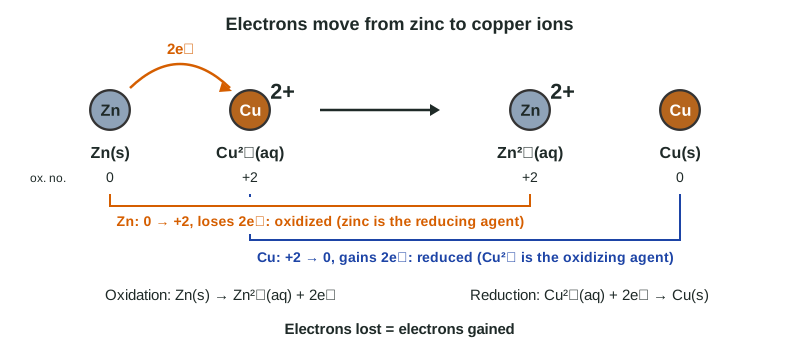
In a redox reaction electrons move from the species oxidized (oxidation number rises) to the species reduced (oxidation number falls).
Part 1 · Hook
Why this matters
Part 2 · Before you start
What this builds on
Part 3 · Prerequisite check
Quick check before you start
1. How many valence electrons does a neutral zinc atom lose to form Zn²⁺?
- 2
- 1
- 0
- 3
Show the answer
The 2+ charge means two more protons than electrons: two electrons were lost.
- Correct: 2:
- 1:
- 0:
- 3:
2. In which reaction do electrons move from one particle to another?
- Zn(s) + Cu²⁺(aq) → Zn²⁺(aq) + Cu(s)
- H⁺(aq) + OH⁻(aq) → H₂O(l)
- Ag⁺(aq) + Cl⁻(aq) → AgCl(s)
- H₂O(s) → H₂O(l)
Show the answer
Zinc atoms become ions and copper ions become atoms: electrons moved from zinc to copper.
- Correct: Zn(s) + Cu²⁺(aq) → Zn²⁺(aq) + Cu(s):
- H⁺(aq) + OH⁻(aq) → H₂O(l):
- Ag⁺(aq) + Cl⁻(aq) → AgCl(s):
- H₂O(s) → H₂O(l):
3. Which element is more electronegative, O or H?
- O
- H
- They are equal
- It depends on the compound
Show the answer
Oxygen has a much larger effective nuclear charge acting on its valence electrons.
- Correct: O:
- H:
- They are equal:
- It depends on the compound:
Part 4 · See it
See it first
Part 5 · Step by step
How it works, step by step
- One substance gives up electrons and another takes themoxidation and reduction always happen together
- Oxidation numbers track electrons as if every bond were ionica rise shows oxidation and a fall shows reduction
- The species that takes electrons causes the other to be oxidizedthe oxidizing agent is the species reduced, and the reducing agent is the one oxidized
- Electrons are neither created nor destroyedhalf-reactions are multiplied so electrons lost equal electrons gained
Part 6 · Key ideas
Key ideas
- Oxidation is loss of electrons (oxidation number goes up); reduction is gain (it goes down).
- Assign an oxidation number: elements 0; monatomic ions = charge; O usually −2; H usually +1; the sum equals the charge.
- The oxidizing agent is reduced; the reducing agent is oxidized.
- Write each half-reaction, multiply so electrons lost = electrons gained, add, and check atoms and charge.
Part 7 · Misconception
A common mistake
The wrong idea: Oxidation means a reaction with oxygen, and the oxidizing agent is the substance that is oxidized.
What actually happens: Oxidation is loss of electrons, with or without oxygen (Zn + Cu²⁺ has none). The oxidizing agent takes electrons, so it is the species that is reduced.
Part 8 · Check yourself
Check yourself
Exam-style questions. Anything you miss goes into your review queue.
Data table
Metals in metal-ion solutions
A student places a clean strip of each metal into 1 M solutions of the nitrates of the other metals and watches for a coating or other change after 10 minutes. Nitrate ions take no part in any of the reactions.
| Metal strip | Cu²⁺(aq) | Zn²⁺(aq) | Ag⁺(aq) | Mg²⁺(aq) |
|---|---|---|---|---|
| Cu | – | ✓ (silver-gray) | – | |
| Zn | ✓ (red-brown) | ✓ (silver-gray) | – | |
| Ag | – | – | – | |
| Mg | ✓ (red-brown) | ✓ (gray) | ✓ (silver-gray) |
1. Which balanced net ionic equation describes the copper strip in the Ag⁺ solution?
- Cu(s) + 2Ag⁺(aq) → Cu²⁺(aq) + 2Ag(s)
- Cu(s) + Ag⁺(aq) → Cu²⁺(aq) + Ag(s)
- Cu²⁺(aq) + 2Ag(s) → Cu(s) + 2Ag⁺(aq)
- Cu(s) + 2Ag⁺(aq) → Cu²⁺(aq) + Ag₂(s)
Show the answer
Copper atoms lose 2 electrons each (Cu → Cu²⁺ + 2e⁻) and each Ag⁺ gains 1 (Ag⁺ + e⁻ → Ag). Two Ag⁺ are needed per Cu so electrons lost equal electrons gained; charge is +2 on both sides.
- Correct: Cu(s) + 2Ag⁺(aq) → Cu²⁺(aq) + 2Ag(s): Right: 2 electrons lost and 2 gained; atoms and charge balance.
- Cu(s) + Ag⁺(aq) → Cu²⁺(aq) + Ag(s): Atoms balance, but charge does not (+1 left, +2 right): electrons lost (2) do not equal electrons gained (1).
- Cu²⁺(aq) + 2Ag(s) → Cu(s) + 2Ag⁺(aq): This is the reverse; the table shows silver metal does not react with Cu²⁺.
- Cu(s) + 2Ag⁺(aq) → Cu²⁺(aq) + Ag₂(s): Silver metal is written as Ag(s); it does not form Ag₂ units.
2. Based on the table, which metal loses electrons most readily?
- Mg
- Zn
- Cu
- Ag
Show the answer
Magnesium reacts with every other metal ion, so it gives electrons to all of them. Silver reacts with none, so it gives up electrons least readily. Order: Mg > Zn > Cu > Ag.
- Correct: Mg: Right: Mg gives electrons to Cu²⁺, Zn²⁺ and Ag⁺.
- Zn: Zinc reacts with Cu²⁺ and Ag⁺ but not Mg²⁺, so magnesium gives up electrons more readily.
- Cu: Copper reacts only with Ag⁺.
- Ag: Silver reacts with none of the solutions, so it loses electrons least readily.
3. In the reaction of zinc metal with Cu²⁺(aq), which species is the oxidizing agent?
- Cu²⁺
- Zn
- Zn²⁺
- Cu
Show the answer
Cu²⁺ gains electrons (it is reduced to Cu), and by taking electrons it causes zinc to be oxidized. The species that is reduced is the oxidizing agent.
- Correct: Cu²⁺: Right: Cu²⁺ is reduced, so it is the oxidizing agent.
- Zn: Zinc loses electrons; it is oxidized, so it is the reducing agent.
- Zn²⁺: Zn²⁺ is a product, formed when zinc is oxidized.
- Cu: Copper metal is a product, formed when Cu²⁺ is reduced.
Data table
A redox titration
A student pipets 25.00 mL of an acidified Fe²⁺ solution into a flask and titrates it with 0.02000 M KMnO₄. The purple MnO₄⁻ ion is reduced to nearly colorless Mn²⁺, so the first lasting pale pink color marks the end point; no separate indicator is needed. The balanced net ionic equation is
MnO₄⁻(aq) + 5Fe²⁺(aq) + 8H⁺(aq) → Mn²⁺(aq) + 5Fe³⁺(aq) + 4H₂O(l)
| Trial | Volume of 0.02000 M KMnO₄ (mL) |
|---|---|
| 1 | 21.63 |
| 2 | 21.66 |
| 3 | 21.61 |
4. What is the oxidation number of manganese in MnO₄⁻?
Type a number.
Show the answer
Oxygen is −2, so 4 O contribute −8. The sum must equal the ion's charge, −1: Mn + (−8) = −1, so Mn = +7.
- Answer: 7
5. How many electrons does each MnO₄⁻ ion gain in this reaction?
- 5, because Mn goes from +7 to +2
- 7, because Mn starts at +7
- 2, because Mn ends as Mn²⁺
- 1, because the ion has a 1− charge
Show the answer
The oxidation number of Mn falls from +7 to +2, a gain of 5 electrons. That matches the 5 Fe²⁺ each losing 1 electron (Fe²⁺ → Fe³⁺).
- Correct: 5, because Mn goes from +7 to +2: Right: +7 to +2 is a change of 5.
- 7, because Mn starts at +7: Uses the starting oxidation number alone; the change is what counts.
- 2, because Mn ends as Mn²⁺: Uses the final oxidation number alone; the change is 7 − 2.
- 1, because the ion has a 1− charge: The charge of the ion is not the number of electrons transferred.
6. Using the average of the three trials, what is the molarity of Fe²⁺ in the sample?
Type a number and its unit.
Show the answer
Average volume = (21.63 + 21.66 + 21.61) mL ÷ 3 = 21.63 mL. Moles MnO₄⁻ = 0.02000 mol/L × 0.02163 L = 4.326 × 10⁻⁴ mol. Moles Fe²⁺ = 5 × 4.326 × 10⁻⁴ = 2.163 × 10⁻³ mol. Molarity = 2.163 × 10⁻³ mol ÷ 0.02500 L = 0.08652 M.
- Answer: 0.08652 M
Part 9 · Summary
Summary
Part 10 · Up next
What comes next
Part 11 · Connections