Reaction Rates
A reaction rate is the change in concentration of a reactant or product per unit time, in M/s.
Part 1 · Hook
Why this matters
Part 2 · Before you start
What this builds on
Part 3 · Prerequisite check
Quick check before you start
1. In 2 H₂ + O₂ → 2 H₂O, how many moles of water form from 3.0 mol of O₂ with excess H₂?
- 6.0 mol
- 3.0 mol
- 1.5 mol
- 9.0 mol
Show the answer
The mole ratio is 2 mol H₂O per 1 mol O₂: 3.0 mol × 2 = 6.0 mol.
- Correct: 6.0 mol:
- 3.0 mol:
- 1.5 mol:
- 9.0 mol:
2. What is the molarity of 0.50 mol of solute in 0.250 L of solution?
- 2.0 M
- 0.13 M
- 0.50 M
- 0.25 M
Show the answer
Molarity = moles ÷ liters = 0.50 mol ÷ 0.250 L = 2.0 M.
- Correct: 2.0 M:
- 0.13 M:
- 0.50 M:
- 0.25 M:
Part 4 · See it
See it first
Part 5 · Step by step
How it works, step by step
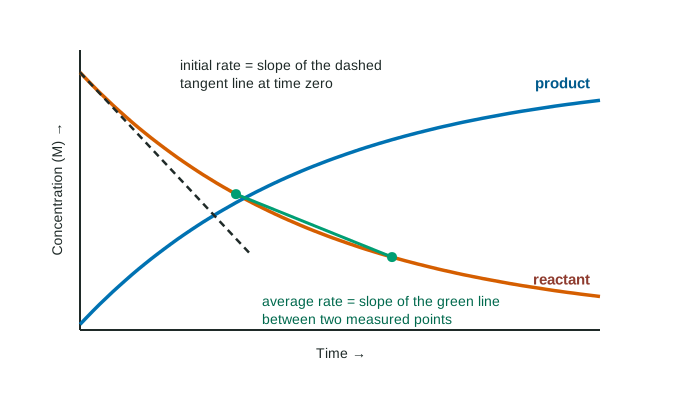
- Reactant particles are used up as the reaction runsthe reactant concentration falls and the product concentration rises
- Fewer reactant particles remain in each literfewer react each second, so the curve flattens and the rate falls
- The balanced equation fixes how many of each particle react togetherthe rates of different substances are linked by their coefficients
- Higher concentration, temperature or surface area make particles meet more often or with more energythe reaction goes faster, but the amount of product is still set by the limiting reactant
Part 6 · Key ideas
Key ideas
- A reaction rate is the change in concentration per unit time, in M/s. Reactant rates carry a minus sign so they come out positive.
- Average rate is the slope between two points; instantaneous rate is the slope of the tangent at one time; initial rate is the tangent at t = 0.
- Divide each substance's rate by its coefficient to get one rate for the reaction.
- Rate is how fast product forms. The amount of product is set by the limiting reactant.
- Higher concentration, higher temperature and more surface area make a reaction faster.
Part 7 · Misconception
A common mistake
The wrong idea: A faster reaction makes more product.
What actually happens: A faster reaction reaches the end sooner. The amount of product is fixed by the limiting reactant and the balanced equation.
Part 8 · Check yourself
Check yourself
Exam-style questions. Anything you miss goes into your review queue.
Data table
Breaking down dinitrogen pentoxide
Dinitrogen pentoxide gas breaks down in a sealed flask at constant temperature:
2 N₂O₅(g) → 4 NO₂(g) + O₂(g)
A student measures the concentration of N₂O₅ every 100 seconds.
| Time (s) | [N₂O₅] (M) |
|---|---|
| 0 | 0.200 |
| 100 | 0.164 |
| 200 | 0.134 |
| 300 | 0.110 |
| 400 | 0.0899 |
1. What is the average rate of disappearance of N₂O₅ from 0 s to 200 s? Include units.
Type a number and its unit.
Show the answer
Average rate = −Δ[N₂O₅]/Δt = −(0.134 M − 0.200 M)/(200 s − 0 s) = 0.066 M / 200 s = 3.3 × 10⁻⁴ M/s. The difference 0.066 M has two significant figures, so the rate does too.
- Answer: 3.3 × 10⁻⁴ M/s
2. Over the same interval, 0 s to 200 s, what is the average rate of appearance of NO₂? Include units.
Type a number and its unit.
Show the answer
Each 2 mol of N₂O₅ that react make 4 mol of NO₂, so NO₂ appears 4/2 = 2 times as fast as N₂O₅ disappears: 2 × 3.3 × 10⁻⁴ M/s = 6.6 × 10⁻⁴ M/s.
- Answer: 6.6 × 10⁻⁴ M/s
3. At the moment N₂O₅ is disappearing at 2.4 × 10⁻⁴ M/s, how fast is O₂ appearing?
- 1.2 × 10⁻⁴ M/s
- 2.4 × 10⁻⁴ M/s
- 4.8 × 10⁻⁴ M/s
- 9.6 × 10⁻⁴ M/s
Show the answer
One O₂ forms for every 2 N₂O₅ used, so O₂ appears half as fast: 2.4 × 10⁻⁴ M/s ÷ 2 = 1.2 × 10⁻⁴ M/s.
- Correct: 1.2 × 10⁻⁴ M/s: Right: the 1 : 2 ratio of the coefficients halves the rate.
- 2.4 × 10⁻⁴ M/s: This treats every species as changing at the same rate, ignoring the coefficients.
- 4.8 × 10⁻⁴ M/s: This multiplies by 2, as if O₂ had the larger coefficient. It has the smaller one (1 vs 2).
- 9.6 × 10⁻⁴ M/s: This is the rate for NO₂ (4 per 2 N₂O₅), not for O₂.
Graph
Marble chips and marble powder in acid
A student drops 0.33 g of calcium carbonate into 50.0 mL of 1.0 M hydrochloric acid, which is in excess, and collects the carbon dioxide gas formed:
CaCO₃(s) + 2 HCl(aq) → CaCl₂(aq) + H₂O(l) + CO₂(g)
Trial 1 uses a few large marble chips; trial 2 uses the same mass of powdered marble. Everything else is the same.
Trial 1: chipsTrial 2: powder
Data table
| Time (s) | Trial 1: chips | Trial 2: powder |
|---|---|---|
| 0 | 0 | 0 |
| 15 | 25 | 57 |
| 30 | 42 | 73 |
| 60 | 62 | 79 |
| 90 | 72 | 80 |
| 120 | 76 | 80 |
| 180 | 79 | 80 |
| 240 | 80 | 80 |
| 300 | 80 | 80 |
4. Both trials end at the same volume of CO₂. Which statement best explains why?
- The same mass of CaCO₃, the limiting reactant, reacted in each trial
- The acid ran out at the same moment in both trials
- The powder reacted faster, so it should have made more gas, but some gas escaped
- The rate of a reaction and the amount of product it makes are the same thing
Show the answer
The acid is in excess, so CaCO₃ is the limiting reactant. 0.33 g of CaCO₃ (about 0.0033 mol) makes the same amount of CO₂ however fast it reacts. Rate is how fast product forms; the amount is set by stoichiometry.
- Correct: The same mass of CaCO₃, the limiting reactant, reacted in each trial: Right: rate changes how quickly you get there, not how much you get.
- The acid ran out at the same moment in both trials: The stem says the acid is in excess, so it does not run out; the marble does.
- The powder reacted faster, so it should have made more gas, but some gas escaped: A faster reaction does not make more product. Nothing in the data shows gas escaping.
- The rate of a reaction and the amount of product it makes are the same thing: This is the mix-up the question targets: rate is amount per unit time; the final amount is set by the limiting reactant.
5. In the reaction N₂(g) + 3 H₂(g) → 2 NH₃(g), hydrogen is used up at 0.090 M/s. At what rate, in M/s, does ammonia form?
Type a number in M/s.
Show the answer
Δ[NH₃]/Δt = (2 mol NH₃ / 3 mol H₂) × 0.090 M/s = 0.060 M/s.
- Answer: 0.060 M/s
6. For 2 N₂O(g) → 2 N₂(g) + O₂(g), which expression gives the same rate whichever substance is measured?
- −½ Δ[N₂O]/Δt = ½ Δ[N₂]/Δt = Δ[O₂]/Δt
- −2 Δ[N₂O]/Δt = 2 Δ[N₂]/Δt = Δ[O₂]/Δt
- Δ[N₂O]/Δt = Δ[N₂]/Δt = Δ[O₂]/Δt
- −½ Δ[N₂O]/Δt = −½ Δ[N₂]/Δt = Δ[O₂]/Δt
Show the answer
Divide each rate by its coefficient, and put a minus sign on reactants so the rate is positive: −½ Δ[N₂O]/Δt = ½ Δ[N₂]/Δt = Δ[O₂]/Δt.
- Correct: −½ Δ[N₂O]/Δt = ½ Δ[N₂]/Δt = Δ[O₂]/Δt: Right: each change divided by its coefficient, with a minus sign for the reactant.
- −2 Δ[N₂O]/Δt = 2 Δ[N₂]/Δt = Δ[O₂]/Δt: Multiplying by the coefficients makes the fastest-changing species look even faster; you divide instead.
- Δ[N₂O]/Δt = Δ[N₂]/Δt = Δ[O₂]/Δt: This ignores the coefficients and the sign: N₂O falls while the others rise, and O₂ changes half as fast.
- −½ Δ[N₂O]/Δt = −½ Δ[N₂]/Δt = Δ[O₂]/Δt: N₂ is a product, so its concentration rises; a minus sign would make its rate negative.
Part 9 · Summary
Summary
Part 10 · Up next
What comes next
Part 11 · Connections