Topics 5.1 to 5.4 described how fast reactions go. The collision model explains why. It is a particle picture: a reaction happens when reactant particles collide with enough energy and in the right orientation.
Particles must collide
Molecules can only react when they meet. In a gas or solution they move constantly, colliding billions of times per second. Anything that raises how often reactants meet, such as a higher concentration, a higher gas pressure or more surface area, raises the rate.
But if every collision caused a reaction, almost every reaction would be over in a fraction of a second. Most collisions do nothing. The colliding particles just bounce apart. Two conditions decide which collisions work.
Condition 1: enough energy
To rearrange atoms, some old bonds have to stretch and partly break. That takes energy, which comes from the kinetic energy of the colliding particles. The minimum energy a collision needs to cause a reaction is the activation energy, Ea. A collision with less energy than Ea cannot react, however it is aimed.
Condition 2: the right orientation
The atoms that need to bond must actually meet. For NOCl + Cl → NO + Cl₂, the lone Cl atom has to hit the chlorine end of NOCl. A hit on the oxygen end puts the wrong atoms together, so nothing happens, even if the energy is large. Small, simple particles (such as single atoms) have fewer wrong orientations than large molecules.
A collision that meets both conditions is an effective collision. The rate of a reaction is the number of effective collisions per second, in a given volume.
Temperature and the energy distribution
In topic 3.5 you saw that the molecules in a sample have a spread of kinetic energies, described by the Maxwell-Boltzmann distribution. Add a line at the activation energy (Figure 1): the area under the curve beyond that line is the fraction of molecules with enough energy to react.
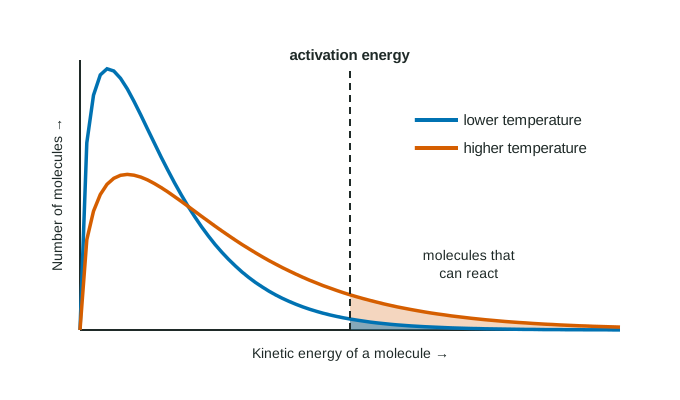
Raising the temperature does two things:
- Molecules move faster, so they collide a little more often.
- Much more importantly, a larger fraction of collisions has at least Ea. For many reactions, a 10 °C rise roughly doubles the rate, mostly because of this effect.
Heating does not lower the activation energy. Ea is a property of the reaction pathway. Heating changes how many molecules can get over the same barrier. This is why the rate constant k gets larger as the temperature rises.
Worked example: counting effective collisions
In a gas mixture, 5.0 × 10³⁰ collisions happen per liter each second. A fraction 4.0 × 10⁻⁶ of them have at least Ea, and 0.20 of those are oriented correctly. How many effective collisions happen per liter each second?
effective collisions = (5.0 × 10³⁰ s⁻¹)(4.0 × 10⁻⁶)(0.20) = 4.0 × 10²⁴ s⁻¹.
Even though 10³⁰ collisions happen every second, only about 1 in 1,250,000 of them works.
Comparing reactions
At the same temperature, all reactions see the same energy distribution. A reaction with a smaller Ea has a larger fraction of molecules above its barrier, so it has a larger rate constant and goes faster (if orientation needs are similar).
| Change | Collisions per second | Fraction with E ≥ Ea | Ea |
|---|---|---|---|
| Higher concentration | Up | Same | Same |
| Higher temperature | Up (a little) | Up (a lot) | Same |
| Smaller solid pieces | Up | Same | Same |