Some reactions are too slow to be useful at a reasonable temperature. Chemists, and living cells, speed them up with a catalyst: a substance that makes a reaction faster without being used up.
How a catalyst works
A catalyst does not push molecules harder or give them more energy. It opens a different mechanism, a new set of elementary steps, whose barriers are lower than the barrier of the uncatalyzed path. At the same temperature, a larger fraction of collisions can clear the lower barriers, so the rate constant is larger and the reaction is faster.
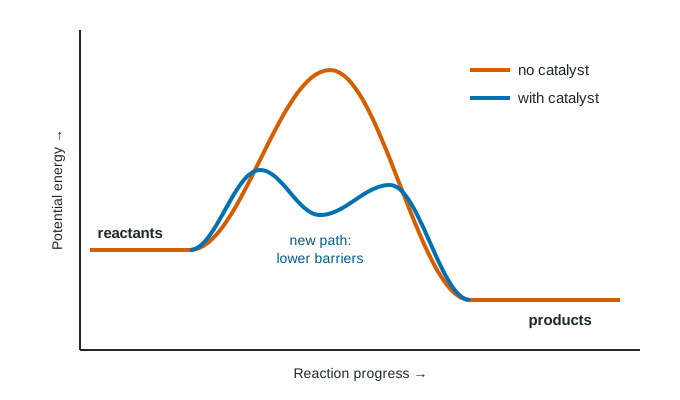
From the energy profile:
- The catalyzed path's highest barrier is lower, so the reaction is faster.
- The reactant and product levels are unchanged, so the overall energy change is the same.
- The catalyzed path often has more steps, with intermediates in the valleys between them.
Catalyst or intermediate?
Both cancel when you add up the steps of a mechanism, and both are a favorite exam question. The difference is the order in which they appear:
| Catalyst | Intermediate | |
|---|---|---|
| First appears as | a reactant of an early step | a product of an early step |
| Later | remade as a product of a later step | used as a reactant of a later step |
| Present at the start? | Yes, added on purpose | No |
| In the rate law? | It can be | No |
Short version: a catalyst is used, then remade; an intermediate is made, then used.
Worked example: finding the catalyst
Mechanism for 2 H₂O₂ → 2 H₂O + O₂ with iodide:
(1) H₂O₂ + I⁻ → H₂O + IO⁻ (slow) (2) H₂O₂ + IO⁻ → H₂O + O₂ + I⁻ (fast)
Sum: 2 H₂O₂ + I⁻ + IO⁻ → 2 H₂O + O₂ + IO⁻ + I⁻. Cancel I⁻ and IO⁻: 2 H₂O₂ → 2 H₂O + O₂. ✓
I⁻: reactant in step 1, product in step 2, used then remade, so it is the catalyst.
IO⁻: product in step 1, reactant in step 2, made then used, so it is the intermediate.
Rate law from the slow step: rate = k[H₂O₂][I⁻]. The catalyst appears in it, which is allowed, because the experimenter sets [I⁻].
What a catalyst does not do
- It is not used up overall, although it takes part in the steps.
- It does not change the energy of the reactants or products, so it does not change the energy released or absorbed.
- It lowers the barrier for the forward reaction and the reverse reaction alike, because both run through the same new pathway. So it does not change how much product the mixture ends up with; it only gets there sooner.
- It does not change the temperature or the energies of the molecules.
Kinds of catalysis
- Homogeneous: the catalyst is in the same phase as the reactants, such as I⁻ ions in a solution of H₂O₂.
- Heterogeneous (surface): a solid catalyst with gas or liquid reactants. Molecules stick to the surface, which weakens their bonds and holds them in a good orientation. A car's catalytic converter uses platinum and palladium this way.
- Acid-base: an acid gives a proton to a reactant (or a base takes one), making it easier to attack; the proton is returned later.
- Enzymes: protein catalysts in living things. A reactant binds in the enzyme's active site, reacts by a lower-barrier path, and leaves, freeing the enzyme to work again.