Some processes make their surroundings hotter and some make them colder. A burning match warms your fingers; an instant cold pack chills a sprained ankle. Chemistry explains both with one idea: energy moves between the particles that are changing and everything around them. This page sets up the words you will use for the whole unit: system, surroundings, exothermic, endothermic and enthalpy.
System and surroundings
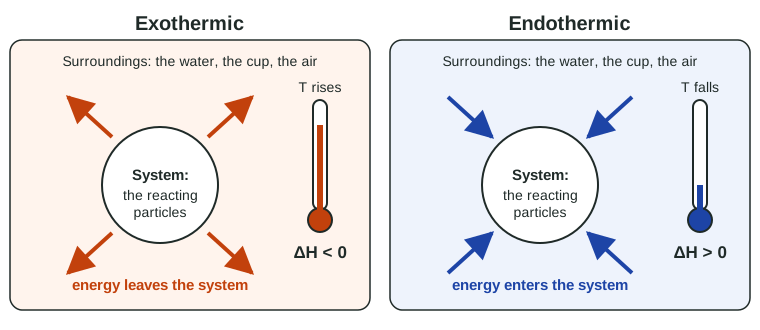
To talk about energy, first draw a boundary. The system is the part you are studying: in a reaction, the reacting particles. The surroundings are everything else: the water the reaction happens in, the beaker, the thermometer, the air. Energy can cross the boundary in either direction.
In the lab, you almost never measure the system directly. You put a thermometer in the water, and the water is part of the surroundings. Keep that in mind: the thermometer tells you what happened to the surroundings, and you reason backward to the system.
Exothermic: energy leaves the system
In an exothermic process, energy flows out of the system into the surroundings. The particles of the surroundings speed up, so the surroundings get warmer. Examples: wood or methane burning, magnesium reacting with acid, calcium chloride dissolving in water, steam condensing on a mirror, water freezing.
Freezing being exothermic surprises people. But as liquid water freezes, molecules lock into place with hydrogen bonds, and forming those attractions releases energy. Fruit farmers use this: spraying water on trees before a frost releases energy as the water freezes, which keeps the fruit from dropping much below 0 °C.
Endothermic: energy enters the system
In an endothermic process, energy flows from the surroundings into the system. The surroundings lose energy, so their particles slow down and they get colder. Examples: ammonium nitrate dissolving in a cold pack, baking soda reacting with citric acid, ice melting, sweat evaporating, and solid barium hydroxide octahydrate reacting with solid ammonium chloride (cold enough to freeze a puddle under the flask).
Notice that nothing called "cold" ever moves. A cold pack does not give cold to your ankle; your ankle gives energy to the pack.
The particle view: breaking and forming
Where does the energy come from? From the attractions between particles, inside molecules (bonds) and between them (intermolecular forces).
- Breaking a bond or an attraction always absorbs energy. The particles attract each other, so pulling them apart takes work, just as pulling two magnets apart does.
- Forming a bond or an attraction always releases energy. The particles fall together to a lower potential energy, and the difference goes to the surroundings.
Most reactions do both: reactant bonds break and product bonds form. If forming releases more than breaking absorbs, the process is exothermic. If breaking absorbs more than forming releases, it is endothermic. "Breaking bonds releases energy" is one of the most common mistakes in chemistry; fuels release energy because the bonds that form in carbon dioxide and water are stronger than the bonds broken.
Physical changes follow the same rule with intermolecular attractions. Melting and boiling overcome attractions, so they are endothermic. Freezing and condensing form attractions, so they are exothermic. No covalent bond breaks when water boils: every molecule is still H₂O.
Enthalpy and the sign of ΔH
Chemists track this energy with enthalpy, H. You will never measure a system's total enthalpy; you measure its change, ΔH (read "delta H"), which equals the energy the system absorbs or releases as heat at constant pressure, the way most reactions run in an open beaker. ΔH is an energy, in joules (J) or kilojoules (kJ).
| Exothermic | Endothermic | |
|---|---|---|
| Energy moves | system → surroundings | surroundings → system |
| Surroundings' temperature | rises | falls |
| Sign of ΔH | negative | positive |
| Particle level | forming releases more than breaking absorbs | breaking absorbs more than forming releases |
The sign is always from the system's point of view. Writing "ΔH is positive because the water gained energy" is the classic slip: the water is not the system.
Reading an experiment
Worked example. A student dissolves a spoonful of potassium chloride in water in a foam cup. The water's temperature drops from 22.0 °C to 18.4 °C. Is the dissolving endothermic or exothermic, and what is the sign of ΔH?
1. What does the thermometer measure? The water, which is the surroundings.
2. What happened to the surroundings? They cooled, so they lost energy.
3. Where did that energy go? Into the system, the dissolving potassium chloride.
4. Conclusion: the dissolving is endothermic, and ΔH is positive.
On the exam, a justification earns the point when it names the system, states the temperature change of the surroundings with its number, and says which way the energy moved.