Topic 6.4 used q = mcΔT, which only works while a substance's temperature is changing. But a lot of energy goes into substances without changing their temperature at all: melting ice, boiling water. This page explains why, gives the two molar enthalpies of phase change, and shows how to read and calculate a heating curve.
Energy without a temperature change
Heat ice at −20 °C steadily. Its temperature rises to 0 °C, then stops. While ice and liquid water are both present, the mixture stays at 0 °C no matter how much energy you add. Only when the last ice has melted does the temperature climb again.
The particle picture explains it. Temperature measures the average kinetic energy of the particles. During melting, the added energy does not speed the molecules up; it pulls them out of the fixed arrangement of the solid, overcoming some of the attractions between them. That raises their potential energy. Kinetic energy is unchanged, so the temperature is unchanged.
No covalent bonds break. Boiling water is still H₂O molecules, now far apart. Only the intermolecular attractions (here, mostly hydrogen bonds) are overcome.
Enthalpy of fusion and enthalpy of vaporization
The energy for a phase change is given per mole:
- Enthalpy of fusion, ΔHfus: the energy absorbed to melt 1 mol of a solid at its melting point. Water: 6.01 kJ/mol.
- Enthalpy of vaporization, ΔHvap: the energy absorbed to vaporize 1 mol of a liquid at its boiling point. Water: 40.7 kJ/mol.
The energy for any amount is
q = n × ΔH(phase change)
The reverse changes release the same energy. Freezing releases n × ΔHfus and condensing releases n × ΔHvap, so their q is negative. Sublimation (solid to gas) absorbs roughly ΔHfus + ΔHvap.
Why is ΔHvap so much larger? In a liquid, molecules still touch and attract their neighbors; melting only lets them slide past each other. Vaporizing pulls them almost completely apart, overcoming nearly all of the attractions. For water, vaporizing takes nearly seven times as much energy as melting.
Stronger attractions mean larger values. Methane (London dispersion forces only) has ΔHvap = 8.19 kJ/mol; water (hydrogen bonds) has 40.7 kJ/mol, though the two molecules have similar masses.
Heating curves
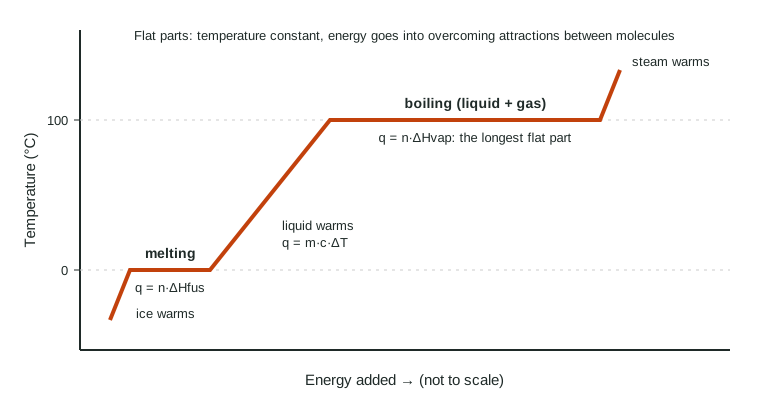
A heating curve plots temperature against energy added (or against time, for a steady heater). It has two kinds of segment:
| Segment | What is present | What the energy does | Equation |
|---|---|---|---|
| Sloped | one phase | speeds particles up (temperature rises) | q = m × c × ΔT |
| Flat | two phases | overcomes attractions (temperature constant) | q = n × ΔHfus or n × ΔHvap |
The temperature of a flat part is the melting or boiling point. Its length is proportional to the energy needed, so the boiling plateau is the longest. Each phase has its own specific heat: ice 2.09, liquid water 4.18 and steam about 2.0 J/(g·°C), which is why the slopes differ. A cooling curve is the same graph run backward, with energy removed.
Multi-step calculations
Worked example. How much energy is needed to turn 18.0 g of ice at −10.0 °C into liquid water at 25.0 °C? Use c(ice) = 2.09 J/(g·°C), c(water) = 4.18 J/(g·°C), ΔHfus = 6.01 kJ/mol, molar mass 18.02 g/mol.
Split the path at every phase change, and do each step in its own phase.
Step 1, warm the ice from −10.0 °C to 0.0 °C: q₁ = 18.0 g × 2.09 J/(g·°C) × 10.0 °C = 376 J = 0.376 kJ
Step 2, melt the ice at 0.0 °C: n = 18.0 g ÷ 18.02 g/mol = 0.9989 mol; q₂ = 0.9989 mol × 6.01 kJ/mol = 6.003 kJ
Step 3, warm the liquid from 0.0 °C to 25.0 °C: q₃ = 18.0 g × 4.18 J/(g·°C) × 25.0 °C = 1881 J = 1.881 kJ
Total: q = 0.376 + 6.003 + 1.881 = 8.261 kJ → 8.26 kJ
Two checks: convert every step to the same unit (kJ) before adding, and notice that melting is the largest step even though the temperature did not change during it.
Everyday consequences
- Ice cools a drink better than the same mass of 0 °C water, because the ice also absorbs about 334 J for each gram that melts.
- Steam at 100 °C burns worse than water at 100 °C: condensing on your skin releases 40.7 kJ for every mole before the water even starts to cool.
- Sweating cools you because evaporation absorbs energy from your skin.