Some reactions cannot be measured directly: they are too slow, make side products, or are dangerous. Hess's law gets their ΔH from reactions that can be measured. It rests on one idea, that enthalpy is a state function, and it closes the unit by showing why the formation method of 6.8 works.
Enthalpy is a state function
A state function is a quantity that depends only on the current state of a system (what substances, how much, at what temperature and pressure), not on how the system got there. Altitude is a good picture: your height above sea level at the top of a mountain does not depend on which trail you took. The distance you walked does depend on the trail, so it is not a state function.
Enthalpy is a state function. So ΔH = H(final) − H(initial) depends only on the start and the end. Any route between the same reactants and the same products has the same ΔH.
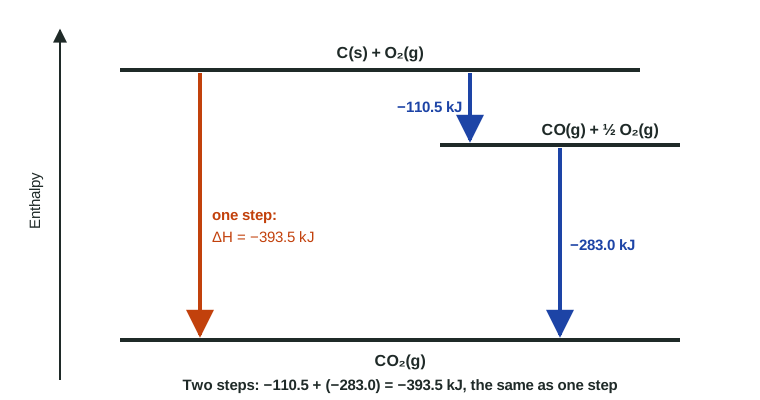
Hess's law
Hess's law: if a target equation is the sum of two or more equations, its ΔH is the sum of their ΔH values. Two rules from topic 6.6 make the equations fit:
- Reverse an equation: change the sign of its ΔH.
- Multiply an equation by a factor: multiply its ΔH by the same factor.
If you reverse and multiply, apply both to ΔH. Adjusting the equation but forgetting one change to ΔH is the most common Hess's law error on the exam.
A method that always works
- Write the target equation.
- Take each substance that appears in only one given equation. Make sure it is on the same side as in the target (reverse if not) and in the same amount (multiply if not).
- Write down each adjusted equation with its adjusted ΔH.
- Add the equations, cancel anything that appears on both sides, and check that exactly the target is left.
- Add the adjusted ΔH values.
Worked example. Find ΔH° for C(graphite) + 2 H₂(g) → CH₄(g), given
(1) C(graphite) + O₂(g) → CO₂(g) ΔH = −393.5 kJ/mol
(2) 2 H₂(g) + O₂(g) → 2 H₂O(l) ΔH = −571.6 kJ/mol
(3) CH₄(g) + 2 O₂(g) → CO₂(g) + 2 H₂O(l) ΔH = −890.3 kJ/mol
Carbon is a reactant in the target and in (1), 1 mol each: keep (1). H₂ is a reactant in the target and in (2), 2 mol each: keep (2). CH₄ is a product in the target but a reactant in (3): reverse (3), ΔH = +890.3 kJ/mol.
Add: C + O₂ + 2 H₂ + O₂ + CO₂ + 2 H₂O → CO₂ + 2 H₂O + CH₄ + 2 O₂. Cancel 2 O₂, CO₂ and 2 H₂O: C + 2 H₂ → CH₄. ✓
ΔH° = (−393.5) + (−571.6) + (+890.3) = −74.8 kJ/mol
That is the standard enthalpy of formation of methane, −74.8 kJ/mol, as it should be: the target is methane's formation reaction.
Hess's law and enthalpies of formation
The equation ΔH°rxn = Σ n ΔH°f(products) − Σ n ΔH°f(reactants) is Hess's law with a fixed route: reverse every reactant's formation reaction (taking it apart into elements), then run every product's formation reaction. The minus sign on the reactants is the "reverse" rule.
Three ways to find ΔH
| Method | What you need | How exact |
|---|---|---|
| Calorimetry (6.4) | a reaction you can run in a cup; m, c, ΔT, moles | good; energy lost to the room makes |ΔH| too small |
| Bond enthalpies (6.7) | Lewis structures; bond enthalpy table | an estimate: the values are averages, gas phase |
| ΔH°f or Hess's law (6.8, 6.9) | tabulated ΔH°f values or measured reactions | most reliable |