Most reactions you have met so far run in one direction until a reactant runs out. Many reactions do not finish like that. In a closed container they slow down and settle into a mixture of reactants and products that stops changing. This page explains what is going on in that mixture: why it stops changing, why the reactions have not stopped, and how to read the graphs that show it.
Reactions that run both ways
In topic 5.9 you met reversible reactions: the products can collide and react to re-form the reactants. A double half-arrow, ⇌, marks them. Take dinitrogen tetroxide, a colorless gas. Its molecules can split into two molecules of nitrogen dioxide, a brown gas, and two NO2 molecules can join back into N2O4:
N2O4(g) ⇌ 2 NO2(g)
colorless brown
The reaction read left to right is the forward reaction; right to left is the reverse reaction. Both can happen in the same flask at the same time.
What happens in a sealed flask
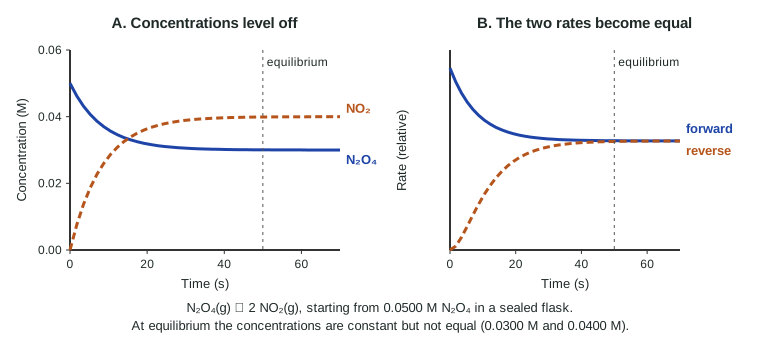
Fill a sealed flask with 0.0500 M N2O4 and keep it at a constant temperature. Follow the particles:
- At the start there is no NO2, so only the forward reaction can happen. The forward rate is at its largest, because N2O4 is at its highest concentration.
- As NO2 forms, N2O4 is used up, so the forward rate falls. At the same time NO2 molecules start bumping into each other and re-forming N2O4, so the reverse rate rises from zero.
- The rates meet. Eventually NO2 forms exactly as fast as it turns back into N2O4. From then on, every concentration stays constant. The color stops getting darker.
This state is chemical equilibrium: the forward and reverse reactions run at equal rates, so the concentrations of all species are constant. You met the same idea in topic 3.3, where a liquid evaporates and its vapor condenses at equal rates. Chemical equilibrium is that dynamic equilibrium applied to a chemical reaction.
Constant is not the same as equal
Look at Figure 1A again. At equilibrium the flask holds 0.0300 M N2O4 and 0.0400 M NO2. The concentrations are constant; they are not equal, and nothing says they should be. Some reactions settle with almost all products, some with almost all reactants, and most somewhere between. The equilibrium concentrations (the concentrations once equilibrium is reached) depend on the reaction, the starting amounts and the temperature. Topics 7.3 to 7.5 show how to put a number on where a reaction settles.
Two more things are not true at equilibrium:
- The reactions have not stopped. Individual molecules keep reacting in both directions. The proof: swap a few ordinary I2 molecules in an H2, I2, HI equilibrium for radioactive I2. The concentrations never change, yet radioactive iodine soon turns up inside HI molecules. Only reactions could have put it there.
- The reaction has not gone to completion. Reactants remain. In the flask above, 60% of the N2O4 is still there.
Reading concentration-time graphs
Graphs like Figure 1A appear on the exam all the time. Three rules read almost all of them:
- A flat line means equilibrium. The first time every curve is horizontal is when equilibrium is reached.
- Changes follow the coefficients. For each N2O4 that reacts, two NO2 form, so the NO2 curve rises twice as far as the N2O4 curve falls (and twice as steeply at every moment).
- Rising product means forward faster than reverse. Before equilibrium, the direction a concentration is moving tells you which reaction is faster.
Worked example. A flask starts with 0.0500 M N2O4 and no NO2. At equilibrium, [NO2] = 0.0400 M. What is [N2O4] at equilibrium?
1. Use the coefficients: 1 N2O4 → 2 NO2. NO2 rose by 0.0400 M, so N2O4 fell by 0.0400 M × (1/2) = 0.0200 M.
2. Subtract from the start: 0.0500 M − 0.0200 M = 0.0300 M N2O4.
Check: the slip readers see most is subtracting 0.0400 M directly, which gives 0.0100 M. That ignores the 2 : 1 ratio.
From either direction
Now fill the same flask with 0.100 M NO2 instead, at the same temperature. That is the same number of N and O atoms as 0.0500 M N2O4. This time only the reverse reaction can run at first; NO2 combines into N2O4, the reverse rate falls and the forward rate rises until they are equal. The system ends at exactly the same mixture: 0.0300 M N2O4 and 0.0400 M NO2. Equilibrium can be approached from either side.
Closed systems only
Equilibrium needs a closed system, where no substance can enter or leave. Heat limestone in an open dish, CaCO3(s) ⇌ CaO(s) + CO2(g), and the CO2 drifts away before it can react back, so the solid keeps decomposing. Seal the same reaction in a container and it reaches equilibrium.