Topic 7.1 showed that a reversible reaction in a closed container settles at equilibrium, where the forward and reverse rates are equal. This page asks the question just before that: when a system is not at equilibrium, which way does it go? And what happens when you disturb a system that is already at equilibrium?
Two reactions, one net result
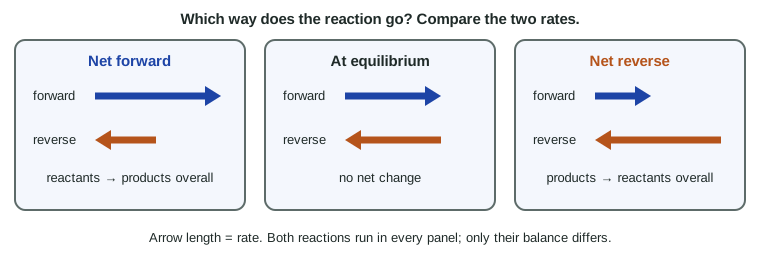
In a mixture of reactants and products, the forward and reverse reactions both run all the time. What you can measure, a color getting darker or a concentration rising, is the net reaction: the overall change once the two reactions are combined.
- If the forward rate is greater than the reverse rate, reactants turn into products faster than products turn back. The net reaction goes forward: reactant concentrations fall and product concentrations rise.
- If the reverse rate is greater, the net reaction goes in reverse: products turn into reactants overall.
- If the rates are equal, there is no net reaction: the system is at equilibrium.
The direction does not come from how the equation is written or from which side has more molecules. It comes only from the comparison of the two rates.
What sets each rate
A reaction's rate depends on how often its reacting particles collide in the right way. For a given temperature, that depends on concentration: more molecules per liter means more collisions each second (topics 5.2 and 5.5). So the forward rate depends on the reactant concentrations and the reverse rate on the product concentrations.
This is why a system always heads toward equilibrium. Suppose the forward rate is larger. The net forward reaction lowers the reactant concentrations, so the forward rate drops, and raises the product concentrations, so the reverse rate climbs. The gap closes until the rates are equal. The same logic works in reverse.
Net rates and coefficients
When a question gives you the two rates, the net rate is their difference. Watch the coefficients: if each reaction event makes two molecules of a product, that product changes twice as fast.
Worked example. For N2O4(g) ⇌ 2 NO2(g), N2O4 splits at 6.0 × 10⁻⁴ M/s and re-forms at 2.5 × 10⁻⁴ M/s. Which way does the net reaction go, and how fast does [NO2] rise?
1. Compare the rates: 6.0 × 10⁻⁴ M/s > 2.5 × 10⁻⁴ M/s, so the net reaction goes forward.
2. Net change in N2O4: 6.0 × 10⁻⁴ M/s − 2.5 × 10⁻⁴ M/s = 3.5 × 10⁻⁴ M/s used up.
3. Apply the coefficients: 2 NO2 per N2O4, so [NO2] rises at 2 × 3.5 × 10−4 M/s = 7.0 × 10⁻⁴ M/s.
Both rates have two significant figures, so the answer has two.
Disturbing a system at equilibrium
Take H2(g) + I2(g) ⇌ 2 HI(g) at equilibrium in a sealed flask, and inject extra H2. At that instant:
- [H2] is higher, so H2 and I2 collide more often: the forward rate jumps. [HI] has not changed yet, so the reverse rate is the same as before.
- Now forward > reverse, so there is a net forward reaction. H2 and I2 are used and HI forms.
- As [H2] and [I2] fall, the forward rate drops; as [HI] rises, the reverse rate climbs. They meet at a new equilibrium.
At the new equilibrium the rates are equal again, but not at their old values. [HI] is higher than before, so the reverse rate is higher, and the forward rate equals it. Removing a species works the same way, by slowing the reaction that uses it.
Worked example. After the H2 injection, [I2] falls from 0.0200 M to 0.0103 M before the flask settles. [HI] started at 0.140 M. What is [HI] at the new equilibrium?
1. Change in I2: 0.0200 M − 0.0103 M = 0.0097 M used.
2. 1 I2 makes 2 HI, so HI rises by 2 × 0.0097 M = 0.0194 M.
3. [HI] = 0.140 M + 0.0194 M = 0.159 M (three significant figures, from the place value of 0.140).
Things that do not change the direction
A catalyst lowers the activation energy for the forward and reverse reactions alike (topic 5.11). Added to a system at equilibrium, it speeds both rates by the same factor, so they stay equal and nothing shifts. A catalyst only helps a system reach equilibrium sooner.
Rate comparisons are the CED's first way to talk about direction. Topic 7.3 gives a second, number-based test that uses concentrations you can measure, and from topic 7.10 on that test is what the exam expects in a justification.