You now know how to write K and calculate its value. This page is about what the value means. K is a ratio of products to reactants at equilibrium, so its size tells you, at a glance, whether the equilibrium mixture is mostly products, mostly reactants or a real mix. It does not tell you how fast the reaction gets there.
Big K, small K
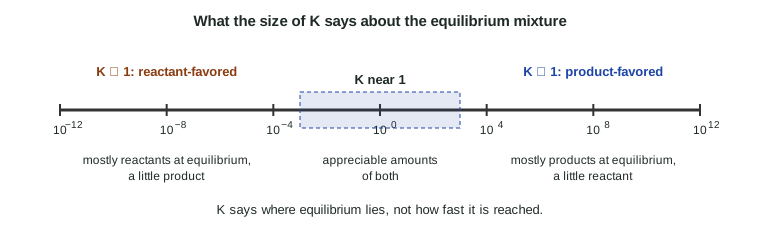
K has products on top and reactants on the bottom. So:
- K ≫ 1 (much greater than 1): the top must be much larger than the bottom at equilibrium. The mixture is mostly products. The reaction is product-favored; starting from reactants, it goes nearly to completion.
- K ≪ 1 (much less than 1): the bottom dominates. The mixture is mostly reactants with a little product. The reaction is reactant-favored.
- K near 1: neither side dominates; both are present in appreciable amounts. A rough guide is K between about 10−3 and 103, but treat that as a rule of thumb, not a sharp line.
Real values span a huge range. For N2(g) + O2(g) ⇌ 2 NO(g) at 25 °C, Kc ≈ 4.5 × 10⁻³¹: the nitrogen and oxygen in the air you breathe are, for all practical purposes, not turning into NO. For H2(g) + Cl2(g) ⇌ 2 HCl(g), Kc ≈ 2.5 × 1033: the reaction goes essentially all the way.
A small K still means some product. K is never zero, and a reactant-favored reaction still reaches a dynamic equilibrium in which product forms and breaks down at equal rates.
Reading K from particles
If you see three containers of different reactions X2 + Y2 ⇌ 2 XY at equilibrium, you can rank their K values by eye. A box with 8 XY and only 1 X2 and 1 Y2 has K = 82/(1 × 1) = 64; a box with 2 XY among 4 X2 and 4 Y2 has K = 22/(4 × 4) = 0.25. (Counting works directly here because the volumes are equal and the moles of gas are the same on both sides; topic 7.8 shows how to convert counts to concentrations in general.)
Using a small K to estimate
When K is very small, so little reactant is used that its equilibrium concentration is almost the same as its starting value. That lets you estimate the product concentration quickly. Topic 7.7 turns this into a general method and shows how to check it.
Worked example. For A(g) ⇌ 2 B(g), Kc = 1.0 × 10⁻⁵. Starting from 0.10 M A, estimate [B] at equilibrium.
1. K is tiny, so very little A reacts: [A]eq ≈ 0.10 M.
2. Expression: Kc = [B]2 / [A], so [B]2 ≈ 1.0 × 10−5 × 0.10 = 1.0 × 10⁻⁶.
3. Square root: [B] ≈ 1.0 × 10⁻³ M.
Check: making 1.0 × 10⁻³ M B uses 0.50 × 10⁻³ M A, which is 0.5% of 0.10 M. The estimate holds.
K is about "how far", not "how fast"
This is the single most tested idea in the topic. K describes the equilibrium mixture. The time it takes to reach that mixture depends on the activation energy and the rate law (Unit 5), and K tells you nothing about those. A mixture of H2 and O2 has an enormous K for forming water, yet sits unchanged for years at room temperature because almost no collisions get over the activation barrier. Add a spark or a platinum catalyst and it reacts at once; the K was the same all along.
| Question | Answered by |
|---|---|
| How much product is there once the system settles? | the size of K |
| Which way will this mixture react right now? | Q compared with K |
| How fast does it react? | the rate law and activation energy, not K |