Magnitude of the Equilibrium Constant
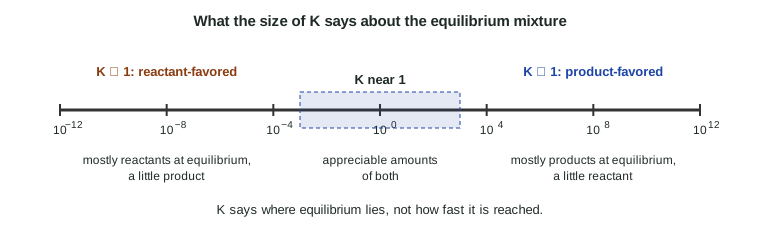
Because K is products over reactants at equilibrium, its size describes the equilibrium mixture.
Part 1 · Hook
Why this matters
Part 2 · Before you start
What this builds on
Part 3 · Prerequisite check
Quick check before you start
1. In the expression for K, where do the products go?
- In the numerator (top)
- In the denominator (bottom)
- They are left out
- They are added to the reactants
Show the answer
K is products over reactants, each raised to its coefficient.
- Correct: In the numerator (top):
- In the denominator (bottom):
- They are left out:
- They are added to the reactants:
2. For A ⇌ B, an equilibrium mixture has [A] = 0.10 M and [B] = 0.50 M. What is K?
- 5.0
- 0.20
- 0.050
- 0.60
Show the answer
K = [B]/[A] = 0.50/0.10.
- Correct: 5.0:
- 0.20:
- 0.050:
- 0.60:
3. What does activation energy control?
- How fast a reaction proceeds
- How much product forms at equilibrium
- Whether a reaction is exothermic
- The coefficients in the equation
Show the answer
A higher activation energy means fewer effective collisions per second, so a slower reaction.
- Correct: How fast a reaction proceeds:
- How much product forms at equilibrium:
- Whether a reaction is exothermic:
- The coefficients in the equation:
Part 4 · See it
See it first
Part 5 · Step by step
How it works, step by step
- K is products over reactants at equilibriumits size tells you which side dominates the equilibrium mixture
- K is much greater than 1the mixture is mostly products: product-favored
- K is much less than 1the mixture is mostly reactants, with a little product: reactant-favored
- K describes only the final mixtureit gives no information about how fast equilibrium is reached
Part 6 · Key ideas
Key ideas
- K ≫ 1: product-favored; mostly products at equilibrium.
- K ≪ 1: reactant-favored; mostly reactants, but some product forms.
- K near 1: appreciable amounts of both reactants and products.
- K tells you how far a reaction goes, never how fast.
Part 7 · Misconception
A common mistake
The wrong idea: A large K means the reaction is fast.
What actually happens: K describes the equilibrium mixture only. H₂ and O₂ have an enormous K for making water but do not react for years at room temperature, because the activation energy is high.
Part 8 · Check yourself
Check yourself
Exam-style questions. Anything you miss goes into your review queue.
Data table
Equilibrium constants for four reactions
A student looks up Kc for four gas-phase reactions, each at 25 °C. Each reaction starts with only its reactants, at 1.0 M each.
| Reaction | Equation | Kc |
|---|---|---|
| 1 | N2(g) + O2(g) ⇌ 2 NO(g) | 4.5 × 10⁻³¹ |
| 2 | H2(g) + Cl2(g) ⇌ 2 HCl(g) | 2.5 × 1033 |
| 3 | CO(g) + H2O(g) ⇌ CO2(g) + H2(g) | 1.0 × 10⁵ |
| 4 | N2O4(g) ⇌ 2 NO2(g) | 4.6 × 10⁻³ |
1. In which reaction does the equilibrium mixture contain almost nothing but reactants?
- Reaction 1
- Reaction 2
- Reaction 3
- Reaction 4
Show the answer
The smaller K is, the less product the equilibrium mixture contains. K = 10⁻³¹ means the reaction barely proceeds.
- Correct: Reaction 1: Right: K = 4.5 × 10⁻³¹ is extremely small, so at equilibrium the product, NO, is present in a tiny amount.
- Reaction 2: K = 2.5 × 10³³ is huge: this reaction goes essentially to products.
- Reaction 3: K = 1.0 × 10⁵ is large, so products are favored.
- Reaction 4: K = 4.6 × 10⁻³ is small, so reactants are favored, but not nearly as strongly as in reaction 1.
2. The student concludes that reaction 2 must reach equilibrium within seconds because its K is so large. Is the conclusion justified?
- No: K shows where equilibrium lies, not how fast it is reached.
- Yes: a large K means a large rate constant for the forward reaction.
- Yes: products form quickly whenever K is greater than 1.
- No: a large K means the reaction is slow, because the reverse reaction is fast.
Show the answer
K describes the mixture once equilibrium is reached. How long that takes is kinetics (Unit 5). H₂ and Cl₂ can sit mixed in the dark for a long time, then react explosively in sunlight; K is the same either way.
- Correct: No: K shows where equilibrium lies, not how fast it is reached.: Right: K is about the composition at equilibrium. Speed depends on the activation energy and the rate law, which K does not tell you.
- Yes: a large K means a large rate constant for the forward reaction.: K compares forward and reverse at equilibrium; a large K is compatible with both reactions being very slow.
- Yes: products form quickly whenever K is greater than 1.: Being product-favored says how much product there will be, not when. Some product-favored reactions take years.
- No: a large K means the reaction is slow, because the reverse reaction is fast.: K does not set the speed in either direction, so it cannot tell you the reaction is slow either.
3. For reaction 4, a student starts with 1.0 M N2O4 and predicts that almost all of it will turn into NO2. Which response is best?
- The prediction is wrong: K < 1, so most N2O4 remains at equilibrium.
- The prediction is right: N2O4 is the one species present at the start.
- The prediction is right: K is positive, so products are favored.
- The prediction is wrong: no NO2 forms, because K is less than 1.
Show the answer
K much less than 1 means reactants are favored: some product forms, but most of the reactant is still there at equilibrium.
- Correct: The prediction is wrong: K < 1, so most N2O4 remains at equilibrium.: Right: K = 4.6 × 10⁻³. With [N₂O₄] near 1.0 M, [NO₂]² ≈ 4.6 × 10⁻³, so [NO₂] ≈ 0.068 M: a few percent reacts.
- The prediction is right: N2O4 is the one species present at the start.: Starting with reactant only tells you the net reaction is forward (Q = 0 < K). It does not tell you how far it goes.
- The prediction is right: K is positive, so products are favored.: Every K is positive. What matters is whether K is much larger or much smaller than 1.
- The prediction is wrong: no NO2 forms, because K is less than 1.: K < 1 does not mean zero product. Some NO₂ forms, just not much.
Particle view
Three reactions at equilibrium
Key: X2Y2XY
Each container shows a different reaction of the form X2(g) + Y2(g) ⇌ 2 XY(g) at equilibrium. The containers have equal volumes and each started with 5 X2 and 5 Y2.
4. Which reaction has the largest equilibrium constant?
- Reaction I
- Reaction II
- Reaction III
- They are equal, because each started with the same amounts.
Show the answer
The equilibrium mixture with the most product relative to reactant has the largest K. Count: I has 8 XY to 1 + 1 reactant molecules.
- Correct: Reaction I: Right: K = 8² / (1 × 1) = 64, by far the most product per reactant.
- Reaction II: K = 2² / (4 × 4) = 0.25, the smallest of the three.
- Reaction III: K = 4² / (3 × 3) ≈ 1.8, in between.
- They are equal, because each started with the same amounts.: Same starting amounts but different reactions settle at different mixtures, so the K values differ.
5. Each particle in a container stands for 0.10 mol, and each container is 1.0 L. Calculate Kc for reaction II.
Type a number.
Show the answer
[XY] = 2 × 0.10 = 0.20 M; [X₂] = [Y₂] = 4 × 0.10 = 0.40 M. Kc = (0.20)² / (0.40 × 0.40) = 0.25.
- Answer: 0.25
6. Which statement about reaction II is correct?
- Its K is less than 1, so reactants are favored.
- Its K is greater than 1, because product is present.
- It is not at equilibrium, because it has more reactant than product.
- It will react further toward products, because K is small.
Show the answer
A small K describes an equilibrium mixture that is mostly reactants. It is still an equilibrium: no further net change.
- Correct: Its K is less than 1, so reactants are favored.: Right: K = 0.25, and the box holds 8 reactant molecules for every 2 product molecules.
- Its K is greater than 1, because product is present.: Any equilibrium mixture contains some product. K > 1 needs products to outweigh reactants in the ratio, which they do not here.
- It is not at equilibrium, because it has more reactant than product.: The question says each container is at equilibrium. Mostly-reactant mixtures are common equilibria.
- It will react further toward products, because K is small.: At equilibrium, Q = K and there is no net reaction, whatever the size of K.
7. A cylinder of H2 and O2 gases can stand for years without forming water, though K for 2 H2(g) + O2(g) ⇌ 2 H2O(g) is enormous at room temperature. What explains this?
- The reaction has a high activation energy, so it is extremely slow at room temperature.
- The mixture is already at equilibrium.
- K is large, so the reverse reaction prevents water from forming.
- K applies once some water has already formed.
Show the answer
Thermodynamics (the size of K) and kinetics (the rate) are separate. A large K tells you where the reaction would end, not that it will get there quickly.
- Correct: The reaction has a high activation energy, so it is extremely slow at room temperature.: Right: K says water is overwhelmingly favored at equilibrium, but without a spark or catalyst very few collisions get over the energy barrier.
- The mixture is already at equilibrium.: At equilibrium with K this large, there would be almost no H₂ and O₂ left. The cylinder is far from equilibrium.
- K is large, so the reverse reaction prevents water from forming.: A large K favors the forward reaction. The reverse reaction is negligible.
- K applies once some water has already formed.: K applies to the reaction at any composition; Q = 0 here, so the net reaction should go forward. It just goes very slowly.
Part 9 · Summary
Summary
Part 10 · Up next
What comes next
Part 11 · Connections