Properties of the Equilibrium Constant
K belongs to one equation written one way.
Part 1 · Hook
Why this matters
Part 2 · Before you start
What this builds on
Part 3 · Prerequisite check
Quick check before you start
1. What is Kc for 2 SO2(g) + O2(g) ⇌ 2 SO3(g)?
- [SO3]2 / ([SO2]2[O2])
- 2[SO3] / (2[SO2][O2])
- [SO2]2[O2] / [SO3]2
- [SO3] / ([SO2][O2])
Show the answer
Products over reactants, coefficients as exponents.
- Correct: [SO3]2 / ([SO2]2[O2]):
- 2[SO3] / (2[SO2][O2]):
- [SO2]2[O2] / [SO3]2:
- [SO3] / ([SO2][O2]):
2. In Hess’s law, reversing a reaction does what to ΔH?
- Changes its sign
- Takes its reciprocal
- Doubles it
- Leaves it unchanged
Show the answer
The reverse reaction has the same size of ΔH with the opposite sign.
- Correct: Changes its sign:
- Takes its reciprocal:
- Doubles it:
- Leaves it unchanged:
3. What does K ≪ 1 tell you?
- The equilibrium mixture is mostly reactants
- The reaction is slow
- The equilibrium mixture is mostly products
- The reaction does not occur
Show the answer
Small K: reactant-favored, with a little product.
- Correct: The equilibrium mixture is mostly reactants:
- The reaction is slow:
- The equilibrium mixture is mostly products:
- The reaction does not occur:
Part 4 · See it
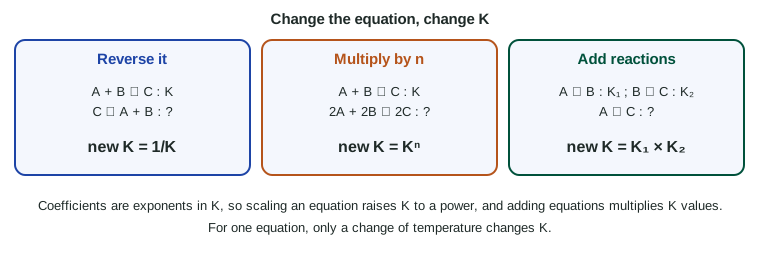
See it first
Part 5 · Step by step
How it works, step by step
- An equation is reversedits K expression turns upside down, so K becomes 1/K
- Every coefficient is multiplied by nevery exponent in K is multiplied by n, so K becomes Kⁿ
- Two equations are addedmultiplying their expressions cancels the shared species, so K = K₁ × K₂
- The same equation is studied at a new temperatureK takes a new value; at a fixed temperature nothing else changes it
Part 6 · Key ideas
Key ideas
- Reverse an equation: Knew = 1/K.
- Multiply all coefficients by n: Knew = Kn (n = ½ means a square root).
- Add equations: multiply their K values.
- For a given equation, K depends only on temperature. Concentration, pressure, volume and catalysts do not change it.
Part 7 · Misconception
A common mistake
The wrong idea: Adding more reactant to an equilibrium mixture increases K.
What actually happens: Adding reactant changes Q, not K. The system reacts until Q equals the same K again. For a given equation, only a change of temperature changes K.
Part 8 · Check yourself
Check yourself
Exam-style questions. Anything you miss goes into your review queue.
Data table
Two reactions of nitrogen oxides
A student is given Kc values for two reactions at 25 °C and wants Kc for related reactions at 25 °C.
| Reaction | Equation | Kc |
|---|---|---|
| A | N2(g) + O2(g) ⇌ 2 NO(g) | 4.5 × 10⁻³¹ |
| B | 2 NO(g) + O2(g) ⇌ 2 NO2(g) | 6.0 × 10¹³ |
1. Calculate Kc for 2 NO2(g) ⇌ 2 NO(g) + O2(g).
Type a number.
Show the answer
This is reaction B reversed, so K = 1/KB = 1 / (6.0 × 10¹³) = 1.7 × 10⁻¹⁴.
- Answer: 1.7 × 10⁻¹⁴
2. Calculate Kc for NO(g) + ½ O2(g) ⇌ NO2(g).
Type a number.
Show the answer
Reaction B with every coefficient halved: K = (KB)1/2 = √(6.0 × 10¹³) = 7.7 × 10⁶.
- Answer: 7.7 × 10⁶
3. Reactions A and B can be combined to describe nitrogen dioxide forming directly from the elements. Use the table to calculate Kc at 25 °C for N2(g) + 2 O2(g) ⇌ 2 NO2(g).
Type a number.
Show the answer
Add reaction A to reaction B: 2 NO cancels, leaving N₂ + 2 O₂ ⇌ 2 NO₂. K = KA × KB = (4.5 × 10⁻³¹)(6.0 × 10¹³) = 2.7 × 10⁻¹⁷.
- Answer: 2.7 × 10⁻¹⁷
4. Which operation gives Kc for 4 NO(g) ⇌ 2 N2(g) + 2 O2(g)?
- (1/KA)2
- 2/(KA)
- (KA)2
- −2KA
Show the answer
Reversing gives the reciprocal; multiplying all coefficients by n raises K to the n. Together: (1/KA)².
- Correct: (1/KA)2: Right: reverse reaction A (1/KA), then double every coefficient (square it).
- 2/(KA): Doubling the equation squares K; it does not multiply K by 2.
- (KA)2: This doubles reaction A but does not reverse it. The new reaction has NO as the reactant.
- −2KA: Neither reversing nor doubling makes K negative or multiplies it by 2.
Data table
K at different temperatures
Kc for N2O4(g) ⇌ 2 NO2(g) is measured at four temperatures.
| Temperature (K) | Kc |
|---|---|
| 298 | 4.6 × 10⁻³ |
| 350 | 0.13 |
| 400 | 1.5 |
| 450 | 10. |
5. A flask at 350 K holds an equilibrium mixture. More N2O4 is injected and the flask is held at 350 K. What is Kc once equilibrium is restored?
- 0.13
- Greater than 0.13, because more N2O4 reacts.
- Less than 0.13, because there is more reactant on the bottom of the expression.
- 1.5, because the system shifts to the next K in the table.
Show the answer
At a fixed temperature, K is a constant. Adding N₂O₄ lowers Q below K, and the net forward reaction restores Q = K = 0.13.
- Correct: 0.13: Right: K depends only on temperature. Adding a reactant changes Q and the concentrations, not K.
- Greater than 0.13, because more N2O4 reacts.: More N₂O₄ reacts, but the new concentrations still satisfy the same K. K itself does not move.
- Less than 0.13, because there is more reactant on the bottom of the expression.: Right after the injection, Q is below 0.13. The system then reacts forward until Q is back at 0.13.
- 1.5, because the system shifts to the next K in the table.: K changes only if the temperature changes. Here it stays at 350 K.
6. Given: (1) A(g) ⇌ B(g), K1 = 1.4 × 10⁻²; (2) B(g) ⇌ 2 C(g), K2 = 6.0 × 10⁻⁵. Calculate K for A(g) ⇌ 2 C(g).
Type a number.
Show the answer
Adding (1) and (2) cancels B: A ⇌ 2 C. K = K₁K₂ = (1.4 × 10⁻²)(6.0 × 10⁻⁵) = 8.4 × 10⁻⁷.
- Answer: 8.4 × 10⁻⁷
7. Which changes alter the value of Kc for a given reaction equation? Select all that apply.
- Changing the temperature
- Adding more of a reactant
- Changing the volume of the container
- Adding a catalyst
Show the answer
For a given equation, K changes only with temperature. Writing the equation differently (reversed, scaled) gives a different K, but that is a different equation.
- Correct: Changing the temperature: Right: K depends on temperature.
- Adding more of a reactant: This changes Q and the concentrations, not K.
- Changing the volume of the container: Volume changes concentrations (and Q), not K.
- Adding a catalyst: A catalyst speeds both directions equally and leaves K unchanged.
Part 9 · Summary
Summary
Part 10 · Up next
What comes next
Part 11 · Connections