Calculating Equilibrium Concentrations
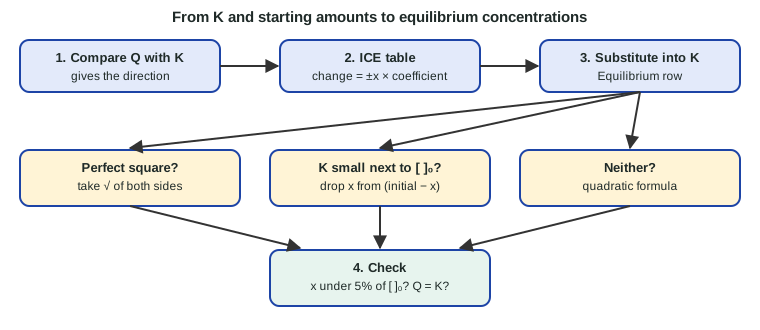
To find equilibrium concentrations from K, compare Q with K to get the direction, build an ICE table with changes of ±x times each coefficient, substitute the Equilibrium row into K and solve for x.
Part 1 · Hook
Why this matters
Part 2 · Before you start
What this builds on
Part 3 · Prerequisite check
Quick check before you start
1. In an ICE table for A ⇌ 2 B, if A changes by −x, what is the change in B?
- +2x
- +x
- −2x
- +x/2
Show the answer
Changes follow the coefficients: 1 A used makes 2 B.
- Correct: +2x:
- +x:
- −2x:
- +x/2:
2. A mixture has Q > K. Which way does the net reaction go?
- In reverse, toward reactants
- Forward, toward products
- Neither; it is at equilibrium
- It depends on the temperature only
Show the answer
Q > K means too much product, so the reaction runs in reverse until Q = K.
- Correct: In reverse, toward reactants:
- Forward, toward products:
- Neither; it is at equilibrium:
- It depends on the temperature only:
3. For a reaction with K = 1 × 10⁻⁸, starting from reactants, how much reactant is left at equilibrium?
- Almost all of it
- About half
- Almost none
- Exactly none
Show the answer
A tiny K means a reactant-favored equilibrium: very little reacts.
- Correct: Almost all of it:
- About half:
- Almost none:
- Exactly none:
Part 4 · See it
See it first
Part 5 · Step by step
How it works, step by step
- Q is compared with K for the starting mixtureyou know which side is used up and which forms
- The ICE table writes each change as ±x times a coefficientevery equilibrium concentration is written with one unknown
- The Equilibrium row is substituted into the K expressionyou get one equation in x
- K is small compared with the starting concentrationx can be dropped from (initial − x), and a 5% check confirms it
- x is solved and checkedevery equilibrium concentration follows from Initial + Change
Part 6 · Key ideas
Key ideas
- Always find the direction first by comparing Q with K; it sets the signs in the Change row.
- Changes are ±x × coefficient. Equilibrium = Initial + Change. Use molarities.
- Perfect square: take the square root of both sides. Small K: drop x only from (initial − x), never x standing alone.
- Check the small-x approximation: the change must be under about 5% of the starting value; otherwise solve exactly.
Part 7 · Misconception
A common mistake
The wrong idea: If K is small, x is small, so every x in the equation can be set to zero.
What actually happens: Only x that is added to or subtracted from a larger number can be dropped: 0.50 − 2x ≈ 0.50. The x terms standing alone on top of the expression stay, or there is nothing left to solve. Then check the 5% rule.
Part 8 · Check yourself
Check yourself
Exam-style questions. Anything you miss goes into your review queue.
Data table
An ICE table for ammonia
A sealed 1.00 L vessel starts with 0.500 M N2 and 0.800 M H2 at a high temperature: N2(g) + 3 H2(g) ⇌ 2 NH3(g). At equilibrium, [NH3] = 0.150 M. A student starts an ICE table.
| [N2] | [H2] | [NH3] | |
|---|---|---|---|
| Initial | 0.500 | 0.800 | 0 |
| Change | −x | ? | +2x |
| Equilibrium | 0.500 − x | ? | 0.150 |
1. What belongs in the Change row for H2?
- −3x
- −x
- +3x
- −x/3
Show the answer
The Change row is x times each coefficient, negative for species used up. H₂ has coefficient 3: −3x.
- Correct: −3x: Right: three H₂ react for every N₂, so H₂ falls three times as fast.
- −x: This ignores the coefficient 3 on H₂.
- +3x: H₂ is a reactant in a net forward reaction, so it is used up: the sign is negative.
- −x/3: The coefficient multiplies x; it does not divide it.
2. Calculate [H2] at equilibrium.
Type a number and its unit.
Show the answer
2x = 0.150 M, so x = 0.0750 M. [H₂] = 0.800 − 3(0.0750) = 0.800 − 0.225 = 0.575 M.
- Answer: 0.575 M
Experimental setup
When x is not small
PCl5 decomposes on heating: PCl5(g) ⇌ PCl3(g) + Cl2(g), Kc = 0.040 at a certain temperature. A sealed flask starts with 0.200 M PCl5 and nothing else. A student writes x2 / (0.200 − x) = 0.040, assumes x is small compared with 0.200, and gets x = 0.089 M.
3. Is the student’s small-x approximation valid?
- No: 0.089 M is about 45% of 0.200 M, far more than 5%.
- Yes: x comes out less than 0.200 M.
- Yes: K = 0.040 is less than 1.
- No: the approximation is not used when the products start at zero.
Show the answer
Check the approximation: x / [initial] × 100% = 0.089 / 0.200 × 100% ≈ 45%. Over about 5%, x cannot be dropped and the equation must be solved exactly.
- Correct: No: 0.089 M is about 45% of 0.200 M, far more than 5%.: Right: the approximation is only safe when x is a few percent of the starting concentration or less.
- Yes: x comes out less than 0.200 M.: Being smaller than 0.200 is not enough; x must be negligible next to it (under about 5%).
- Yes: K = 0.040 is less than 1.: K < 1 alone does not guarantee x is small. Here K is only moderately small compared with the concentration.
- No: the approximation is not used when the products start at zero.: Starting with no products is the usual case for the approximation. It fails here because K is not small enough.
4. Solve x2 / (0.200 − x) = 0.040 exactly (with the quadratic formula) and give [Cl2] at equilibrium.
Type a number and its unit.
Show the answer
Rearrange: x² = 0.040(0.200 − x), so x² + 0.040x − 0.0080 = 0. x = [−0.040 + √((0.040)² + 4(0.0080))] / 2 = (−0.040 + √0.0336) / 2 = 0.0717 M ≈ 0.072 M.
- Answer: 0.072 M
5. For H2(g) + I2(g) ⇌ 2 HI(g), Kc = 50.0 at 450 °C. A flask starts with 0.100 M H2 and 0.100 M I2. Calculate [HI] at equilibrium.
Type a number and its unit.
Show the answer
(2x)² / (0.100 − x)² = 50.0. Both sides are perfect squares: 2x / (0.100 − x) = √50.0 = 7.071. So 2x = 0.7071 − 7.071x, 9.071x = 0.7071, x = 0.0780 M. [HI] = 2x = 0.156 M.
- Answer: 0.156 M
6. For 2 NOCl(g) ⇌ 2 NO(g) + Cl2(g), Kc = 1.6 × 10⁻⁵. A flask starts with 0.50 M NOCl. Using the small-x approximation, calculate [Cl2] at equilibrium.
Type a number and its unit.
Show the answer
(2x)²(x) / (0.50)² = 1.6 × 10⁻⁵ → 4x³ = 4.0 × 10⁻⁶ → x³ = 1.0 × 10⁻⁶ → x = 0.010 M. Check: 2x = 0.020 M is 4% of 0.50 M, under 5%. [Cl₂] = 0.010 M.
- Answer: 0.010 M
7. For CO(g) + H2O(g) ⇌ CO2(g) + H2(g), Kc = 1.56. A flask starts with 0.0500 M CO, 0.0500 M H2O, 0.200 M CO2 and 0.200 M H2. How should the Change row be written?
- +x for CO, H2O; −x for CO2, H2
- −x for CO, H2O; +x for CO2, H2
- −x for each of the four species
- 0 for each species, since the four start at nonzero values
Show the answer
Compare Q with K before writing the Change row. Q > K means net reverse: the reactant side gains +x and the product side loses −x.
- Correct: +x for CO, H2O; −x for CO2, H2: Right: Q = (0.200)² / (0.0500)² = 16.0 > K, so the net reaction goes in reverse: reactants form, products are used.
- −x for CO, H2O; +x for CO2, H2: This assumes a forward reaction. Check Q first: Q = 16.0 is greater than K, so the reaction runs in reverse.
- −x for each of the four species: Every species cannot decrease; atoms must go somewhere. One side forms while the other is used.
- 0 for each species, since the four start at nonzero values: Having all species present does not mean equilibrium. Q = 16.0 ≠ K = 1.56.
Part 9 · Summary
Summary
Part 10 · Up next
What comes next
Part 11 · Connections