In topic 3.10 you sorted salts into "soluble" and "insoluble". In fact, even an "insoluble" salt dissolves a tiny bit, and the dissolved ions reach an equilibrium with the undissolved solid. This page puts a number on that equilibrium, the solubility product constant Ksp, and shows how to convert between Ksp and how much of the salt actually dissolves.
The equilibrium in a saturated solution
Drop silver chloride into water. A few ions break away from the crystal: AgCl(s) → Ag+(aq) + Cl−(aq). As the dissolved ions build up, some collide with the solid and stick back on. When ions return as fast as they leave, the solution is saturated, and you have an equilibrium:
AgCl(s) ⇌ Ag+(aq) + Cl−(aq)
Like every equilibrium, it is dynamic, and like every heterogeneous equilibrium, its K leaves out the pure solid (topic 7.4). So the equilibrium constant is just the product of the ion concentrations:
Ksp = [Ag+][Cl−]
For a salt that gives more than one of an ion, each concentration is raised to its coefficient. For CaF2(s) ⇌ Ca2+(aq) + 2 F−(aq), Ksp = [Ca2+][F−]2. A small Ksp means very little dissolves. Adding more solid to a saturated solution does not change the ion concentrations, because the solid is not in Ksp.
Molar solubility
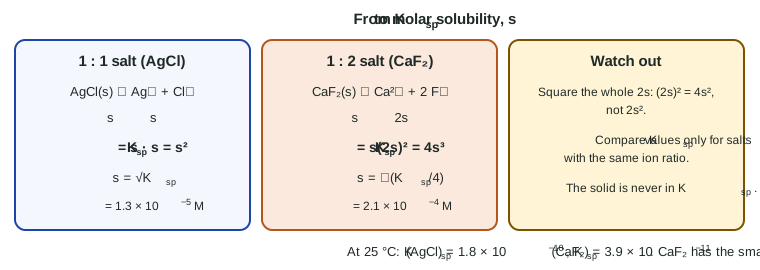
The molar solubility, s, is the number of moles of the salt that dissolve per liter of saturated solution. Each dissolved formula unit releases its ions in the ratio of the formula, so every ion concentration is s times its coefficient.
Worked example. Ksp of AgCl is 1.8 × 10⁻¹⁰ at 25 °C. Find its molar solubility.
1. AgCl(s) ⇌ Ag+ + Cl−: [Ag+] = s, [Cl−] = s.
2. Ksp = s × s = s2 = 1.8 × 10⁻¹⁰.
3. s = √(1.8 × 10⁻¹⁰) = 1.3 × 10⁻⁵ M.
Worked example. Ksp of Ag2CrO4 is 1.1 × 10⁻¹². Find its molar solubility.
1. Ag2CrO4(s) ⇌ 2 Ag+ + CrO42−: [Ag+] = 2s, [CrO42−] = s.
2. Ksp = (2s)2(s) = 4s3 = 1.1 × 10⁻¹². Square all of 2s: (2s)2 = 4s2, not 2s2.
3. s3 = 2.75 × 10⁻¹³, so s = 6.5 × 10⁻⁵ M.
Notice: Ag2CrO4 has the smaller Ksp but the larger molar solubility. Ranking salts by Ksp works only when they give the same number and ratio of ions.
Going the other way: Ksp from solubility
Worked example. The molar solubility of Mg(OH)2 is 1.1 × 10⁻⁴ M. Find Ksp.
1. Mg(OH)2(s) ⇌ Mg2+ + 2 OH−: [Mg2+] = 1.1 × 10⁻⁴ M; [OH−] = 2(1.1 × 10⁻⁴) = 2.2 × 10⁻⁴ M.
2. Ksp = [Mg2+][OH−]2 = (1.1 × 10⁻⁴)(2.2 × 10⁻⁴)2 = 5.3 × 10⁻¹².
The readers' most common slip here is forgetting to square [OH−], which gives 2.4 × 10⁻⁸.
If the solubility is given in grams per liter, divide by the molar mass first to get mol/L.
Will a precipitate form?
Compare the ion product Q (same form as Ksp, with the concentrations present now) with Ksp, just as in topic 7.3:
- Q < Ksp: the solution is unsaturated; more solid could dissolve and no precipitate forms.
- Q = Ksp: saturated, at equilibrium.
- Q > Ksp: more ions than equilibrium allows; solid precipitates until Q = Ksp.
When you mix two solutions, find each ion's concentration in the combined volume before calculating Q. Mixing equal volumes halves each concentration.
Ksp, like any K, changes with temperature. For a salt whose dissolving is endothermic, a higher temperature means a larger Ksp and greater solubility.