Introduction to Solubility Equilibria
A slightly soluble salt reaches a dynamic equilibrium with its ions in a saturated solution.
Part 1 · Hook
Why this matters
Part 2 · Before you start
What this builds on
Part 3 · Prerequisite check
Quick check before you start
1. What does "soluble" mean for an ionic compound in water?
- An appreciable amount dissolves to form ions
- It does not dissolve at all
- It reacts with water to form a gas
- It melts in water
Show the answer
Soluble salts dissolve and dissociate into ions.
- Correct: An appreciable amount dissolves to form ions:
- It does not dissolve at all:
- It reacts with water to form a gas:
- It melts in water:
2. When CaCl2 dissolves, how many Cl− ions form per formula unit?
- 2
- 1
- 3
- 0
Show the answer
CaCl₂ → Ca²⁺ + 2 Cl⁻.
- Correct: 2:
- 1:
- 3:
- 0:
3. Which species are left out of an equilibrium constant expression?
- Pure solids and pure liquids
- Gases
- Dissolved ions
- Products
Show the answer
Their concentrations are fixed, so they drop out.
- Correct: Pure solids and pure liquids:
- Gases:
- Dissolved ions:
- Products:
Part 4 · See it
See it first
Part 5 · Step by step
How it works, step by step
- A slightly soluble salt is placed in waterions leave the solid, and some return to it
- Ions return as fast as they leavethe saturated solution is at equilibrium, with Ksp = product of ion concentrations
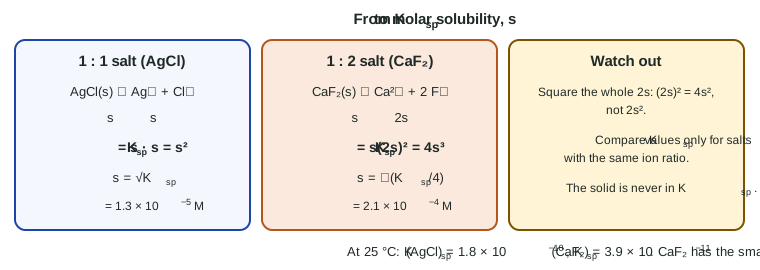
- Each formula unit releases ions in the ratio of its formulaevery ion concentration is s times its coefficient
- The ion concentrations are put into Ksp with their exponentsyou can solve for s, or calculate Ksp from a measured s
- The ion product Q is greater than Kspsolid precipitates until Q = Ksp
Part 6 · Key ideas
Key ideas
- Ksp is the product of the ion concentrations in a saturated solution, each raised to its coefficient; the solid is left out.
- Molar solubility s: mol of salt dissolved per liter. 1 : 1 salt: Ksp = s². MX2 salt: Ksp = s(2s)² = 4s³.
- Rank solubility by Ksp only for salts with the same ion ratio.
- Q > Ksp: precipitate forms. Q < Ksp: more can dissolve.
Part 7 · Misconception
A common mistake
The wrong idea: For Mg(OH)₂, Ksp = s × 2s, because there are two hydroxide ions.
What actually happens: [OH⁻] = 2s, and it is raised to the power 2 in Ksp: Ksp = s(2s)² = 4s³. Forgetting to square [OH⁻] is the most common Ksp error on the exam.
Part 8 · Check yourself
Check yourself
Exam-style questions. Anything you miss goes into your review queue.
Data table
Solubility products of four salts
A student looks up Ksp values (approximate, at 25 °C) for four slightly soluble salts.
| Salt | Ions formed per formula unit | Ksp |
|---|---|---|
| AgCl | 1 Ag+, 1 Cl− | 1.8 × 10⁻¹⁰ |
| AgBr | 1 Ag+, 1 Br− | 5.0 × 10⁻¹³ |
| Ag2CrO4 | 2 Ag+, 1 CrO42− | 1.1 × 10⁻¹² |
| CaF2 | 1 Ca2+, 2 F− | 3.9 × 10⁻¹¹ |
1. Calculate the molar solubility of AgCl in pure water at 25 °C.
Type a number and its unit.
Show the answer
AgCl(s) ⇌ Ag⁺ + Cl⁻; [Ag⁺] = [Cl⁻] = s. Ksp = s² = 1.8 × 10⁻¹⁰, so s = √(1.8 × 10⁻¹⁰) = 1.3 × 10⁻⁵ M.
- Answer: 1.3 × 10⁻⁵ M
2. Calculate the molar solubility of Ag2CrO4 in pure water at 25 °C.
Type a number and its unit.
Show the answer
Ag₂CrO₄(s) ⇌ 2 Ag⁺ + CrO₄²⁻; [Ag⁺] = 2s, [CrO₄²⁻] = s. Ksp = (2s)²(s) = 4s³ = 1.1 × 10⁻¹², so s³ = 2.75 × 10⁻¹³ and s = 6.5 × 10⁻⁵ M.
- Answer: 6.5 × 10⁻⁵ M
3. Ag2CrO4 has a smaller Ksp than AgCl. Which salt has the greater molar solubility in water?
- Ag2CrO4
- AgCl
- They are equally soluble, because both are silver salts.
- It is undecided without the masses of the salts.
Show the answer
Ranking by Ksp works only for salts with the same ion ratio. Otherwise, calculate the molar solubility of each.
- Correct: Ag2CrO4: Right: 6.5 × 10⁻⁵ M versus 1.3 × 10⁻⁵ M. With different ion ratios, the Ksp expressions have different forms, so Ksp alone cannot be compared.
- AgCl: AgCl has the larger Ksp, but the expressions differ (s² vs 4s³). Calculate s for each.
- They are equally soluble, because both are silver salts.: Sharing a cation does not make solubilities equal.
- It is undecided without the masses of the salts.: It can: solve each Ksp expression for s.
4. Which pair of salts can be ranked by solubility just by comparing their Ksp values?
- AgCl and AgBr
- AgCl and Ag2CrO4
- AgBr and CaF2
- Ag2CrO4 and AgBr
Show the answer
When two salts produce the same number and ratio of ions, their Ksp expressions have the same form, so Ksp ranks solubility directly.
- Correct: AgCl and AgBr: Right: both are 1 : 1, so Ksp = s² for each and a larger Ksp means a larger s.
- AgCl and Ag2CrO4: These have different ion ratios (1 : 1 and 2 : 1), so their expressions differ.
- AgBr and CaF2: Different ion ratios: s² versus 4s³.
- Ag2CrO4 and AgBr: Different ion ratios: 4s³ versus s².
5. The molar solubility of Mg(OH)2 in water at 25 °C is 1.1 × 10⁻⁴ M. Calculate Ksp.
Type a number.
Show the answer
[Mg²⁺] = 1.1 × 10⁻⁴ M; [OH⁻] = 2(1.1 × 10⁻⁴) = 2.2 × 10⁻⁴ M. Ksp = (1.1 × 10⁻⁴)(2.2 × 10⁻⁴)² = 5.3 × 10⁻¹².
- Answer: 5.3 × 10⁻¹²
6. Equal volumes of 2.0 × 10⁻⁴ M AgNO3 and 2.0 × 10⁻⁴ M NaCl are mixed. Ksp of AgCl is 1.8 × 10⁻¹⁰. Does AgCl precipitate?
- Yes: Q = 1.0 × 10⁻⁸ > Ksp.
- No: Q = 1.0 × 10⁻⁸ < Ksp.
- Yes: Q = 4.0 × 10⁻⁸ > Ksp.
- No: both solutions are too dilute to form a solid.
Show the answer
Compare the ion product Q with Ksp. After mixing, [Ag⁺] = [Cl⁻] = 1.0 × 10⁻⁴ M; Q = 1.0 × 10⁻⁸ > Ksp, so solid AgCl forms until Q = Ksp.
- Correct: Yes: Q = 1.0 × 10⁻⁸ > Ksp.: Right: mixing equal volumes halves each concentration to 1.0 × 10⁻⁴ M, and Q = (1.0 × 10⁻⁴)² = 1.0 × 10⁻⁸ > 1.8 × 10⁻¹⁰.
- No: Q = 1.0 × 10⁻⁸ < Ksp.: Compare powers of ten: 10⁻⁸ is larger than 10⁻¹⁰.
- Yes: Q = 4.0 × 10⁻⁸ > Ksp.: The conclusion is right but Q is wrong: mixing equal volumes halves each concentration before you multiply.
- No: both solutions are too dilute to form a solid.: Dilution matters only through Q; here Q is still far above Ksp.
7. Put the steps for finding molar solubility from Ksp in order.
- Write the dissolving equation, with the ions in the ratio of the formula.
- Let s be the molar solubility and write each ion concentration as s times its coefficient.
- Write Ksp with each ion concentration raised to its coefficient, e.g. s(2s)2 = 4s3.
- Solve for s and report it in mol/L.
Show the answer
Equation, ion concentrations in terms of s, Ksp expression with exponents, solve.
- Correct order: 1. Write the dissolving equation, with the ions in the ratio of the formula. 2. Let s be the molar solubility and write each ion concentration as s times its coefficient. 3. Write Ksp with each ion concentration raised to its coefficient, e.g. s(2s)2 = 4s3. 4. Solve for s and report it in mol/L.
Part 9 · Summary
Summary
Part 10 · Up next
What comes next
Part 11 · Connections