Topic 6.1 said energy moves between a system and its surroundings. This page looks at how it moves: what heat is, why it always flows from hot to cold, what happens to the particles on the way, and when it stops. The key rule, energy lost equals energy gained, is the basis of every energy measurement in the next topic.
Temperature, thermal energy and heat
Three words are easy to mix up:
- Temperature measures the average kinetic energy of the particles. Faster particles, higher temperature.
- Thermal energy is the total kinetic energy of all the particles in an object. A bathtub of warm water has far more thermal energy than a cup of hot coffee, even though the coffee is hotter.
- Heat is energy transferred from one object to another because their temperatures differ. Objects do not contain heat; they exchange it.
How energy moves: collisions
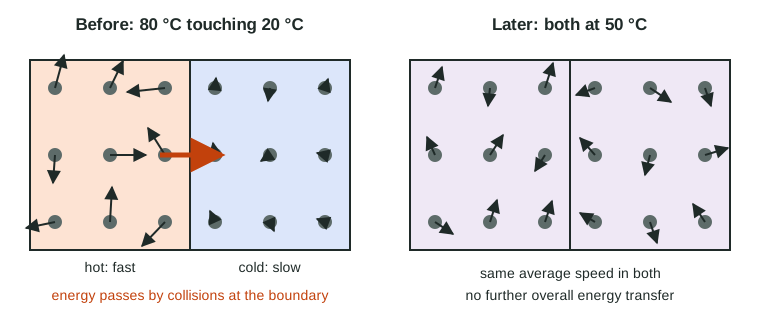
Picture a hot metal block touching a cold one. At the boundary, fast-vibrating atoms of the hot block bump into slow-vibrating atoms of the cold block. In a collision between a fast particle and a slow one, the fast one usually slows down and the slow one usually speeds up, just as a fast billiard ball slows when it hits a slow one. Over billions of collisions, energy moves from the hot block into the cold block.
That is why heat always flows from the warmer object to the cooler one. Nothing called "cold" ever flows: an ice cube cools a drink because energy leaves the drink and goes into the ice.
Thermal equilibrium
As energy flows, the hot object cools and the cold one warms. The flow slows as the temperature gap closes, because the particles on each side become more alike. When the temperatures are equal, the objects are in thermal equilibrium.
At equilibrium the particles have not stopped. They keep colliding and individual collisions still pass energy, but as much energy goes each way as the other, so there is no net transfer. The temperature then stays constant.
A practical consequence: a thermometer works because it reaches thermal equilibrium with whatever it touches, and then it reads its own temperature, which is now the same.
Energy lost = energy gained
Energy is conserved. If two objects exchange energy inside an insulated container, so nothing leaks to the room, then
energy lost by the hot object = energy gained by the cold object
With signs: the hot object's energy change is negative and the cold object's is positive, and they add to zero.
Worked example. A hot piece of iron is dropped into water in an insulated cup. The iron loses 3.20 kJ before both reach the same temperature. How much energy does the water gain, in joules?
Energy gained by the water = energy lost by the iron = 3.20 kJ.
Convert: 3.20 kJ × (1000 J / 1 kJ) = 3.20 × 10³ J.
The iron's energy change is −3.20 × 10³ J; the water's is +3.20 × 10³ J.
Notice that the same amount of energy can produce very different temperature changes. 3.20 kJ might cool a small piece of iron by 70 °C but warm a large amount of water by only a few degrees. How many degrees a given amount of energy changes a substance depends on what it is and how much there is; topic 6.4 makes that quantitative.
Where the final temperature lands
The final temperature is always between the two starting temperatures: the hot object cannot end hotter than it started, and the cold one cannot end colder. When equal masses of the same substance are mixed, each changes by the same number of degrees, so the final temperature is the average. Mixing 100 g of water at 60 °C with 100 g at 20 °C gives 40 °C.
Why metal feels colder than wood
Touch a metal bench and a wooden bench on a cold morning. Both are at the air temperature, but the metal feels colder. Your skin does not sense the bench's temperature; it senses how fast your skin is losing energy. Metal passes energy along from particle to particle much faster than wood, so it pulls energy out of your hand faster.