You cannot put a thermometer on a molecule. But you can let a reaction exchange energy with a known amount of water and measure how much the water's temperature changes. That is calorimetry, and it is one of the most tested lab skills on the exam: a calorimetry question appears on the free response almost every year. This page covers specific heat, the equation q = mcΔT, the sign rule that links the solution to the reaction, ΔH per mole, and how errors push the answer.
Specific heat capacity
Put the same amount of energy into 1 g of water and 1 g of iron. The iron's temperature rises about nine times as much. Substances differ in how much energy it takes to warm them.
The specific heat capacity (specific heat), c, is the energy needed to raise the temperature of 1 g of a substance by 1 °C. For liquid water it is 4.18 J/(g·°C); for iron about 0.45 J/(g·°C). A change of 1 °C is the same size as a change of 1 K, so J/(g·°C) and J/(g·K) are the same unit.
Water's high specific heat is why lakes and oceans warm and cool slowly, and why a beach's sand can burn your feet while the water stays cool.
Heat capacity, C, is the same idea for a whole object: the energy to raise the object's temperature by 1 °C, in J/°C. For an object made of one substance, C = m × c. A swimming pool and a cup of water have the same specific heat but very different heat capacities.
q = mcΔT
The energy transferred as heat to or from a sample is
q = m × c × ΔT
where m is the mass in grams, c is the specific heat, and ΔT = T(final) − T(initial). This equation is on the exam's equations sheet. If the sample warms, ΔT is positive and q is positive (the sample gained energy). If it cools, both are negative.
Worked example 1. How much energy does it take to warm 250.0 g of water from 20.0 °C to 85.0 °C?
ΔT = 85.0 °C − 20.0 °C = 65.0 °C
q = 250.0 g × 4.18 J/(g·°C) × 65.0 °C = 67,925 J
Units: g cancels g, °C cancels °C, leaving J. Round once, at the end, to three significant figures (4.18 and 65.0 each have three): q = 67.9 kJ.
The coffee-cup calorimeter
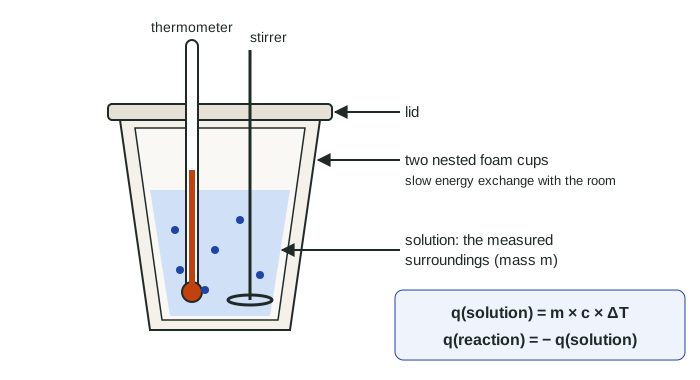
A calorimeter is a container that keeps the energy of a process inside a measured mass of solution. In school labs it is two nested foam cups with a lid. The reaction is the system; the solution is the surroundings you measure. Because energy is conserved,
q(reaction) = −q(solution)
The minus sign is the most important part of the calculation. If the solution warms, it gained energy, so the reaction lost that energy: q(reaction) is negative and the reaction is exothermic. If the solution cools, the reaction absorbed energy: q(reaction) is positive.
The same rule covers physical processes such as dissolving a salt: if the water cools as the salt dissolves, the dissolving absorbed energy and has a positive q.
From q to ΔH per mole
The energy measured depends on how much reacted. To compare reactions, chemists divide by moles to get ΔH per mole. Use the moles of the substance named in the question, and if the reactants are not in the right ratio, the moles of the limiting reactant, because the excess reactant does not react.
Worked example 2. 50.0 mL of 1.00 M HCl and 50.0 mL of 1.00 M NaOH are mixed in a coffee-cup calorimeter. The temperature rises from 21.48 °C to 28.15 °C. Take the solution's mass as 100.0 g and c = 4.18 J/(g·°C). Find ΔH per mole of water formed.
1. ΔT = 28.15 °C − 21.48 °C = 6.67 °C
2. q(solution) = 100.0 g × 4.18 J/(g·°C) × 6.67 °C = 2788.1 J = 2.7881 kJ (keep extra digits until the end)
3. q(reaction) = −q(solution) = −2.7881 kJ
4. Moles of water = moles of H⁺ = 0.0500 L × 1.00 mol/L = 0.0500 mol (H⁺ and OH⁻ react 1 : 1 and are in equal amounts)
5. ΔH = −2.7881 kJ ÷ 0.0500 mol = −55.76 kJ/mol → −55.8 kJ/mol (three significant figures)
Three slips cost the most points here: forgetting the minus sign, dividing a value in J by moles and calling it kJ/mol (a factor of 1000), and using the mass of only one of the two solutions.
Reading temperature-time data
Real calorimeters leak a little. Probes record temperature against time, and the curve rises (or falls) quickly while the reaction runs, then drifts slowly back toward room temperature. Use the highest (or lowest) temperature as the final temperature, not the last reading: the drift afterward is energy leaking to or from the room.
How errors change the result
| Error | Effect on measured q | Effect on calculated |ΔH| |
|---|---|---|
| Energy escapes to the room (no lid, one cup) | too small | too small |
| Thermometer read before the extreme temperature | too small | too small |
| Calorimeter's own heat capacity ignored | too small | too small |
| Some limiting reactant spilled, full amount used in the division | too small | too small |
| Mass of solution recorded too large | too large | too large |
For an exothermic reaction, "|ΔH| too small" means ΔH is less negative than the true value. Exam answers earn the point by naming the direction and the reason: "Energy was lost to the surroundings, so ΔT and the calculated q were smaller than they should be, and the magnitude of ΔH is too small."