In Unit 2 you met bond energy: the energy needed to pull two bonded atoms apart. This page turns that idea into a way to estimate the enthalpy of a reaction without a calorimeter. It is also where the most common sign mistake of the unit lives, so the order of subtraction gets special attention.
Bond enthalpy
The bond enthalpy of a bond is the energy needed to break 1 mol of that bond in gas-phase molecules, leaving separate atoms. Because bonded atoms attract each other, breaking a bond always takes energy, so bond enthalpies are positive. Forming the same bond releases the same amount.
A table lists average bond enthalpies. The C–H bond in methane, in ethane and in ethanol is not exactly equally strong, because the rest of the molecule changes the electrons around it. The table value, 413 kJ/mol, is an average over many molecules.
| Bond | kJ/mol | Bond | kJ/mol |
|---|---|---|---|
| H–H | 436 | C–C | 348 |
| C–H | 413 | C=C | 614 |
| O–H | 463 | O=O | 495 |
| H–Cl | 431 | C=O (in CO₂) | 799 |
| Cl–Cl | 242 | N≡N | 941 |
Two patterns: multiple bonds are stronger than single bonds between the same atoms (C–C 348, C=C 614), and bonds between small atoms tend to be strong.
Broken minus formed
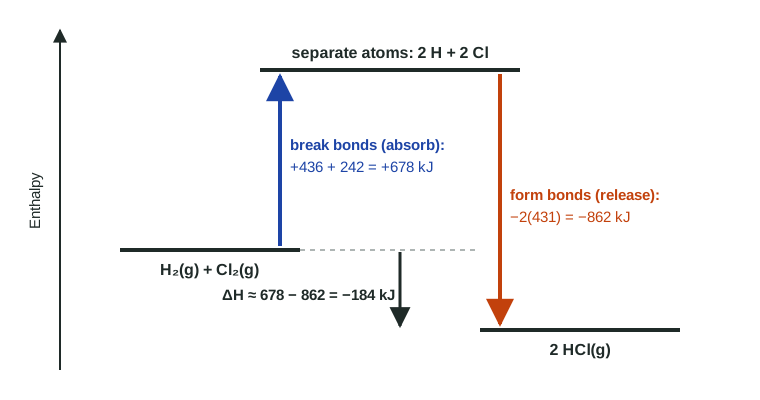
Imagine a reaction happening in two steps. First, every bond in the reactants breaks, giving separate atoms; that absorbs energy. Then the atoms join into the products; that releases energy. The net change is
ΔH ≈ Σ(bond enthalpies of bonds broken) − Σ(bond enthalpies of bonds formed)
Notice the order: broken minus formed, which is reactants minus products. That is the opposite of the "products minus reactants" rule you will use in the next topic. Mixing them up gives the right number with the wrong sign, a slip the exam readers see every year. If you remember the reason (breaking costs energy, forming pays it back), you will not need to memorize the order.
Worked example
Worked example. Estimate ΔH for the combustion of methane, CH₄(g) + 2 O₂(g) → CO₂(g) + 2 H₂O(g).
1. Draw the structures and list every bond. CH₄ has 4 C–H. Each O₂ has 1 O=O, and there are 2 O₂. CO₂ is O=C=O: 2 C=O. Each H₂O has 2 O–H, and there are 2 H₂O: 4 O–H.
2. Bonds broken: 4 C–H + 2 O=O = 4(413 kJ) + 2(495 kJ) = 1652 + 990 = 2642 kJ
3. Bonds formed: 2 C=O + 4 O–H = 2(799 kJ) + 4(463 kJ) = 1598 + 1852 = 3450 kJ
4. ΔH ≈ 2642 kJ − 3450 kJ = −808 kJ/mol
The measured value for these gas-phase products is −802 kJ/mol, so the estimate is within 1%. The small gap comes from using averages.
A shortcut: bonds that appear on both sides (like the four C–H bonds of ethene that are still there in ethane) can be left out of both sums, because breaking and re-forming them cancels.
Why bond enthalpies give estimates
- The values are averages, so the answer differs from the measured ΔH by a few kJ, sometimes a few percent.
- They apply to gas-phase molecules. If a reactant or product is a liquid or solid, the attractions between molecules are not counted, and the estimate is less reliable. Methane burning to liquid water releases 890 kJ/mol, not 808: condensing the water releases the extra energy.
When the exam asks why a bond-enthalpy result differs from a measured one, the expected answer is that tabulated bond enthalpies are averages over many compounds.
Reasoning without numbers
You can often predict the sign without a table. A reaction that breaks weak bonds and forms strong ones is exothermic: H₂ + F₂ → 2 HF breaks a very weak F–F bond (155 kJ/mol) and forms two very strong H–F bonds (567 kJ/mol each), releasing about 543 kJ/mol. A reaction that breaks a very strong bond, like N≡N (941 kJ/mol), has a large energy cost to overcome.