Bond enthalpies give quick estimates, but chemists need exact values for real compounds, in real states. The solution is a table with one number per compound: its standard enthalpy of formation. With it, the ΔH of almost any reaction is a few lines of arithmetic. The equation you use is printed on the exam's equations sheet.
Standard states
The standard state of a substance is its pure form at 1 atm (and, in tables, usually 25 °C). For an element it is the most stable form under those conditions:
- oxygen: O₂(g), not O atoms and not ozone, O₃(g);
- hydrogen, nitrogen, chlorine: H₂(g), N₂(g), Cl₂(g);
- carbon: graphite, not diamond;
- bromine: Br₂(l); mercury: Hg(l); iron: Fe(s).
A small degree sign marks standard conditions: ΔH°.
Standard enthalpy of formation
The standard enthalpy of formation, ΔH°f, of a compound is the enthalpy change for making 1 mol of it from its elements, each in its standard state. Its formation reaction may need fractions:
½ N₂(g) + O₂(g) → NO₂(g) ΔH°f = +33.2 kJ/mol
C(graphite) + O₂(g) → CO₂(g) ΔH°f = −393.5 kJ/mol
For an element already in its standard state there is nothing to make, so its ΔH°f is zero by definition. A negative ΔH°f means the compound is lower in enthalpy than its elements (most compounds); a positive one means it is higher (NO, NO₂, ozone, ethene).
The state matters: H₂O(l) is −285.8 kJ/mol and H₂O(g) is −241.8 kJ/mol. The 44.0 kJ difference is the energy to vaporize 1 mol of water at 25 °C.
ΔH° of any reaction
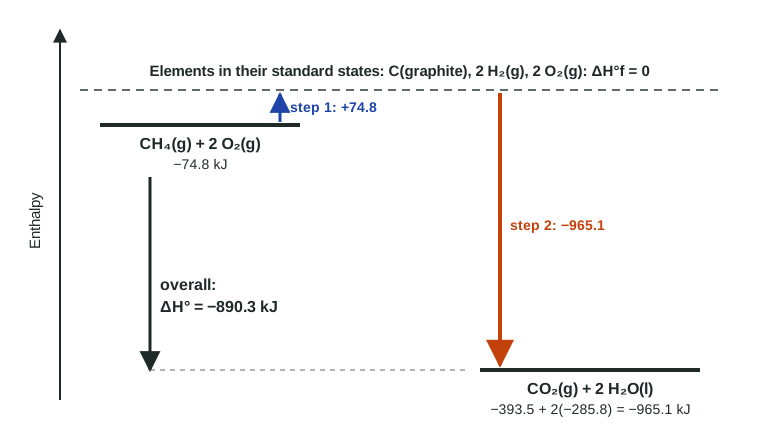
Imagine the reaction in two steps. First, take every reactant apart into its elements: that is each formation reaction run backward, so it contributes −ΔH°f for each reactant. Then build every product from those elements: +ΔH°f for each product. The overall change does not depend on the route (topic 6.9 shows why), so
ΔH°rxn = Σ n·ΔH°f(products) − Σ n·ΔH°f(reactants)
where each n is a coefficient from the balanced equation.
Worked example. Calculate ΔH° for CH₄(g) + 2 O₂(g) → CO₂(g) + 2 H₂O(l). ΔH°f: CH₄(g) −74.8, CO₂(g) −393.5, H₂O(l) −285.8 kJ/mol.
1. Products: 1(−393.5) + 2(−285.8) = −393.5 − 571.6 = −965.1 kJ
2. Reactants: 1(−74.8) + 2(0) = −74.8 kJ (O₂ is an element in its standard state)
3. ΔH° = (−965.1 kJ) − (−74.8 kJ) = −890.3 kJ/mol
Watch the double negative in step 3: subtracting a negative number adds it.
Working backward
If you know ΔH°rxn and every ΔH°f but one, solve for the missing one. Ethene burns as C₂H₄(g) + 3 O₂(g) → 2 CO₂(g) + 2 H₂O(l) with ΔH° = −1411.0 kJ/mol. Then −1411.0 = [2(−393.5) + 2(−285.8)] − [ΔH°f(C₂H₄) + 0] = −1358.6 − ΔH°f(C₂H₄), so ΔH°f(C₂H₄) = +52.4 kJ/mol.
Two subtraction rules, side by side
| Method | Equation | Why that order |
|---|---|---|
| Bond enthalpies (6.7) | Σ broken − Σ formed (reactants − products) | breaking absorbs, forming releases |
| Enthalpies of formation (6.8) | Σ products − Σ reactants | build the products, take the reactants apart |
Results from ΔH°f values are more reliable than bond-enthalpy estimates, because each ΔH°f is measured for one specific substance in one specific state, while bond enthalpies are averages.