Calorimetry measures the energy of one run of a reaction. To use that energy for any amount, chemists attach it to the balanced equation. This page explains the thermochemical equation, what "kJ/mol" means in it, how to scale and reverse it, and how to combine it with stoichiometry, including limiting reactants.
Thermochemical equations
A thermochemical equation is a balanced equation, with the state of every substance, followed by its enthalpy of reaction, ΔH:
N₂(g) + 3 H₂(g) → 2 NH₃(g) ΔH = −92.2 kJ/mol
The "per mole" means per mole of reaction: the reaction happening once in exactly the amounts the coefficients say. Here, when 1 mol of N₂ reacts with 3 mol of H₂ to make 2 mol of NH₃, 92.2 kJ is released. It does not mean 92.2 kJ per mole of NH₃. When ΔH is measured with every substance in its usual form at 1 atm (and usually 25 °C), it is written ΔH° and called the standard enthalpy of reaction.
The states matter. Burning methane to make liquid water releases 890.3 kJ/mol; making water vapor instead releases only 802.3 kJ/mol, because 2 mol of water vapor still hold the 2 × 44.0 kJ that condensing would release.
Scaling and reversing
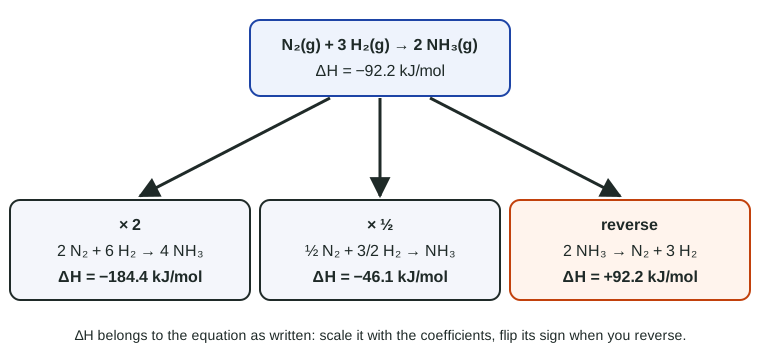
- Multiply every coefficient by a number, and multiply ΔH by the same number. Twice the reaction, twice the energy.
- Reverse the equation, and change the sign of ΔH. If forming ammonia releases 92.2 kJ, decomposing it absorbs 92.2 kJ.
Fractions are fine in a thermochemical equation, because coefficients count moles, not molecules: ½ N₂(g) + 3/2 H₂(g) → NH₃(g), ΔH = −46.1 kJ/mol.
Energy for a given amount
Treat ΔH as one more term in the mole ratio. From the ammonia equation you can write three conversion factors:
−92.2 kJ / 1 mol N₂ −92.2 kJ / 3 mol H₂ −92.2 kJ / 2 mol NH₃
Worked example 1. Propane burns as C₃H₈(g) + 5 O₂(g) → 3 CO₂(g) + 4 H₂O(l), ΔH = −2220 kJ/mol. What is q for the system when 11.0 g of propane (44.10 g/mol) burns?
1. Moles: 11.0 g ÷ 44.10 g/mol = 0.2494 mol C₃H₈
2. Energy: 0.2494 mol C₃H₈ × (−2220 kJ / 1 mol C₃H₈) = −553.7 kJ
3. Round once: q = −554 kJ (three significant figures, from 11.0 g). The minus sign says the system releases 554 kJ.
Worked example 2, limiting reactant. A hand warmer reacts 4 Fe(s) + 3 O₂(g) → 2 Fe₂O₃(s), ΔH = −1648.4 kJ/mol. It has 10.0 g of iron (55.85 g/mol), but only 0.0500 mol of O₂ reaches it. How much energy is released?
1. Which runs out? 10.0 g Fe = 0.1791 mol, which would need 0.1791 × 3/4 = 0.1343 mol O₂. Only 0.0500 mol is available, so O₂ is limiting.
2. Energy: 0.0500 mol O₂ × (1648.4 kJ / 3 mol O₂) = 27.47 kJ → 27.5 kJ released.
Using the iron instead would give 73.8 kJ, energy from iron that never reacted.
Signs: system and surroundings
ΔH and q(reaction) describe the reacting system. The surroundings always have the opposite sign: q(surroundings) = −q(reaction). In the propane example, the grill, food and air gain +554 kJ. On the exam, say which one you mean: "the reaction releases 554 kJ" or "q for the reaction is −554 kJ" are both right; "q = +554 kJ for the reaction" is not.
Common slips
| Slip | Fix |
|---|---|
| Using ΔH as "per mole of product" when the product's coefficient is 2 | Divide ΔH by that coefficient first |
| Multiplying grams by kJ/mol | Convert to moles first |
| Basing the energy on the reactant in excess | Find the limiting reactant |
| Halving the equation but not ΔH (or reversing without changing the sign) | Whatever you do to the equation, do to ΔH |
| Ignoring the states | Check whether water is (l) or (g) |