Bond Enthalpies
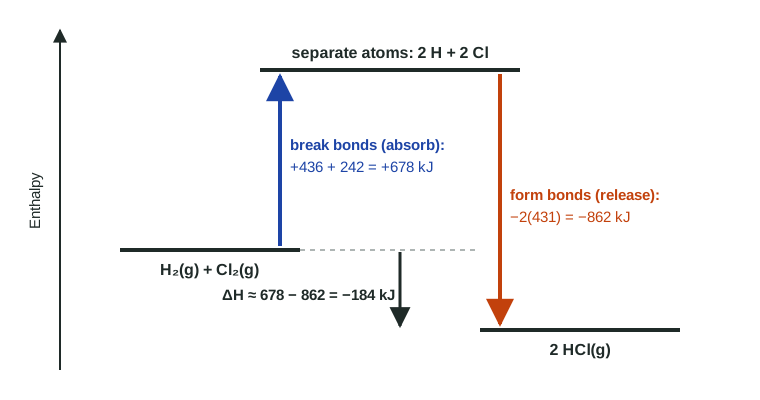
Bond enthalpies give an estimate of ΔH: add the bond enthalpies of the bonds broken, then subtract those of the bonds formed.
Part 1 · Hook
Why this matters
Part 2 · Before you start
What this builds on
Part 3 · Prerequisite check
Quick check before you start
1. The bond energy of a covalent bond is
- the energy needed to break it
- the energy released when it breaks
- the mass of the bond
- the length of the bond
Show the answer
It is the depth of the potential energy well: the energy needed to pull the bonded atoms apart.
- Correct: the energy needed to break it:
- the energy released when it breaks:
- the mass of the bond:
- the length of the bond:
2. How many bonds are in one CO₂ molecule (O=C=O)?
- Two C=O double bonds
- Two C–O single bonds
- One C=O double bond
- Three bonds
Show the answer
The Lewis structure has carbon double-bonded to each oxygen.
- Correct: Two C=O double bonds:
- Two C–O single bonds:
- One C=O double bond:
- Three bonds:
3. ΔH for a thermochemical equation is per
- mole of reaction as written
- gram of product
- molecule
- mole of each substance
Show the answer
It goes with the coefficients exactly as written.
- Correct: mole of reaction as written:
- gram of product:
- molecule:
- mole of each substance:
Part 4 · See it
See it first
Part 5 · Step by step
How it works, step by step
- Bonded atoms attract each otherbreaking a bond absorbs energy, its bond enthalpy (always positive)
- Separate atoms are pulled together into a bondforming the bond releases the same amount of energy
- A reaction breaks the reactant bonds and forms the product bondsΔH ≈ Σ(bonds broken) − Σ(bonds formed)
- Strong bonds form from weak onesmore energy is released than absorbed: exothermic
- Table values are averages over many moleculesthe result is an estimate, close to but not equal to the measured ΔH
Part 6 · Key ideas
Key ideas
- A bond enthalpy is the energy needed to break 1 mol of a bond in gas-phase molecules; it is always positive.
- ΔH ≈ Σ(bonds broken) − Σ(bonds formed). Broken first; this is not "products minus reactants".
- Draw the structures and count every bond, including coefficients: 2 O₂ means 2 O=O.
- Multiple bonds are stronger than single bonds between the same atoms.
- Average values make the answer an estimate; it is meant for gas-phase reactions.
Part 7 · Misconception
A common mistake
The wrong idea: Energy is stored in chemical bonds and released when the bonds break.
What actually happens: Breaking a bond always absorbs energy. Energy is released when bonds form; a reaction is exothermic when the bonds formed are stronger overall than those broken.
Part 8 · Check yourself
Check yourself
Exam-style questions. Anything you miss goes into your review queue.
Data table
Average bond enthalpies
Average bond enthalpies for bonds in gas-phase molecules. Use them for every item in this set.
| Bond | Bond enthalpy (kJ/mol) | Bond | Bond enthalpy (kJ/mol) |
|---|---|---|---|
| H–H | 436 | N≡N | 941 |
| C–H | 413 | N–H | 391 |
| C–C | 348 | H–Cl | 431 |
| C=C | 614 | Cl–Cl | 242 |
| O–H | 463 | C–Cl | 328 |
| O=O | 495 | H–F | 567 |
| C=O (in CO₂) | 799 | F–F | 155 |
1. Estimate ΔH, in kJ/mol, for CH₄(g) + 2 O₂(g) → CO₂(g) + 2 H₂O(g). (CO₂ is O=C=O; water is H–O–H.)
Type a number and its unit.
Show the answer
Broken: 4 C–H + 2 O=O = 4(413) + 2(495) = 2642 kJ. Formed: 2 C=O + 4 O–H = 2(799) + 4(463) = 3450 kJ. ΔH ≈ broken − formed = 2642 − 3450 = −808 kJ/mol.
- Answer: -808 kJ/mol
2. Estimate ΔH, in kJ/mol, for the hydrogenation of ethene: H₂C=CH₂(g) + H–H(g) → H₃C–CH₃(g).
Type a number and its unit.
Show the answer
Only the changed bonds matter (the four C–H bonds of ethene stay). Broken: C=C + H–H = 614 + 436 = 1050 kJ. Formed: C–C + 2 C–H = 348 + 2(413) = 1174 kJ. ΔH ≈ 1050 − 1174 = −124 kJ/mol.
- Answer: -124 kJ/mol
3. Estimate ΔH, in kJ/mol, for N₂(g) + 3 H₂(g) → 2 NH₃(g).
Type a number and its unit.
Show the answer
Broken: N≡N + 3 H–H = 941 + 3(436) = 2249 kJ. Formed: 2 NH₃ have 6 N–H = 6(391) = 2346 kJ. ΔH ≈ 2249 − 2346 = −97 kJ/mol.
- Answer: -97 kJ/mol
4. The measured ΔH for N₂(g) + 3 H₂(g) → 2 NH₃(g) is −92.2 kJ/mol. Why does the estimate from the table differ slightly?
- The estimate counts the bonds broken but leaves out the bonds formed.
- Bond enthalpies give the energy released when bonds break, so the sign is reversed.
- The measured value includes energy to melt the ammonia, which the estimate leaves out.
- The table lists averages over many molecules, not the N–H bond strength in NH₃ itself.
Show the answer
Bond enthalpies are averages for a bond type across many compounds, so a bond-enthalpy ΔH is an estimate; here −97 kJ/mol versus −92.2 kJ/mol measured.
- The estimate counts the bonds broken but leaves out the bonds formed.: Both are counted: ΔH ≈ broken − formed.
- Bond enthalpies give the energy released when bonds break, so the sign is reversed.: Breaking a bond absorbs energy, and the sign of the estimate matches the measured value.
- The measured value includes energy to melt the ammonia, which the estimate leaves out.: All three substances are gases at these conditions; nothing melts.
- Correct: The table lists averages over many molecules, not the N–H bond strength in NH₃ itself.: Right: an N–H bond's strength depends on the rest of the molecule; 391 kJ/mol is an average.
5. Which expression gives ΔH from average bond enthalpies?
- Sum of bond enthalpies of bonds formed − sum of bond enthalpies of bonds broken
- Sum of bond enthalpies of bonds broken − sum of bond enthalpies of bonds formed
- Sum of bond enthalpies of the products − sum of bond enthalpies of the reactants
- Sum of bond enthalpies of the bonds in the reactants and products
Show the answer
ΔH ≈ Σ(bonds broken) − Σ(bonds formed). Breaking bonds costs energy (+); forming them pays energy back (−).
- Sum of bond enthalpies of bonds formed − sum of bond enthalpies of bonds broken: This gives the right size with the wrong sign. Bonds broken come first.
- Correct: Sum of bond enthalpies of bonds broken − sum of bond enthalpies of bonds formed: Right: energy in to break bonds, minus energy out from forming them.
- Sum of bond enthalpies of the products − sum of bond enthalpies of the reactants: This is the "products minus reactants" habit; with bond enthalpies it gives the wrong sign.
- Sum of bond enthalpies of the bonds in the reactants and products: Breaking and forming have opposite signs, so they cannot simply be added.
6. A student says, "Fuels like gasoline store energy in their bonds, and the energy is released when those bonds break." Which statement best corrects this?
- Breaking the fuel's bonds releases energy, but just at a high temperature.
- Breaking the fuel's bonds absorbs energy; burning releases energy because the bonds formed in CO₂ and H₂O are stronger.
- The energy comes from the oxygen's bonds breaking, not the fuel's.
- The energy comes from the fuel's bonds getting stronger as it burns.
Show the answer
Energy is released when bonds form. Burning a fuel is exothermic because the C=O and O–H bonds formed in CO₂ and H₂O release more energy than breaking the fuel's bonds and the O=O bonds absorbs; for methane, 2 C=O and 4 O–H formed outweigh 4 C–H and 2 O=O broken.
- Breaking the fuel's bonds releases energy, but just at a high temperature.: Breaking bonds absorbs energy at any temperature.
- Correct: Breaking the fuel's bonds absorbs energy; burning releases energy because the bonds formed in CO₂ and H₂O are stronger.: Right: the energy comes from the difference, with strong product bonds forming.
- The energy comes from the oxygen's bonds breaking, not the fuel's.: Breaking O=O bonds also absorbs energy.
- The energy comes from the fuel's bonds getting stronger as it burns.: The fuel molecules are taken apart; new, stronger bonds form in the products.
7. Using H–H 436, O=O 495 and O–H 463 kJ/mol, what is the estimated ΔH for 2 H₂(g) + O₂(g) → 2 H₂O(g)?
- +485 kJ/mol
- +5 kJ/mol
- −485 kJ/mol
- +441 kJ/mol
Show the answer
Count every bond: 2 H–H and 1 O=O broken; 2 × 2 = 4 O–H formed. ΔH ≈ 1367 − 1852 = −485 kJ/mol.
- +485 kJ/mol: Size right, sign wrong: you subtracted broken from formed.
- +5 kJ/mol: You counted one H–H bond and two O–H bonds; two H₂ react and two H₂O (four O–H) form.
- Correct: −485 kJ/mol: Right: broken 2(436) + 495 = 1367; formed 4(463) = 1852; ΔH ≈ 1367 − 1852 = −485 kJ/mol.
- +441 kJ/mol: Each water molecule has two O–H bonds, so four O–H bonds form.
Part 9 · Summary
Summary
Part 10 · Up next
What comes next
Part 11 · Connections