Energy of Phase Changes
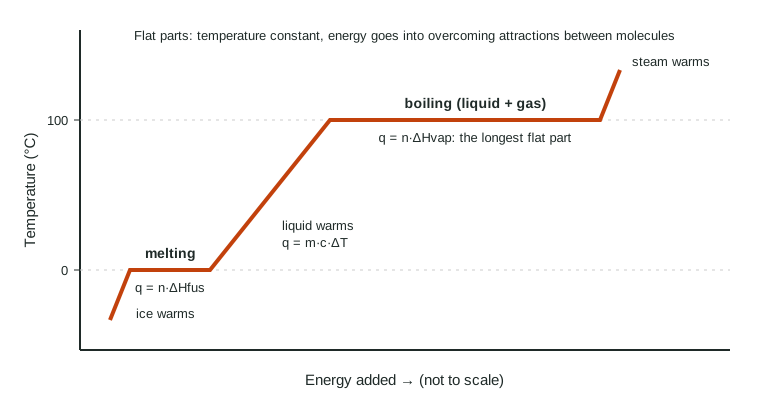
During a phase change, energy overcomes (or forms) attractions between particles, so the temperature stays constant.
Part 1 · Hook
Why this matters
Part 2 · Before you start
What this builds on
Part 3 · Prerequisite check
Quick check before you start
1. When water boils, what is overcome?
- Hydrogen bonds between water molecules
- O–H covalent bonds inside each molecule
- Ionic bonds
- Nothing
Show the answer
Phase changes overcome attractions between molecules; the molecules stay intact.
- Correct: Hydrogen bonds between water molecules:
- O–H covalent bonds inside each molecule:
- Ionic bonds:
- Nothing:
2. How much energy warms 10.0 g of water by 5.0 °C? (c = 4.18 J/(g·°C))
- 209 J
- 50 J
- 20.9 J
- 2.09 J
Show the answer
q = mcΔT = 10.0 × 4.18 × 5.0 = 209 J.
- Correct: 209 J:
- 50 J:
- 20.9 J:
- 2.09 J:
Part 4 · See it
See it first
Part 5 · Step by step
How it works, step by step
- Energy is added to a solidits particles vibrate faster and its temperature rises until it reaches the melting point
- At the melting point, added energy overcomes the attractions holding particles in placethe solid melts at constant temperature; potential energy rises, kinetic energy does not
- Once melted, added energy speeds the particles up againthe liquid warms until the boiling point
- Boiling separates the particles almost completelythe boiling plateau is longest: ΔHvap is larger than ΔHfus
- Running the curve backward (cooling)condensing and freezing release the same energies: q = −nΔH
Part 6 · Key ideas
Key ideas
- The enthalpy of fusion (ΔHfus) is the energy to melt 1 mol of solid at its melting point; the enthalpy of vaporization (ΔHvap) is the energy to vaporize 1 mol of liquid.
- Melting, vaporizing and subliming absorb energy (q = +nΔH); freezing and condensing release it (q = −nΔH).
- ΔHvap > ΔHfus: vaporizing separates molecules almost completely.
- On a heating curve, slopes use q = mcΔT and flat parts use q = nΔH; add the steps.
- Stronger attractions between particles mean larger ΔHfus and ΔHvap.
Part 7 · Misconception
A common mistake
The wrong idea: While water boils, the energy from the burner makes the water molecules move faster.
What actually happens: The temperature stays at 100 °C, so the average speed of the molecules does not change. The energy goes into separating the molecules from each other.
Part 8 · Check yourself
Check yourself
Exam-style questions. Anything you miss goes into your review queue.
Graph
Heating curve of Compound Q
A 47.05 g sample of solid Compound Q (molar mass 94.10 g/mol) at 20.0 °C is heated by a heater that supplies 150. J of energy to the sample each second. Melting runs from 9.6 s to 47.2 s; boiling runs from 142.3 s to 295.3 s.
Data table
| Time (s) | Compound Q |
|---|---|
| 0 | 20 |
| 9.6 | 41 |
| 47.2 | 41 |
| 142.3 | 182 |
| 295.3 | 182 |
| 303.8 | 200 |
1. During which time interval is Compound Q entirely liquid?
- From 47.2 s to 142.3 s
- From 9.6 s to 47.2 s
- From 142.3 s to 295.3 s
- From 0 s to 9.6 s
Show the answer
Sloped parts show one phase warming; flat parts show two phases changing at constant temperature. The liquid alone is the slope between the two flat parts.
- Correct: From 47.2 s to 142.3 s: Right: melting has finished at the end of the first flat part, and boiling has not yet begun.
- From 9.6 s to 47.2 s: This flat part is melting: solid and liquid are both present.
- From 142.3 s to 295.3 s: This flat part is boiling: liquid and gas are both present.
- From 0 s to 9.6 s: Before the first flat part, the sample is a solid warming up.
2. Calculate the molar enthalpy of fusion of Compound Q, in kJ/mol.
Type a number and its unit.
Show the answer
Melting time = 47.2 s − 9.6 s = 37.6 s. Energy = 37.6 s × 150. J/s = 5640 J = 5.64 kJ. Moles = 47.05 g ÷ 94.10 g/mol = 0.500 mol. ΔHfus = 5.64 kJ ÷ 0.500 mol = 11.28 → 11.3 kJ/mol.
- Answer: 11.3 kJ/mol
3. The boiling plateau is about four times as long as the melting plateau. Which explanation is correct?
- Boiling breaks the covalent bonds inside the molecules of Compound Q; melting leaves them intact.
- The temperature is higher during boiling, so each molecule needs more energy to move.
- Boiling pulls the molecules almost fully apart; melting just loosens their attractions.
- There is more liquid than solid in the sample, so boiling takes longer.
Show the answer
Melting turns a fixed arrangement into a liquid where molecules still touch; vaporizing pulls them apart into a gas. More attractions are overcome, so ΔHvap > ΔHfus.
- Boiling breaks the covalent bonds inside the molecules of Compound Q; melting leaves them intact.: No covalent bonds break in either change; the molecules are still Compound Q in the gas.
- The temperature is higher during boiling, so each molecule needs more energy to move.: The plateau length measures energy to overcome attractions, not the temperature.
- Correct: Boiling pulls the molecules almost fully apart; melting just loosens their attractions.: Right: in the liquid, molecules still touch and attract; boiling overcomes nearly all those attractions.
- There is more liquid than solid in the sample, so boiling takes longer.: The same 0.500 mol of Compound Q melts and then boils.
4. Between 142.3 s and 295.3 s, what happens to the average kinetic energy of the molecules of Compound Q?
- It increases, because the heater keeps adding 150. J of energy to the sample each second.
- It decreases, because the molecules spread far apart from each other as they become a gas.
- It increases, because covalent bonds break and release energy.
- It stays the same, because the energy goes into overcoming attractions between molecules.
Show the answer
Temperature tracks average kinetic energy. On a flat part, the added energy separates molecules (potential energy goes up) while their average speed stays constant.
- It increases, because the heater keeps adding 150. J of energy to the sample each second.: The energy is added, but it does not speed the molecules up while the temperature is flat.
- It decreases, because the molecules spread far apart from each other as they become a gas.: Spreading out raises their potential energy; their average speed stays the same at constant temperature.
- It increases, because covalent bonds break and release energy.: No covalent bonds break, and breaking bonds would absorb energy, not release it.
- Correct: It stays the same, because the energy goes into overcoming attractions between molecules.: Right: constant temperature means constant average kinetic energy; the energy raises the potential energy.
5. Why does the temperature of a melting ice-water mixture stay at 0 °C while energy is added?
- The added energy is lost to the room as fast as it is added.
- The thermometer stops reading temperature changes while ice is present.
- The added energy overcomes attractions between water molecules instead of speeding them up.
- The added energy breaks O–H bonds inside the water molecules.
Show the answer
During a phase change, energy goes into potential energy (separating molecules), not kinetic energy, so the temperature is constant until the change is complete.
- The added energy is lost to the room as fast as it is added.: In a sealed, insulated container, the temperature still stays at 0 °C until the ice is gone.
- The thermometer stops reading temperature changes while ice is present.: The thermometer works fine; the temperature really is constant.
- Correct: The added energy overcomes attractions between water molecules instead of speeding them up.: Right: potential energy rises as the solid structure comes apart; average kinetic energy, and so temperature, stays the same.
- The added energy breaks O–H bonds inside the water molecules.: The molecules stay intact as H₂O; only attractions between them are overcome.
6. How much energy, in kJ, is needed to turn 18.0 g of ice at −10.0 °C into liquid water at 25.0 °C? Use c(ice) = 2.09 J/(g·°C), c(water) = 4.18 J/(g·°C), ΔHfus = 6.01 kJ/mol and 18.02 g/mol.
Type a number and its unit.
Show the answer
Warm the ice: 18.0 × 2.09 × 10.0 = 376 J. Melt: (18.0 ÷ 18.02) mol × 6.01 kJ/mol = 6.003 kJ. Warm the liquid: 18.0 × 4.18 × 25.0 = 1881 J. Total = 0.376 + 6.003 + 1.881 = 8.261 → 8.26 kJ.
- Answer: 8.26 kJ
7. A drink is cooled with either 50 g of ice at 0 °C or 50 g of liquid water at 0 °C. Which cools the drink more, and why?
- The cold water, because liquid water has a higher specific heat than ice.
- They cool it equally, because both start at 0 °C.
- The ice, because melting it absorbs energy from the drink before the meltwater starts to warm.
- The cold water, because ice releases energy as it melts.
Show the answer
Melting is endothermic. The ice takes energy from the drink to melt (6.01 kJ/mol, about 334 J/g) and then more to warm, so it cools the drink more.
- The cold water, because liquid water has a higher specific heat than ice.: Both warm up from 0 °C, but only the ice also absorbs energy by melting.
- They cool it equally, because both start at 0 °C.: Same temperature, but the ice must also melt, which absorbs energy.
- Correct: The ice, because melting it absorbs energy from the drink before the meltwater starts to warm.: Right: each gram of ice absorbs about 334 J just to melt, on top of the energy it absorbs warming up.
- The cold water, because ice releases energy as it melts.: Melting is endothermic: it absorbs energy.
Part 9 · Summary
Summary
Part 10 · Up next
What comes next
Part 11 · Connections