Topic 5.4 showed that an elementary step is a single event: one collision or one particle breaking apart. Most reactions are not single events. They happen as a series of elementary steps, and that series is the reaction mechanism.
Why most reactions take several steps
Look at 2 NO(g) + 2 H₂(g) → N₂(g) + 2 H₂O(g). Four molecules are on the left. For it to happen in one step, four molecules would have to collide at the same instant, in exactly the right orientation, which essentially never happens. Instead, the reaction goes through several one- or two-particle steps, each of which is likely.
Adding up a mechanism
A mechanism is only acceptable if its steps add up to the overall equation. To add them, write all the reactants of all the steps on the left, all the products on the right, and cancel anything that appears on both sides. Unless a mechanism says otherwise, each step is counted once for each time the overall reaction occurs.
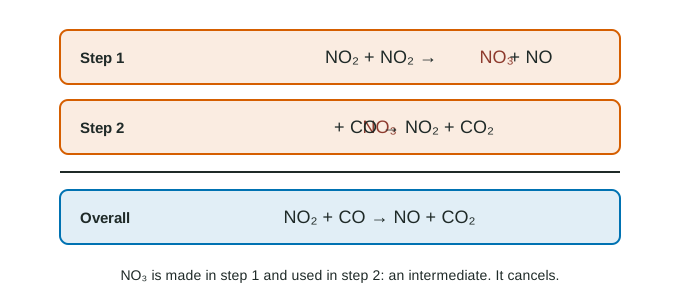
Worked example: checking a mechanism
Overall: 2 NO + 2 H₂ → N₂ + 2 H₂O. Proposed steps:
(1) 2 NO → N₂O₂ (2) N₂O₂ + H₂ → N₂O + H₂O (3) N₂O + H₂ → N₂ + H₂O
Add: 2 NO + N₂O₂ + H₂ + N₂O + H₂ → N₂O₂ + N₂O + H₂O + N₂ + H₂O
Cancel N₂O₂ and N₂O (each appears on both sides).
Result: 2 NO + 2 H₂ → N₂ + 2 H₂O. The steps sum to the overall reaction, so the mechanism passes this test. N₂O₂ and N₂O are intermediates.
Intermediates
A reaction intermediate is a species that is made in one step and used up in a later step. It does not appear in the overall equation, because it cancels when the steps are added.
- Intermediates are real particles. They exist for a short time between steps and can sometimes be detected, which is evidence for a mechanism.
- They are usually present at very low concentration, because the step that uses them is often fast.
- Do not confuse an intermediate with a transition state. A transition state is the top of a single step's energy barrier and cannot be isolated; an intermediate sits between steps.
| Species | First appears as | Then | In the overall equation? |
|---|---|---|---|
| Reactant | reactant of a step | never made by a step | Yes, on the left |
| Product | product of a step | never used by a later step | Yes, on the right |
| Intermediate | product of an earlier step | used by a later step | No |
A mechanism is a hypothesis
Nobody watches the individual collisions. A mechanism is a proposed explanation, and it must pass tests:
- Its elementary steps must add up to the overall equation.
- Each step must be reasonable: unimolecular or bimolecular, rarely termolecular.
- The rate law it predicts must match the rate law measured in the lab (topic 5.8).
Passing these tests makes a mechanism consistent with the evidence. It does not prove it; two different mechanisms can both pass.