A mechanism (topic 5.7) is a proposal. The strongest test is to ask what rate law it predicts and compare that with the rate law measured in the lab. This topic shows how to get the predicted rate law when the first step is the slow one.
The slowest step sets the pace
Think of a line of people passing buckets of water: the line moves only as fast as its slowest person. A reaction mechanism is the same. The slowest elementary step is the rate-determining step. The overall reaction cannot go faster than it, and speeding up any of the fast steps changes nothing.
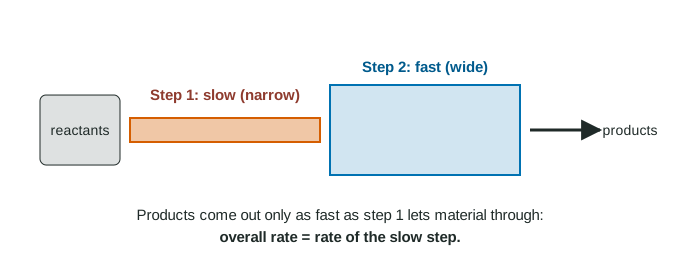
When the first step is slow
If the first step is rate-determining, the overall rate law is simply that step's rate law. Because the step is elementary, you write it from its coefficients (topic 5.4).
- Species that react only in later, fast steps do not appear in the rate law. That is how a reactant can be zero order.
- The rate law is in terms of reactants only, because the slow first step involves only reactants.
Worked example: predicting a rate law and testing a mechanism
Overall: NO₂(g) + CO(g) → NO(g) + CO₂(g). Measured rate law: rate = k[NO₂]².
Mechanism A: one step, NO₂ + CO → NO + CO₂. Predicted: rate = k[NO₂][CO]. This does not match: the data say CO is zero order. Rejected.
Mechanism B: (1) NO₂ + NO₂ → NO₃ + NO (slow); (2) NO₃ + CO → NO₂ + CO₂ (fast).
Sum: 2 NO₂ + NO₃ + CO → NO₃ + NO + NO₂ + CO₂. Cancel NO₃ and one NO₂: NO₂ + CO → NO + CO₂. ✓
Predicted rate law: from the slow step, rate = k[NO₂]². ✓ It matches. Mechanism B is consistent with the data (not proven).
Three tests for a mechanism
| Test | How |
|---|---|
| Sum | Add the steps and cancel; the result must be the overall equation. |
| Reasonable steps | Each step is uni- or bimolecular (rarely termolecular). |
| Rate law | The rate law predicted from the slow step must match the measured one. |
Two different mechanisms can both pass every test. Data can rule a mechanism out, but they can never prove one is right. In your justifications, say the mechanism is "consistent with" the data.
Why the fast steps drop out
Suppose step 1 makes an intermediate slowly and step 2 uses it quickly. As soon as a particle of intermediate forms, step 2 grabs it. So step 2 can never run faster than step 1 feeds it, and the overall rate is the rate of step 1. If you add more of a reactant that is used only in step 2, step 2 just waits more often: nothing speeds up. That is why such a reactant is zero order.
For the same reason, products form at a rate set by the slow step, and the intermediate stays at a very low concentration throughout.
A common slip
Do not write the rate law from the coefficients of the overall equation. In the example, the overall equation would suggest rate = k[NO₂][CO], which is wrong. Only an elementary step, here the slow one, can be read that way.