Collision Model
A reaction happens when particles collide with at least the activation energy and a suitable orientation.
Part 1 · Hook
Why this matters
Part 2 · Before you start
What this builds on
Part 3 · Prerequisite check
Quick check before you start
1. What happens to the average kinetic energy of gas molecules when the temperature rises?
- It increases
- It decreases
- It stays the same
- It becomes zero
Show the answer
Temperature measures average kinetic energy; heating raises it.
- Correct: It increases:
- It decreases:
- It stays the same:
- It becomes zero:
2. A Maxwell-Boltzmann distribution at a higher temperature is:
- flatter and shifted to higher energy
- taller and shifted to lower energy
- identical to the lower-temperature curve
- a single spike at the average energy
Show the answer
More molecules have high energies, so the curve spreads to the right and its peak drops.
- Correct: flatter and shifted to higher energy:
- taller and shifted to lower energy:
- identical to the lower-temperature curve:
- a single spike at the average energy:
Part 4 · See it
See it first
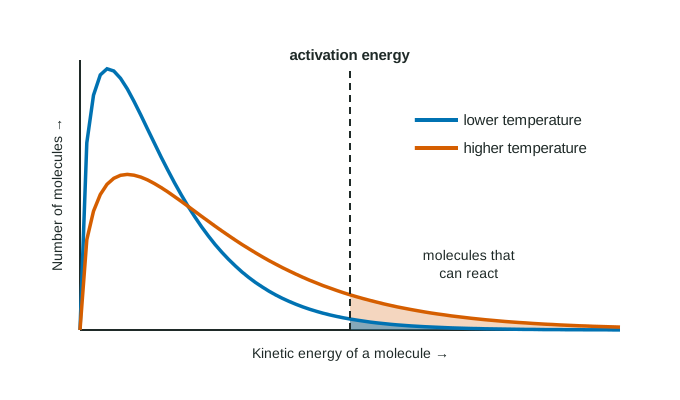
Part 5 · Step by step
How it works, step by step
- Reactant particles move and collide constantlya reaction is possible only where they meet
- Bonds must stretch and break for atoms to rearrangea collision needs at least the activation energy
- The atoms that will bond must meeta collision also needs a suitable orientation
- Raising the temperature shifts the energy distribution to higher energiesa larger fraction of collisions clears the same barrier, so the rate and k rise
Part 6 · Key ideas
Key ideas
- A reaction happens through effective collisions: enough energy (at least Ea) and the right orientation.
- Most collisions do not react, because they lack the energy, the orientation, or both.
- Higher temperature: a little more collision frequency, and a much larger fraction of collisions above Ea. Ea itself does not change.
- At the same temperature, a smaller Ea means a faster reaction and a larger k.
Part 7 · Misconception
A common mistake
The wrong idea: Heating speeds up a reaction by lowering its activation energy.
What actually happens: Heating leaves the activation energy the same. It gives a larger fraction of molecules at least that much energy, so more collisions succeed.
Part 8 · Check yourself
Check yourself
Exam-style questions. Anything you miss goes into your review queue.
Graph
Molecular energies at two temperatures
The graph shows how the kinetic energies of the molecules in a gas are spread out at two temperatures, T₁ and T₂. The same gas sample is used for both. The reaction the gas undergoes has an activation energy of 20 kJ/mol.
T₁T₂
Data table
| Kinetic energy (kJ/mol) | T₁ | T₂ |
|---|---|---|
| 0 | 0 | 0 |
| 2 | 15.8 | 7.8 |
| 4 | 11.4 | 7.9 |
| 6 | 7.2 | 6.9 |
| 8 | 4.3 | 5.7 |
| 10 | 2.4 | 4.6 |
| 12 | 1.4 | 3.6 |
| 14 | 0.8 | 2.8 |
| 16 | 0.4 | 2.1 |
| 18 | 0.2 | 1.6 |
| 20 | 0.1 | 1.2 |
| 24 | 0 | 0.7 |
| 28 | 0 | 0.4 |
| 32 | 0 | 0.2 |
| 36 | 0 | 0.1 |
| 40 | 0 | 0.1 |
1. Which temperature is higher, and how does the graph show it?
- T₂: its curve is flatter and spread to higher energies
- T₁: its curve has the taller peak
- T₁: more of its molecules have low energies
- T₂: its curve holds more molecules in total
Show the answer
At a higher temperature the average kinetic energy is larger, so the distribution shifts right and spreads out; with the same number of molecules, its peak is lower. That describes T₂.
- Correct: T₂: its curve is flatter and spread to higher energies: Right: shifted and spread toward higher energy.
- T₁: its curve has the taller peak: A taller, narrower peak at low energy means a lower temperature.
- T₁: more of its molecules have low energies: Many molecules at low energy means a lower average kinetic energy, so a lower temperature.
- T₂: its curve holds more molecules in total: It is the same sample, so both curves represent the same number of molecules (equal areas).
2. The reaction is faster at T₂. Which explanation uses the graph correctly?
- At T₂ more of the molecules have 20 kJ/mol or more
- At T₂ the activation energy is lower than 20 kJ/mol
- At T₂ each molecule has at least 20 kJ/mol
- At T₂ the molecules are smaller and fit together more easily
Show the answer
The area under each curve to the right of 20 kJ/mol is the fraction of molecules with enough energy to react. It is much larger for T₂, so a larger fraction of collisions succeeds.
- Correct: At T₂ more of the molecules have 20 kJ/mol or more: Right: more of the curve lies beyond the activation energy.
- At T₂ the activation energy is lower than 20 kJ/mol: Heating does not change the activation energy; it changes how many molecules can reach it.
- At T₂ each molecule has at least 20 kJ/mol: Even at T₂, many molecules have less than 20 kJ/mol; the curve starts near zero.
- At T₂ the molecules are smaller and fit together more easily: Temperature does not change the size of molecules.
3. Raising the temperature makes molecules collide more often, and makes collisions more energetic. Which effect is larger for most reactions, and why?
- The energy effect: the fraction above Ea grows fastest
- The collision-frequency effect: faster molecules meet each other far more often
- The two effects are about equal in size for most reactions
- Neither: temperature changes the rate by changing the activation energy
Show the answer
A modest rise in temperature raises the collision frequency by a few percent, but it can multiply the fraction of molecules with energy above Ea several times over (compare the tails of the two curves beyond 20 kJ/mol). The energy effect dominates.
- Correct: The energy effect: the fraction above Ea grows fastest: Right: the high-energy tail grows sharply.
- The collision-frequency effect: faster molecules meet each other far more often: Collision frequency does rise, but only a little compared with the growth of the high-energy tail.
- The two effects are about equal in size for most reactions: The energy effect is much larger for reactions with a significant activation energy.
- Neither: temperature changes the rate by changing the activation energy: The activation energy is a property of the pathway; heating does not change it.
Particle view
Two collisions with the same energy
Molecules of NOCl hit chlorine atoms. In the reaction NOCl + Cl → NO + Cl₂, the Cl atom must take the chlorine atom of NOCl. Both collisions below have more than enough energy.
Key: O, oxygen atom; N, nitrogen atom; Cl, chlorine atom. Arrows show the direction the lone Cl atom is moving.
4. Which collision can lead to reaction, and why?
- Collision 1: the Cl atom strikes the Cl end of NOCl
- Collision 2: the Cl atom strikes the O end, which is more reactive
- Both: each one has more than enough energy
- Neither: Cl atoms need a third particle to react
Show the answer
To form Cl₂, the incoming Cl must meet the Cl of NOCl. A collision at the O end, however energetic, puts the atoms in the wrong places, so the molecules bounce apart.
- Correct: Collision 1: the Cl atom strikes the Cl end of NOCl: Right: enough energy and the right orientation.
- Collision 2: the Cl atom strikes the O end, which is more reactive: The O end is far from the Cl atom that must be taken, so this orientation cannot make Cl₂.
- Both: each one has more than enough energy: Energy is necessary but not enough; orientation matters too.
- Neither: Cl atoms need a third particle to react: The step is bimolecular; two particles are enough.
5. Which conditions must a collision meet to cause a reaction?
- Enough energy and a suitable orientation
- Energy of at least Ea, with any orientation
- A suitable orientation, with any amount of energy
- The two molecules have the same mass
Show the answer
The collision model needs both: enough energy to break and rearrange bonds, and the right atoms facing each other.
- Correct: Enough energy and a suitable orientation: Right: both conditions.
- Energy of at least Ea, with any orientation: Energy alone is not enough; the wrong orientation bounces apart.
- A suitable orientation, with any amount of energy: Orientation alone is not enough; a gentle bump does not break bonds.
- The two molecules have the same mass: Mass is not a requirement for an effective collision.
6. A student says, "Heating a reaction mixture lowers the activation energy, which is why it speeds up." Which response is best?
- Ea is unchanged; more molecules now reach it
- Correct: heating lowers Ea and makes collisions more frequent
- Ea rises when heated, but collisions become more frequent
- Heating speeds a reaction just by making molecules collide more often
Show the answer
Activation energy belongs to the reaction pathway. Heating shifts the distribution of molecular energies so that a larger fraction of collisions clears the same barrier.
- Correct: Ea is unchanged; more molecules now reach it: Right: same barrier, more molecules over it.
- Correct: heating lowers Ea and makes collisions more frequent: The barrier is not lowered by heat; that is the misconception.
- Ea rises when heated, but collisions become more frequent: Ea does not change with temperature in either direction.
- Heating speeds a reaction just by making molecules collide more often: Collision frequency rises only slightly; the big effect is the energy distribution.
Part 9 · Summary
Summary
Part 10 · Up next
What comes next
Part 11 · Connections