Reaction Energy Profile
An energy profile shows potential energy along the reaction coordinate.
Part 1 · Hook
Why this matters
Part 2 · Before you start
What this builds on
Part 3 · Prerequisite check
Quick check before you start
1. What is the minimum energy a collision needs to cause a reaction called?
- The activation energy
- The kinetic energy
- The bond energy
- The thermal energy
Show the answer
A collision needs at least the activation energy, Ea, to react.
- Correct: The activation energy:
- The kinetic energy:
- The bond energy:
- The thermal energy:
2. Raising the temperature speeds up a reaction mainly because:
- more collisions have at least Ea
- Ea becomes smaller
- the molecules become larger
- fewer collisions happen
Show the answer
The energy distribution shifts so a larger fraction of collisions clears the same barrier.
- Correct: more collisions have at least Ea:
- Ea becomes smaller:
- the molecules become larger:
- fewer collisions happen:
Part 4 · See it
See it first
Part 5 · Step by step
How it works, step by step
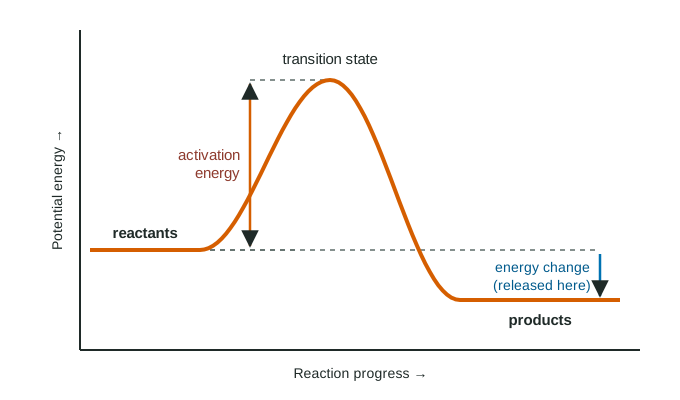
- Bonds must partly break before new ones formpotential energy rises to a peak, the transition state
- The climb from reactants to that peak is the activation energya higher peak means fewer collisions succeed and a smaller k
- The products sit at their own level, above or below the reactantsproducts minus reactants gives the energy released or absorbed
- A reaction and its reverse share one transition statethe difference between their barriers equals the energy change
Part 6 · Key ideas
Key ideas
- An energy profile plots potential energy against reaction progress, from reactants through the transition state to products.
- Ea = E(transition state) − E(reactants). Energy change = E(products) − E(reactants).
- Energy change = Ea(forward) − Ea(reverse).
- A higher barrier means a smaller k and a slower reaction at the same temperature. The overall energy change does not set the rate.
Part 7 · Misconception
A common mistake
The wrong idea: A reaction that releases a lot of energy must be fast.
What actually happens: The rate depends on the barrier height, not on how much energy is released. A reaction can release a lot of energy and still be very slow if its activation energy is high.
Part 8 · Check yourself
Check yourself
Exam-style questions. Anything you miss goes into your review queue.
Graph
Energy profile for a one-step reaction
The graph is the energy profile for a one-step (elementary) gas reaction, A + BC → AB + C. Reaction progress has no units.
Data table
| Reaction progress | Energy |
|---|---|
| 0 | 40 |
| 1 | 40 |
| 2 | 40 |
| 3 | 67.5 |
| 4 | 122.5 |
| 5 | 150 |
| 6 | 115 |
| 7 | 45 |
| 8 | 10 |
| 9 | 10 |
| 10 | 10 |
1. What is the activation energy of the reaction as written, in kJ/mol?
Type a number in kJ/mol.
Show the answer
Ea (forward) = E(transition state) − E(reactants) = 150 kJ/mol − 40 kJ/mol = 110 kJ/mol.
- Answer: 110 kJ/mol
2. What is the energy change for the reaction (products minus reactants), in kJ/mol?
Type a number in kJ/mol.
Show the answer
Energy change = E(products) − E(reactants) = 10 kJ/mol − 40 kJ/mol = −30 kJ/mol. The negative sign means the reacting particles give off energy.
- Answer: -30 kJ/mol
3. What is the activation energy for the reaction run in reverse, AB + C → A + BC, in kJ/mol?
Type a number in kJ/mol.
Show the answer
Run in reverse, the reaction starts at the products and climbs to the same transition state: Ea (reverse) = 150 − 10 = 140 kJ/mol. Check: Ea(reverse) − Ea(forward) = 140 − 110 = 30, the size of the energy released.
- Answer: 140 kJ/mol
4. What does the highest point of the curve represent?
- The transition state, with bonds half broken and half formed
- A stable molecule that can be collected
- The products, which have the most energy
- The average energy of the reactant molecules
Show the answer
The peak is the transition state, the highest-energy arrangement along the path. It lasts for about one molecular vibration and cannot be isolated.
- Correct: The transition state, with bonds half broken and half formed: Right: the unstable arrangement at the top of the barrier.
- A stable molecule that can be collected: Nothing can be collected at the peak; it is the least stable point on the path.
- The products, which have the most energy: The products are at the right-hand end, here at 10 kJ/mol.
- The average energy of the reactant molecules: The reactants are the left-hand plateau, not the peak.
Graph
Two reactions at the same temperature
Energy profiles for two different one-step reactions, P and Q, run at the same temperature with the same starting concentrations. Assume their orientation needs are similar.
Reaction PReaction Q
Data table
| Reaction progress | Reaction P | Reaction Q |
|---|---|---|
| 0 | 50 | 50 |
| 1 | 50 | 50 |
| 2 | 50 | 50 |
| 3 | 62.5 | 77.5 |
| 4 | 87.5 | 132.5 |
| 5 | 100 | 160 |
| 6 | 93.8 | 125 |
| 7 | 81.3 | 55 |
| 8 | 75 | 20 |
| 9 | 75 | 20 |
| 10 | 75 | 20 |
5. Which reaction is faster, and why?
- P, because its activation energy is smaller
- Q, because it releases more energy
- Q, because its products are lower in energy
- They are equally fast, because they start at the same energy
Show the answer
P has Ea = 100 − 50 = 50 kJ/mol; Q has Ea = 160 − 50 = 110 kJ/mol. At the same temperature, a larger fraction of collisions clears the smaller barrier, so P is faster. How much energy a reaction releases does not set its rate.
- Correct: P, because its activation energy is smaller: Right: the barrier height controls the rate.
- Q, because it releases more energy: Releasing more energy says nothing about how fast the reaction starts; Q has the much higher barrier.
- Q, because its products are lower in energy: The product level sets the overall energy change, not the rate.
- They are equally fast, because they start at the same energy: Equal starting energies do not mean equal barriers.
6. For a one-step reaction, the forward activation energy is 48 kJ/mol and the reverse activation energy is 75 kJ/mol. What is the overall energy change, products minus reactants, in kJ/mol?
Type a number in kJ/mol.
Show the answer
Energy change = Ea(forward) − Ea(reverse) = 48 − 75 = −27 kJ/mol. The products lie 27 kJ/mol below the reactants.
- Answer: -27 kJ/mol
Part 9 · Summary
Summary
Part 10 · Up next
What comes next
Part 11 · Connections