A bacterium in your gut, a mushroom, an oak tree and you look like they have nothing in common. Inside their cells, though, they run on the same basic machinery. This page lists the features every living thing shares, the extra features every eukaryote shares, and why those shared features are the strongest evidence that all life on Earth descends from one ancestor.
Features every living thing shares
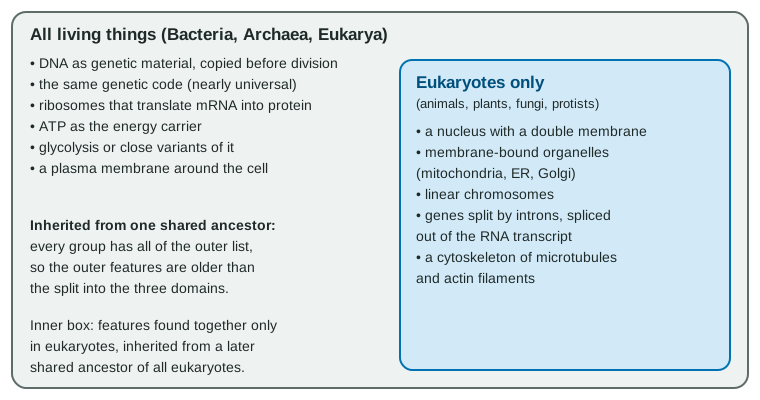
Start with what you already know about cells, and ask which parts turn up everywhere (Figure 1):
- DNA as the genetic material. Every cell stores its genes in DNA and copies it before dividing.
- The same genetic code. A codon such as GGC means glycine in a bacterium, a tree and a human. That is why a human gene placed in a bacterium can be translated into the human protein, the basis of insulin made by bacteria.
- Ribosomes. Every cell builds proteins on ribosomes made of rRNA and protein, with the same overall plan of a large and a small subunit.
- ATP carries energy in every cell, and almost all cells make it with an ATP synthase driven by a proton gradient across a membrane.
- A plasma membrane of lipids encloses every cell.
- Core pathways. Glycolysis, or close variants of it, breaks down glucose in organisms from every major group.
These are called the universal features of life. None of them is the only way chemistry could work. Other molecules could carry energy, and a different codon table could code for proteins just as well. So when every organism has the same versions, the simplest explanation is that all of them inherited those versions from one ancestor.
LUCA: the last universal common ancestor
The last universal common ancestor (LUCA) is the most recent population of cells from which every organism alive today descends. Because every living group has the universal features, LUCA must already have had them: DNA, the code, ribosomes, ATP and a membrane. LUCA was not the first life. Simpler living things probably came before it, and other early lines may have died out without descendants. LUCA is simply the most recent point where all surviving lines meet.
Why the shared features stay the same
Mutations happen in every gene. So why has the genetic code not drifted apart in billions of years? Follow the chain:
- A core system is used by thousands of other parts. Every protein is built with the genetic code.
- Reassigning even one codon would change the amino acids in many proteins at once.
- Cells with such a change work worse and leave fewer offspring.
- Natural selection removes the change, generation after generation, so the system stays the same.
The same logic explains conserved genes: genes whose sequences barely change over vast spans of time. The protein histone H4, which packs DNA, differs at only 2 of its 102 amino acids between peas and cows, whose ancestors split over a billion years ago. Mutations arose in the H4 gene as often as in any other gene. Nearly all that changed the protein were harmful and disappeared. Genes for rRNA, ribosome proteins and glycolysis enzymes are conserved in the same way, which is why scientists compare them to study very distantly related organisms.
Worked example: reading a gene-swap experiment. Yeast missing an essential glycolysis gene cannot grow. Given the human version (53% of amino acids identical), it grows at 94% of normal. Given nothing, it grows at 0%. Given its own gene back, it grows at 99%.
Step 1. Check the controls. No gene: 0%, so the gene is essential. Own gene back: 99%, so the method itself does no harm. Step 2. Read the test. The human gene restores growth almost fully. Step 3. Explain. Yeast ribosomes read the human gene with the same genetic code, and the enzyme still does its job because both versions descend from an ancestral enzyme. Step 4. Do not overclaim. The result shows shared ancestry. It does not show that humans came from yeast; both lines have been evolving for the same length of time.
Features every eukaryote shares
A second, smaller set of features is found together in every eukaryote, from yeast to oak trees to people, and in no prokaryote:
- a nucleus wrapped in a double membrane;
- membrane-bound organelles such as the endoplasmic reticulum, the Golgi and mitochondria (or, in a few groups, reduced remnants of them);
- linear chromosomes, several in each nucleus;
- genes interrupted by introns, which are spliced out of the RNA transcript by RNA-protein machines built from similar parts in every eukaryote;
- a cytoskeleton of microtubules and actin filaments.
Each of these is complex. It is very unlikely that the same set arose separately in yeast, oaks and humans. The pattern points to a common ancestor of all eukaryotes that already had them, an ancestor much more recent than LUCA.
The three domains
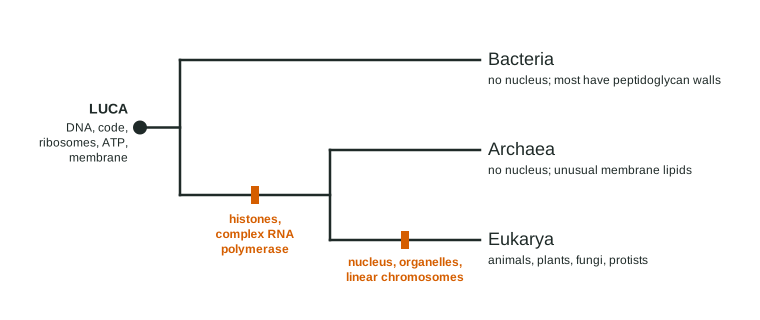
Comparing rRNA genes, which every cell has, Carl Woese found in 1977 that prokaryotes fall into two very different groups. Life is now sorted into three domains: Bacteria, Archaea and Eukarya (Figure 2). Archaea look like bacteria under a microscope, but in several molecular features they resemble eukaryotes.
| Feature | Bacteria | Archaea | Eukarya |
|---|---|---|---|
| Nucleus and membrane-bound organelles | No | No | Yes |
| Main chromosome | Circular | Circular | Linear, several |
| DNA wrapped on histones | No | In many | Yes |
| RNA polymerase | One, simpler | One, complex, like eukaryotes' | Several, complex |
| Introns in protein-coding genes | Rare | Rare | Common |
| Peptidoglycan in the cell wall | Most | No | No |
| Membrane lipids | Ester-linked | Ether-linked | Ester-linked |
| Genetic code, ribosomes, ATP | Shared | Shared | Shared |
Notice the logic. Archaea and Bacteria both lack a nucleus, but that does not group them together, because lacking a nucleus is the older condition every early cell had. What groups Archaea with Eukarya are newer features the two share and Bacteria lack: histones and a complex RNA polymerase. Features that appeared later and were passed on are the ones that reveal who shares the more recent ancestor.
A code that is nearly universal
The genetic code has a few known exceptions. In human mitochondria, UGA means tryptophan instead of stop. In some single-celled ciliates, UAA and UAG mean glutamine. These do not weaken the case for common ancestry. Each variant code differs from the standard one in only a few of the 64 codons (four in human mitochondria), which is what you expect if one inherited code was slightly modified in a few lines. Separate origins of life would be expected to produce codes unlike each other throughout.