Common Ancestry
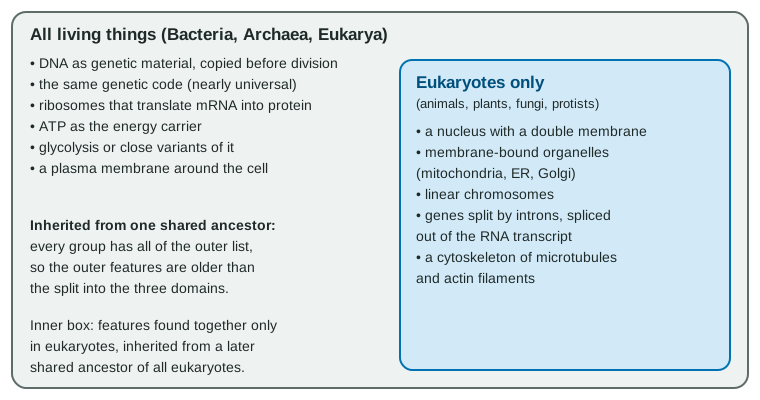
Every living thing stores its genes in DNA, reads them with a nearly universal genetic code on ribosomes, powers its work with ATP, is bounded by a plasma membrane and runs core pathways such as glycolysis.
Part 1 · Hook
Why this matters
In 1987 researchers took yeast cells with a broken copy of a gene they need to divide, and gave them the matching gene from a human. The yeast divided normally. Years later a larger study tried the same swap for several hundred essential yeast genes, and nearly half of the human versions worked. Yeast and people last shared an ancestor more than a billion years ago, yet many of their parts are still interchangeable. That is what you would expect if all life is one family.
Part 2 · Before you start
What this builds on
Part 3 · Prerequisite check
Quick check before you start
1. What does it mean that the genetic code is universal?
- Nearly every organism reads the same codons as the same amino acids
- Every organism has the same genes in the same order
- Every protein is made of the same amino acid sequence
Show the answer
The code is the codon-to-amino-acid dictionary. Organisms have different genes, but almost all read codons the same way.
- Correct: Nearly every organism reads the same codons as the same amino acids:
- Every organism has the same genes in the same order:
- Every protein is made of the same amino acid sequence:
2. Which feature separates eukaryotic cells from prokaryotic cells?
- A nucleus and other membrane-bound organelles
- Ribosomes for making proteins
- A plasma membrane around the cytoplasm
Show the answer
Every cell has ribosomes and a plasma membrane; only eukaryotes have a nucleus and membrane-bound organelles.
- Correct: A nucleus and other membrane-bound organelles:
- Ribosomes for making proteins:
- A plasma membrane around the cytoplasm:
3. Similar DNA or amino acid sequences in two organisms are evidence that
- they inherited the sequence from a common ancestor
- they live in the same environment
- one of them evolved from the other within the last few generations
Show the answer
Sequence similarity is molecular homology: the more alike the sequences, the more recently the two shared an ancestor.
- Correct: they inherited the sequence from a common ancestor:
- they live in the same environment:
- one of them evolved from the other within the last few generations:
Part 4 · See it
See it first
Part 5 · Step by step
How it works, step by step
- All organisms alive today descend from one ancestral population of cells, the last universal common ancestor (LUCA), which lived billions of years ago.LUCA already stored information in DNA, read it with the genetic code on ribosomes, used ATP and was wrapped in a membrane, and its descendants inherited all of these.
- Each of these core systems is used by thousands of other parts of the cell.Almost any change to them, such as reassigning a codon, harms many proteins at once and lowers fitness.
- Natural selection removes most changes to these core systems generation after generation.The systems stay nearly the same in Bacteria, Archaea and Eukarya, and the genes for them are conserved.
- Later, one lineage of cells evolved a nucleus, membrane-bound organelles, linear chromosomes and genes interrupted by introns.All of its descendants, the eukaryotes, share these features too, which points to a more recent ancestor of all eukaryotes.
- Shared features are found in nested layers: some in all life, some only in eukaryotes.The pattern is what common ancestry predicts: groups that share more features share a more recent ancestor.
Part 6 · Key ideas
Key ideas
- Universal features of life: DNA, a nearly universal genetic code, ribosomes, ATP, a plasma membrane, and core pathways such as glycolysis. They were present in LUCA, the last universal common ancestor.
- Eukaryotes also share a nucleus, membrane-bound organelles, linear chromosomes and genes with introns, inherited from a later shared ancestor.
- Life falls into three domains: Bacteria, Archaea and Eukarya. Archaea share histones and a complex RNA polymerase with eukaryotes, so they are closer to us than to Bacteria.
- Conserved genes change slowly because selection removes most changes to essential proteins, not because they mutate less.
Part 7 · Misconception
A common mistake
The wrong idea: Because human genes work in yeast, humans must have evolved from yeast.
What actually happens: Humans and yeast both descend from an ancestor they share. Modern yeast has been evolving exactly as long as the human line has, so it is a distant relative, not an ancestor.
Part 8 · Check yourself
Check yourself
Exam-style questions. Anything you miss goes into your review queue.
Data table
Human genes in yeast cells
Baker's yeast cannot divide if it lacks any one of the six genes below. Researchers deleted one gene at a time and gave each deletion strain the matching human gene. As controls, some deletion strains received no gene and some received the yeast's own gene back. Every strain grew for 48 h at 30 °C. Growth is given as a percent of unaltered yeast (mean of 4 cultures).
| Job of the gene's protein | Amino acids identical in the yeast and human proteins (%) | Growth with human gene (% of unaltered) | Growth with no gene (% of unaltered) | Growth with yeast gene put back (% of unaltered) |
|---|---|---|---|---|
| Enzyme of glycolysis | 53 | 94 | 0 | 99 |
| Protein of the small ribosomal subunit | 61 | 88 | 0 | 101 |
| Enzyme that makes nucleotides for DNA | 46 | 81 | 0 | 98 |
| Enzyme that makes sterols for the cell membrane | 49 | 90 | 0 | 100 |
| Part of a six-protein complex that starts DNA replication | 58 | 0 | 0 | 100 |
| Protein that links chromosomes to the spindle in mitosis | 31 | 0 | 0 | 97 |
1. Which explanation best accounts for the human glycolysis gene restoring growth to yeast that lack their own version?
- Yeast and humans inherited this enzyme and the genetic code from a shared ancestor, so yeast can build a working enzyme from it
- The human gene mutated inside the yeast cells until its sequence matched the missing yeast gene, so the yeast enzyme was made again
- The two enzymes have the same amino acid sequence, so the yeast cell makes exactly its own enzyme from the human gene
- Glycolysis arose separately in the ancestors of yeast and of humans, and the two versions happen to catalyze the same steps
Show the answer
The human gene is read with the same genetic code by yeast's ribosomes, and the enzyme it codes for still does the same job because both versions descend from one ancestral enzyme. Common ancestry explains both the shared code and the shared function.
- Correct: Yeast and humans inherited this enzyme and the genetic code from a shared ancestor, so yeast can build a working enzyme from it: Correct: a shared code lets yeast translate the gene, and shared descent keeps the enzyme's function.
- The human gene mutated inside the yeast cells until its sequence matched the missing yeast gene, so the yeast enzyme was made again: Mutations are random and rare; nothing steers a gene toward the yeast sequence within 48 hours.
- The two enzymes have the same amino acid sequence, so the yeast cell makes exactly its own enzyme from the human gene: Only 53% of the amino acids are identical, so the proteins differ at nearly half their positions.
- Glycolysis arose separately in the ancestors of yeast and of humans, and the two versions happen to catalyze the same steps: Separate origins would not explain why the human enzyme works inside yeast, or why the sequences match at over half their positions.
2. What does the control in which the yeast's own gene is put back allow the researchers to rule out?
- That the gene-transfer method itself harms growth, which would make failures with human genes meaningless
- That the yeast cells could grow well without the deleted gene, so the gene was not essential for division
- That the human genes were too long for the yeast's ribosomes to translate into complete proteins
- That the growth medium lacked a nutrient yeast needs, so no strain could grow well at 30 °C
Show the answer
Strains given their own gene back grow at 97-101% of normal, so the procedure itself does not harm growth. When a human gene fails (0%), the failure must come from the human gene, not from the method.
- Correct: That the gene-transfer method itself harms growth, which would make failures with human genes meaningless: Correct: it shows the method works, so a failure points to the gene put in.
- That the yeast cells could grow well without the deleted gene, so the gene was not essential for division: The no-gene control (0% growth) is what shows the gene is needed; putting the yeast gene back does not test that.
- That the human genes were too long for the yeast's ribosomes to translate into complete proteins: This control uses yeast genes, so it says nothing about translating human genes.
- That the growth medium lacked a nutrient yeast needs, so no strain could grow well at 30 °C: Unaltered yeast and the put-back strains grow well in the same medium, but that is not the main thing this control is designed to test.
3. A student concludes from these results that humans evolved from yeast. Which response is best supported by the data and by evolutionary theory?
- The data fit humans and yeast descending from a shared ancestor; modern yeast is a distant relative, not an ancestor
- The data support the conclusion, since four human genes can do the job of yeast genes and so came from yeast originally
- The data contradict any relationship, because two of the six human genes failed to work in yeast
- The data show that humans and yeast are close relatives, since their proteins are identical at about half of their positions
Show the answer
Shared genes that still work in each other's cells show descent from a common ancestor. Both lineages have kept changing since they split, so neither modern organism is the ancestor of the other.
- Correct: The data fit humans and yeast descending from a shared ancestor; modern yeast is a distant relative, not an ancestor: Correct: shared ancestry, not descent of one living organism from another.
- The data support the conclusion, since four human genes can do the job of yeast genes and so came from yeast originally: Working genes show both inherited them from a common ancestor; modern yeast has evolved for as long as the human line has.
- The data contradict any relationship, because two of the six human genes failed to work in yeast: Failures are expected where proteins have changed or must work with partners that changed; most of the genes still worked.
- The data show that humans and yeast are close relatives, since their proteins are identical at about half of their positions: About half the amino acids differ, which fits a very distant relationship, not a close one.
Data table
Four newly sampled single-celled organisms
Researchers grew four single-celled organisms, W, X, Y and Z, from soil and hot-spring samples and examined their cells and molecules.
| Feature | W | X | Y | Z |
|---|---|---|---|---|
| Nucleus | − | − | + | − |
| Cell wall containing peptidoglycan | + | − | − | − |
| Links joining tails to glycerol in membrane lipids | ester | ether | ester | ester |
| DNA wrapped around histone proteins | − | + | + | − |
| Shape of the main chromosome | circular | circular | linear | circular |
| Introns in protein-coding genes | − | − | + | − |
| Reads mRNA with the standard genetic code | + | + | + | + |
| Makes ATP with an ATP synthase in a membrane | + | + | + | + |
4. Which evidence from the table best supports the claim that X shares a more recent common ancestor with Y than with W?
- X and Y both wrap their DNA around histones, and W does not
- X and W both lack a nucleus, and Y has one
- X and Y both lack peptidoglycan in a cell wall, and W has it
- X and W both have a circular main chromosome, and Y does not
Show the answer
A newer feature that two organisms share, and others lack, points to an ancestor they alone share. Histone-wrapped DNA is such a feature: X and Y have it, W does not.
- Correct: X and Y both wrap their DNA around histones, and W does not: Correct: a shared newer feature unites X and Y.
- X and W both lack a nucleus, and Y has one: Lacking a nucleus is the older state that all prokaryotes keep, so it links X to W no more than it links X to any prokaryote.
- X and Y both lack peptidoglycan in a cell wall, and W has it: Lacking a feature is weak evidence: Z, which matches the bacterium W in its lipids and lack of histones, also lacks peptidoglycan.
- X and W both have a circular main chromosome, and Y does not: A circular chromosome is the older state shared by all prokaryotes, so it does not show that X and W are close.
5. Penicillin stops cells from building peptidoglycan. If each organism is grown with penicillin, whose growth is expected to be slowed?
- W and Z
- W, but not X, Y or Z
- X and Y
- W, X and Z, the three prokaryotes
Show the answer
Penicillin can only harm cells that build peptidoglycan. In the table, W is the one with a peptidoglycan wall.
- W and Z: Z is a bacterium by its other features, but it has no peptidoglycan wall, so penicillin has nothing to block.
- Correct: W, but not X, Y or Z: Correct: W is the one organism making peptidoglycan.
- X and Y: Neither X nor Y makes peptidoglycan.
- W, X and Z, the three prokaryotes: X and Z lack peptidoglycan; being prokaryotes does not make them sensitive.
6. Which reasoning best explains why a nearly universal genetic code is strong evidence that all life shares one ancestor?
- Many different codes would work equally well, so separate origins of life would be unlikely to arrive at the same one
- The chemistry of the four bases fixes which amino acid each codon stands for, so any life anywhere would use this code
- Organisms frequently trade codon tables with neighbors by gene transfer, so the code spread across life
- The code changes quickly, so organisms with the same code probably shared an ancestor recently
Show the answer
Which codon stands for which amino acid is largely arbitrary, and a change to the code would alter many proteins at once, so a code, once in place, is kept. The same code everywhere is best explained by inheritance from one ancestor.
- Correct: Many different codes would work equally well, so separate origins of life would be unlikely to arrive at the same one: Correct: an arbitrary code shared by all is best explained by shared descent.
- The chemistry of the four bases fixes which amino acid each codon stands for, so any life anywhere would use this code: Engineered and natural variant codes work, so chemistry does not force this code; if it did, sharing it would say nothing about ancestry.
- Organisms frequently trade codon tables with neighbors by gene transfer, so the code spread across life: Genes move between organisms, but the code is read by a cell's own tRNAs and enzymes and is not swapped as a unit.
- The code changes quickly, so organisms with the same code probably shared an ancestor recently: The code is very stable, which is why it is shared by organisms whose last common ancestor lived billions of years ago.
7. The protein histone H4 in peas and in cows differs at only 2 of its 102 amino acids. Which explanation best accounts for so few differences?
- Most changes to H4 disrupt DNA packing, so carriers left fewer offspring and the changes were lost
- The gene for H4 is protected from mutation, so its DNA sequence has not been copied with errors
- Peas and cows share a fairly recent common ancestor, so there has been too little time for many changes
- H4 is made of nucleic acid, so its sequence is copied more accurately than a protein's
Show the answer
H4 is a conserved protein: mutations arise in its gene as in any gene, but almost every amino acid change harms DNA packing, so natural selection removes it. Over a billion or so years, very few changes have survived.
- Correct: Most changes to H4 disrupt DNA packing, so carriers left fewer offspring and the changes were lost: Correct: selection removes harmful changes, keeping the sequence nearly the same.
- The gene for H4 is protected from mutation, so its DNA sequence has not been copied with errors: Mutations arise in this gene at a normal rate; what differs is that selection removes most changes to the protein.
- Peas and cows share a fairly recent common ancestor, so there has been too little time for many changes: Plants and animals last shared an ancestor over a billion years ago, which is plenty of time for change.
- H4 is made of nucleic acid, so its sequence is copied more accurately than a protein's: H4 is a protein, built from amino acids.
Part 9 · Summary
Summary
Every living thing stores its genes in DNA, reads them with a nearly universal genetic code on ribosomes, powers its work with ATP, is bounded by a plasma membrane and runs core pathways such as glycolysis. These shared features were inherited from the last universal common ancestor (LUCA), the most recent population all life descends from. They stay nearly the same because almost any change to them is harmful and is removed by natural selection; genes that change this slowly are called conserved. Eukaryotes also share a nucleus, membrane-bound organelles, linear chromosomes and introns, inherited from a later ancestor of all eukaryotes. Life is grouped into three domains, Bacteria, Archaea and Eukarya, and Archaea share more features with eukaryotes than with Bacteria. Small exceptions, such as a few reassigned codons in mitochondria, are changes made after the shared start, not separate origins.
Part 10 · Up next
What comes next
Part 11 · Connections