A gene's DNA stays in the nucleus, but proteins are built by ribosomes in the cytoplasm. The cell bridges that gap by copying the gene into RNA. This page follows that copy from the start of a gene to a finished messenger RNA leaving the nucleus.
The central dogma
The central dogma of molecular biology describes the usual flow of genetic information: DNA → RNA → protein. DNA is copied into DNA when a cell divides (replication, topic 6.2). A gene is copied into RNA when its product is needed (transcription, this page). The mRNA's message is then used to build a protein (topic 6.4). Some viruses run part of this flow backward, as you will see in 6.4, but every cell follows it.
Where copying starts: the promoter
A gene is not copied from just anywhere. Just before each gene is a promoter, a DNA sequence that marks where copying starts and which strand is copied. Many eukaryotic promoters contain a TATA box, a short run rich in T and A about 25-30 base pairs before the transcription start site. Proteins bind the TATA box first and then bring in RNA polymerase. In bacteria, a protein attached to RNA polymerase recognizes the promoter directly.
RNA polymerase opens a short stretch of the double helix (it does its own unwinding) and starts a new chain. Unlike DNA polymerase, it needs no primer.
Template strand and coding strand
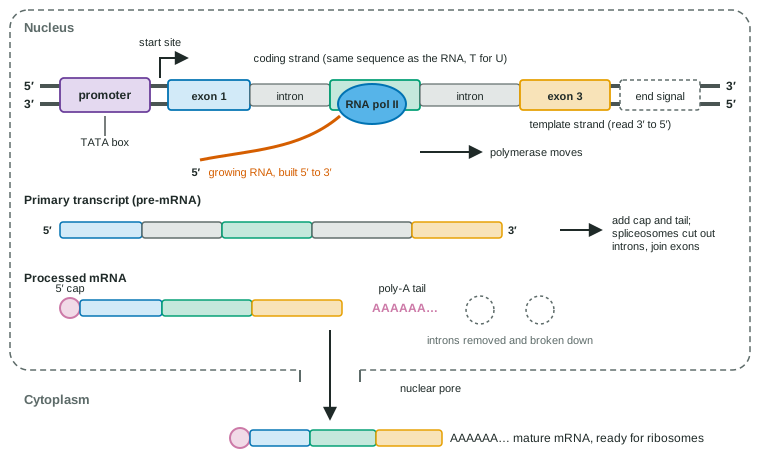
Only one of the two DNA strands is copied for any one gene. That strand is the template strand. RNA polymerase reads it 3′ to 5′ and builds the RNA 5′ to 3′, placing A opposite T, U opposite A, G opposite C and C opposite G. The other strand is the coding strand: the RNA has the same sequence as the coding strand, with U where the coding strand has T (Figure 1). For this reason gene sequences are usually written as the coding strand.
Worked example: from DNA to RNA. A gene's template strand reads 3′-TACGGCAAT-5′. What RNA is made?
Step 1. Pair each base, with U for A: T→A, A→U, C→G, G→C, G→C, C→G, A→U, A→U, T→A. Step 2. The RNA is antiparallel to the template, so it reads 5′-AUGCCGUUA-3′. Step 3. Check against the coding strand, 5′-ATGCCGTTA-3′: same letters, U for T.
Different genes on the same chromosome can use different strands as their template. Each gene's promoter decides which strand is read and in which direction.
Comparing replication and transcription
| Replication | Transcription | |
|---|---|---|
| What is copied | The whole genome, both strands | One gene at a time, one strand (the template) |
| When | Once per cell cycle (S phase) | Whenever the gene's product is needed, many times |
| Enzyme | DNA polymerase | RNA polymerase |
| Primer needed? | Yes (RNA primer) | No |
| Starts at | Origins of replication | Promoters |
| Product | Double-stranded DNA with T | Single-stranded RNA with U |
| Direction | New strand 5′ → 3′ | New RNA 5′ → 3′ |
The protein-building step completes this comparison in topic 6.4.
Ending transcription
In bacteria, RNA polymerase stops when it copies a terminator: a sequence whose RNA folds back on itself or is recognized by a protein, which pulls the RNA away. In eukaryotes, RNA polymerase II copies past a signal near the end of the gene; the RNA is cut there and released. Bacteria have one RNA polymerase. Eukaryotes have three: RNA polymerase II copies the genes for proteins, and the other two copy the genes for ribosomal RNA and tRNA.
Processing pre-mRNA in eukaryotes
A eukaryotic gene's first copy, the pre-mRNA (primary transcript), is not ready to use. Three changes in the nucleus, together called RNA processing, turn it into mature mRNA.
- 5′ cap. A modified G nucleotide is attached to the RNA's 5′ end, joined in an unusual 5′-to-5′ way. It protects the end from enzymes that break down RNA and helps ribosomes find the mRNA.
- Poly-A tail. About 200 A nucleotides are added to the 3′ end. The tail helps the mRNA leave the nucleus and protects it; mRNAs with shorter tails tend to be broken down sooner.
- Splicing. Most eukaryotic genes are split. Exons are the stretches kept in the mature mRNA; introns are the stretches between them that are cut out. Spliceosomes, complexes of proteins and short RNA molecules, recognize the exon-intron boundaries, cut out each intron and join the exons. The removed introns are broken down in the nucleus.
Introns can be long. In many human genes they make up most of the gene.
Worked example: how much is removed? A gene has exons of 210, 135, 96 and 489 nucleotides and introns of 1,450, 3,820 and 870 nucleotides.
Exons: 210 + 135 + 96 + 489 = 930. Introns: 1,450 + 3,820 + 870 = 6,140. Pre-mRNA: 930 + 6,140 = 7,070 nucleotides. Removed by splicing: 6,140 ÷ 7,070 = 86.8%. The mature mRNA is 930 nucleotides plus the cap and a tail of about 200.
Bacteria do none of this: their genes rarely have introns, they add no cap or long tail, and with no nucleus their mRNA can be used while it is still being made (topic 6.4).
Alternative splicing: one gene, several proteins
Spliceosomes do not always join the same exons. In alternative splicing, the same pre-mRNA is spliced in different ways, leaving out or including particular exons, so one gene gives several different mature mRNAs and therefore several proteins. Which version is made can depend on the cell type: a gene may include an exon in liver cells and skip it in muscle cells. Humans have about 20,000 protein-coding genes but make many more kinds of protein, and alternative splicing is a major reason.
| Cell type | Exons joined | mRNA length (nucleotides, without cap and tail) |
|---|---|---|
| Liver | 1-2-3-4 | 210 + 135 + 96 + 489 = 930 |
| Muscle | 1-2-4 | 210 + 135 + 489 = 834 |
RNAs that are not messages
Many genes are transcribed into RNAs that are never used as instructions for a protein. They do their job as RNA:
- tRNA (transfer RNA): a short RNA, about 80 nucleotides long, that folds into a compact L shape and carries a specific amino acid to the ribosome.
- Ribosomal RNA (rRNA): together with proteins, it forms the ribosome, and it does the actual joining of amino acids.
Common mistakes
- "mRNA matches the template strand." It is complementary to the template and matches the coding strand.
- "Introns are removed from the DNA." The gene keeps its introns; they are removed from the RNA copy.
- "RNA polymerase needs a primer." It starts chains by itself at the promoter.
- "The cap and tail are copied from the gene." They are added to the RNA after it is made; the poly-A tail is not encoded as a run of T in the gene.