Transcription and RNA Processing
Transcription copies a gene into RNA, the first step of the central dogma (DNA → RNA → protein).
Part 1 · Hook
Why this matters
The death cap mushroom kills more people than any other mushroom, and a single cap can be enough. Its main poison, α-amanitin, does one thing: it jams RNA polymerase II, the enzyme that copies genes into messenger RNA. Liver cells, which take up the toxin first, stop making new mRNA, their proteins run out over the following days, and the cells die. Copying genes into RNA is so central that blocking one enzyme is lethal.
Part 2 · Before you start
What this builds on
Part 3 · Prerequisite check
Quick check before you start
1. How does RNA differ from DNA?
- RNA has ribose and uracil and is usually single-stranded
- RNA has deoxyribose and thymine and is double-stranded
- RNA has no phosphate groups in its backbone
Show the answer
RNA uses ribose and U (in place of T) and is usually one strand; both have sugar-phosphate backbones.
- Correct: RNA has ribose and uracil and is usually single-stranded:
- RNA has deoxyribose and thymine and is double-stranded:
- RNA has no phosphate groups in its backbone:
2. In a eukaryotic cell, where is DNA kept and where are proteins built?
- DNA in the nucleus; proteins on ribosomes in the cytoplasm and on the rough ER
- Both in the nucleus
- DNA in the cytoplasm; proteins in the nucleus
Show the answer
DNA stays in the nucleus, so a messenger (mRNA) must carry each gene's instructions out to the ribosomes.
- Correct: DNA in the nucleus; proteins on ribosomes in the cytoplasm and on the rough ER:
- Both in the nucleus:
- DNA in the cytoplasm; proteins in the nucleus:
3. DNA polymerase builds new DNA
- 5′ to 3′, adding nucleotides to the 3′ end
- 3′ to 5′, adding nucleotides to the 5′ end
- in either direction
Show the answer
New nucleic acid chains grow at their 3′ end; RNA polymerase follows the same rule.
- Correct: 5′ to 3′, adding nucleotides to the 3′ end:
- 3′ to 5′, adding nucleotides to the 5′ end:
- in either direction:
Part 4 · See it
See it first
Part 5 · Step by step
How it works, step by step
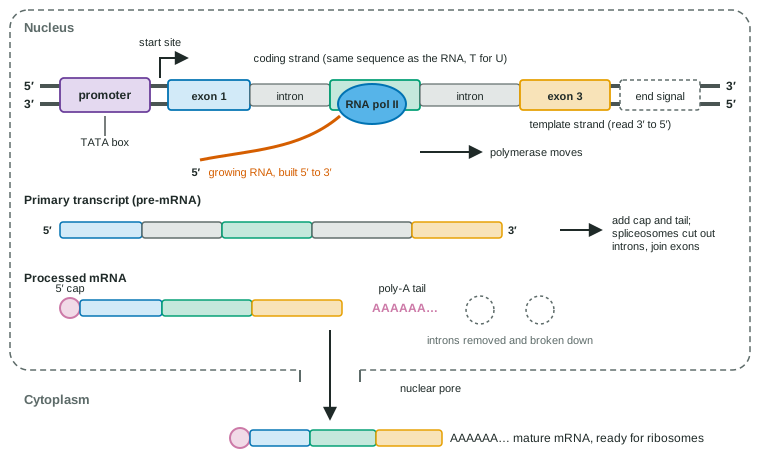
- Proteins recognize a gene's promoter (in many eukaryotic genes, a TATA box) and place RNA polymerase at the start site.RNA polymerase opens a short stretch of the double helix and begins copying.
- RNA polymerase reads the template strand 3′ to 5′ and adds matching RNA nucleotides (U opposite A) to the RNA's 3′ end.The RNA grows 5′ to 3′ with the same sequence as the coding strand, except U for T.
- The polymerase copies a terminator (in bacteria) or a signal near the gene's end (in eukaryotes).The RNA is released; in eukaryotes this primary transcript is pre-mRNA.
- In the nucleus, the pre-mRNA gets a 5′ cap and a poly-A tail.The cap and tail protect the mRNA from breakdown, help it leave the nucleus, and help ribosomes bind it.
- Spliceosomes cut out the introns and join the exons.Mature mRNA holds one continuous coded message; joining different sets of exons (alternative splicing) gives different mRNAs from one gene.
- Mature mRNA passes through nuclear pores into the cytoplasm.Ribosomes there can use it to build a protein (topic 6.4).
Part 6 · Key ideas
Key ideas
- The central dogma: information flows DNA → RNA → protein. Transcription is the DNA → RNA step.
- RNA polymerase starts at a promoter, needs no primer, reads the template strand 3′ to 5′ and builds RNA 5′ to 3′. The RNA matches the coding strand with U for T. A terminator ends it in bacteria.
- Eukaryotic pre-mRNA is processed in the nucleus: 5′ cap, poly-A tail, and splicing by spliceosomes, which remove introns and join exons.
- Alternative splicing joins different exons in different cells, so one gene can give several proteins.
- Not every RNA is mRNA: tRNA carries amino acids and ribosomal RNA (rRNA) forms much of the ribosome; both work as RNA.
Part 7 · Misconception
A common mistake
The wrong idea: The mRNA has the same sequence as the template strand, since it is copied from it.
What actually happens: The mRNA is complementary to the template strand. It has the same sequence as the other strand, the coding strand, with U in place of T.
Part 8 · Check yourself
Check yourself
Exam-style questions. Anything you miss goes into your review queue.
Model
A stretch of a gene and the RNA made from it
The model shows twelve base pairs at the start of a bacterial gene, just after its promoter (which lies to the left), and the RNA that RNA polymerase made from this stretch.
| DNA strand A | 5′ | A | T | G | C | C | G | T | T | A | G | C | A | 3′ |
|---|---|---|---|---|---|---|---|---|---|---|---|---|---|---|
| DNA strand B | 3′ | T | A | C | G | G | C | A | A | T | C | G | T | 5′ |
| RNA made | 5′ | A | U | G | C | C | G | U | U | A | G | C | A | 3′ |
1. Which DNA strand was the template strand for this RNA, and why?
- Strand B, because the RNA pairs with B and runs antiparallel to it
- Strand A, because the RNA has the same sequence as A, with U in place of T
- Strand A, because the RNA and strand A both start at their 5′ ends on the left
- Strand B, because RNA polymerase copies whichever strand is drawn below
Show the answer
The RNA is built by pairing with the template, so it is complementary and antiparallel to it: RNA 5′-AUG… pairs with B 3′-TAC…. That makes B the template and A the coding strand.
- Correct: Strand B, because the RNA pairs with B and runs antiparallel to it: Correct: complementary and antiparallel to the RNA means template.
- Strand A, because the RNA has the same sequence as A, with U in place of T: Matching the RNA's sequence is the mark of the coding strand, not the template.
- Strand A, because the RNA and strand A both start at their 5′ ends on the left: Running in the same direction as the RNA is another sign of the coding strand.
- Strand B, because RNA polymerase copies whichever strand is drawn below: Which strand is drawn below is a drawing choice; the template is identified by pairing.
2. In which direction did RNA polymerase move along strand B to make this RNA?
- From B's 3′ end toward its 5′ end, left to right in the model, away from the promoter
- From B's 5′ end toward its 3′ end, right to left in the model, toward the promoter
- From B's 3′ end toward its 5′ end, right to left in the model, toward the promoter
- In both directions at once, so that the RNA is built from its two ends toward the middle
Show the answer
RNA grows 5′ to 3′, so the polymerase reads its template 3′ to 5′. Strand B's 3′ end is on the left, beside the promoter, so the enzyme moves left to right, away from the promoter.
- Correct: From B's 3′ end toward its 5′ end, left to right in the model, away from the promoter: Correct: template read 3′ to 5′, RNA built 5′ to 3′.
- From B's 5′ end toward its 3′ end, right to left in the model, toward the promoter: Reading the template 5′ to 3′ would build RNA 3′ to 5′, which RNA polymerase cannot do.
- From B's 3′ end toward its 5′ end, right to left in the model, toward the promoter: B's 3′ end is on the left in the model, so moving 3′ to 5′ means moving right.
- In both directions at once, so that the RNA is built from its two ends toward the middle: One enzyme builds the RNA from its 5′ end onward, starting at the promoter.
Data table
Exons and introns of gene K
A human gene, gene K, was compared with the mature mRNA made from it. The table lists the parts of the gene in order, from the transcription start site to the end of the last exon. In the cell, the mRNA also gets a 5′ cap and a poly-A tail of about 200 nucleotides, which are not counted in the table.
| Part of the gene | Length (nucleotides) |
|---|---|
| Exon 1 | 210 |
| Intron 1 | 1,450 |
| Exon 2 | 135 |
| Intron 2 | 3,820 |
| Exon 3 | 96 |
| Intron 3 | 870 |
| Exon 4 | 489 |
3. What percentage of gene K's pre-mRNA (from the start site to the end of exon 4) is removed by splicing? Give one decimal place.
Type a number in %.
Show the answer
Introns: 1,450 + 3,820 + 870 = 6,140. Whole pre-mRNA: 6,140 + 930 = 7,070. Removed: 6,140 ÷ 7,070 × 100 = 86.8%.
- Answer: 86.8 %
4. Liver cells make a gene K mRNA of 930 nucleotides (without cap and tail), but muscle cells make one of 834 nucleotides. The gene's DNA is the same in both. Which explanation is best supported?
- Muscle cells splice the pre-mRNA so that exon 3 is left out, joining exon 2 directly to exon 4.
- Muscle cells keep intron 3 in the mRNA but remove exons 3 and 4 along with the other introns.
- Muscle cells copy part of the gene, because RNA polymerase stops early inside intron 3.
- Muscle cells have lost 96 base pairs from their copy of gene K as they became muscle cells.
Show the answer
930 − 834 = 96, exactly the length of exon 3. Joining exons 1, 2 and 4 is alternative splicing: the same pre-mRNA, spliced in two ways in two tissues.
- Correct: Muscle cells splice the pre-mRNA so that exon 3 is left out, joining exon 2 directly to exon 4.: Correct: the difference matches exon 3, and the DNA is unchanged.
- Muscle cells keep intron 3 in the mRNA but remove exons 3 and 4 along with the other introns.: Keeping intron 3 (870) and dropping exons 3 and 4 (585) would give 345 + 870 = 1,215, not 834.
- Muscle cells copy part of the gene, because RNA polymerase stops early inside intron 3.: Stopping inside intron 3 would leave out exon 4 (489 nucleotides), not 96.
- Muscle cells have lost 96 base pairs from their copy of gene K as they became muscle cells.: The stem says the DNA is the same in both cell types; the difference arises after copying.
Data table
Following newly made RNA in human cells
Cultured human cells were given radioactive uridine, an RNA building block, for 10 minutes, then a large excess of unlabeled uridine. At each time, cells were split into nucleus and cytoplasm and the radioactivity in RNA was measured. A second set of cells was treated with α-amanitin, a mushroom toxin that at this dose blocks RNA polymerase II, before the label was added. Values are thousands of counts per minute per million cells (means of three dishes).
| Time after label added (min) | Untreated: nucleus | Untreated: cytoplasm | α-amanitin: nucleus | α-amanitin: cytoplasm |
|---|---|---|---|---|
| 10 | 48 | 1 | 26 | 0 |
| 30 | 40 | 9 | 24 | 2 |
| 60 | 31 | 15 | 20 | 5 |
| 120 | 24 | 18 | 16 | 7 |
5. Which claim is best supported by the untreated cells' data?
- RNA is made in the nucleus, and some of it later moves to the cytoplasm.
- RNA is made in the cytoplasm, and some of it later moves into the nucleus.
- RNA is made in both places at once, at about the same rate in each.
- RNA stays where it is made, and the label simply fades over time.
Show the answer
At 10 minutes almost all label (48 of 49) is in the nucleus. Over two hours the nuclear label falls while the cytoplasmic label rises to 18, so labeled RNA made in the nucleus is moving out.
- Correct: RNA is made in the nucleus, and some of it later moves to the cytoplasm.: Correct: label appears in the nucleus first, then in the cytoplasm.
- RNA is made in the cytoplasm, and some of it later moves into the nucleus.: The cytoplasm starts with almost no label (1), so RNA is not made there first.
- RNA is made in both places at once, at about the same rate in each.: If both made RNA, the cytoplasm would be labeled from the start; it was not.
- RNA stays where it is made, and the label simply fades over time.: The cytoplasm's label rises from 1 to 18, so RNA does move.
6. In untreated cells, the nucleus loses 24 thousand counts between 10 and 120 minutes, but the cytoplasm gains only 17 thousand. Which explanation fits what you know about RNA processing?
- Introns cut out of pre-mRNA in the nucleus are broken down and never leave it.
- Some labeled RNA is turned back into DNA in the nucleus and stays there as DNA.
- The cap and tail are removed from mRNA as it moves out, taking their label with them.
- Labeled RNA in the cytoplasm is copied into new RNA that carries no label.
Show the answer
Much of each pre-mRNA is intron, which spliceosomes remove in the nucleus; the cut-out introns are broken down, so their label is lost instead of reaching the cytoplasm.
- Correct: Introns cut out of pre-mRNA in the nucleus are broken down and never leave it.: Correct: label in introns never leaves the nucleus.
- Some labeled RNA is turned back into DNA in the nucleus and stays there as DNA.: Cells do not turn their RNA back into DNA as part of making mRNA.
- The cap and tail are removed from mRNA as it moves out, taking their label with them.: The cap and tail stay on the mRNA when it is exported.
- Labeled RNA in the cytoplasm is copied into new RNA that carries no label.: Copying labeled RNA would not remove its label; RNA is made from DNA templates.
7. A change in the DNA alters the TATA box of a gene's promoter so that the proteins that recognize it no longer bind. Predict the effect.
- Far less mRNA from that gene is made, because RNA polymerase II is not positioned to start.
- The gene's mRNA is made at the usual rate but is missing its first exon.
- The gene's mRNA is made, but its introns are no longer removed by spliceosomes.
- More mRNA from that gene is made, because RNA polymerase can now bind anywhere.
Show the answer
The promoter, including the TATA box, is where proteins gather and place RNA polymerase II at the start site. Without that binding, the gene is rarely transcribed.
- Correct: Far less mRNA from that gene is made, because RNA polymerase II is not positioned to start.: Correct: the promoter controls where and whether copying starts.
- The gene's mRNA is made at the usual rate but is missing its first exon.: The promoter lies before the start site and is not part of the mRNA; damaging it reduces starting, not the first exon.
- The gene's mRNA is made, but its introns are no longer removed by spliceosomes.: Splicing depends on sequences at the exon-intron boundaries, not the promoter.
- More mRNA from that gene is made, because RNA polymerase can now bind anywhere.: Without a recognizable promoter, RNA polymerase is not positioned at the gene at all.
Part 9 · Summary
Summary
Transcription copies a gene into RNA, the first step of the central dogma (DNA → RNA → protein). RNA polymerase binds at the promoter, needs no primer, reads the template strand 3′ to 5′ and builds RNA 5′ to 3′, so the RNA matches the coding strand with U for T. In bacteria a terminator ends transcription. In eukaryotes, RNA polymerase II makes pre-mRNA, which is processed in the nucleus: a 5′ cap and a poly-A tail are added, and spliceosomes remove introns and join exons. Alternative splicing joins different exons in different cells, so one gene can make several proteins. The mature mRNA leaves through nuclear pores to the ribosomes. Other genes make RNAs that work as RNA, such as tRNA and ribosomal RNA.
Part 10 · Up next
What comes next
Part 11 · Connections